First Person vs. Third Person Perspective in Digital Games: Do Player Preferences Affect Immersion?
ConferenceCORE conference ranking: CORE A*Proceedings of the 33rd Annual ACM Conference on Human Factors in Computing Systems (CHI'15), 2015
In short
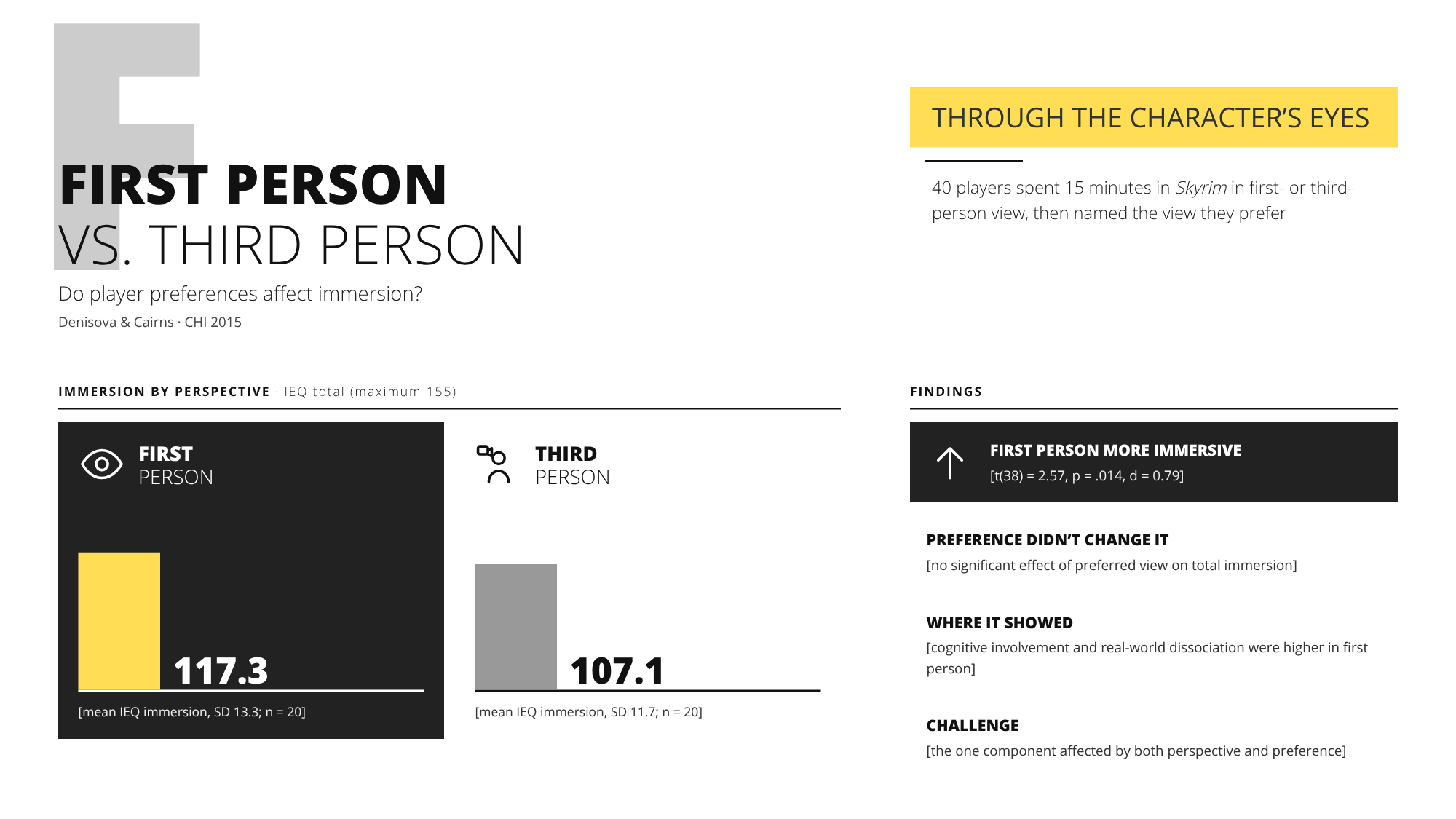
It is often assumed that playing in first person is more immersive than third person, but there was little evidence for it. Forty players spent 15 minutes on an early quest in Skyrim in either first- or third-person view, said which view they usually prefer, and rated their immersion with the Immersive Experience Questionnaire.
In games
The game in the study
-
In the paper
The Elder Scrolls V: Skyrim
Players can switch freely between first- and third-person view, which made it possible to compare the two perspectives in the same game.
How the study worked
- Game
- Skyrim on the PS3, with the option to change perspective disabled
- Task
- Complete (at least partially) ‘The Golden Claw Quest’, one of the very first missions in the game
- Design
- Two groups playing in either first or third person, also factoring in their pre-existing preferences for a particular perspective
- Play time
- A tutorial in the same perspective, then 15 minutes of play
- Measures
- Immersion, using the 31-item IEQ
Key findings
- Players were more immersed in first person than in third person (mean IEQ 117.3 vs 107.1), a medium-to-large effect.
- Players' preferred perspective did not change their overall immersion.
- First person raised cognitive involvement and real-world dissociation; challenge was the one component affected by both perspective and preference.
Read and cite
APA citation
Denisova, A., & Cairns, P. (2015). First Person vs. Third Person Perspective in Digital Games: Do Player Preferences Affect Immersion? In Proceedings of the 33rd Annual ACM Conference on Human Factors in Computing Systems (CHI'15) (pp. 145-148).
- Non-Euclidean Video Games: Exploring Player Perceptions and Experiences inside Impossible Spaces PDF of Non-Euclidean Video Games: Exploring Player Perceptions and Experiences inside Impossible SpacesPublisher's version of Non-Euclidean Video Games: Exploring Player Perceptions and Experiences inside Impossible Spaces
- Redefining Play: A Novel Framework for Differentiating Agency and Autonomy in Video Games PDF of Redefining Play: A Novel Framework for Differentiating Agency and Autonomy in Video GamesPublisher's version of Redefining Play: A Novel Framework for Differentiating Agency and Autonomy in Video Games
- The Effect of Time Manipulation on Immersion in Digital Games PDF of The Effect of Time Manipulation on Immersion in Digital GamesPublisher's version of The Effect of Time Manipulation on Immersion in Digital Games