A few featured papers, then my full papers with short summaries and links to the PDF and publisher's version, followed by short papers, workshops and Dagstuhl reports. Filter by theme. For a complete, citation-ranked list, see Google Scholar.
Theme
Featured 9
"It's a terrible choice to make but also a necessary one": Exploring player experiences with moral decision making mechanics in video games
Playing Through Tough Times: Exploring the Relationship between Game Aspects and Coping Strategies during Difficult Life Challenges
The Basic Needs in Games Scale (BANGS): A new tool for investigating positive and negative video game experiences
Towards Democratisation of Games User Research: Exploring Playtesting Challenges of Indie Video Game Developers
Keep Calm and Aim for the Head: Biofeedback-Controlled Dynamic Difficulty Adjustment in a Horror Game
"Whatever the Emotional Experience, It's Up to Them": Insights from Designers of Emotionally Impactful Games
Measuring Perceived Challenge in Digital Games: Development & Validation of the Challenge Originating from Recent Gameplay Interaction Scale (CORGIS)
The Placebo Effect in Digital Games: Phantom Perception of Adaptive Artificial Intelligence
Full papers 28
Journal articles and full conference papers.
2026 (Full papers)
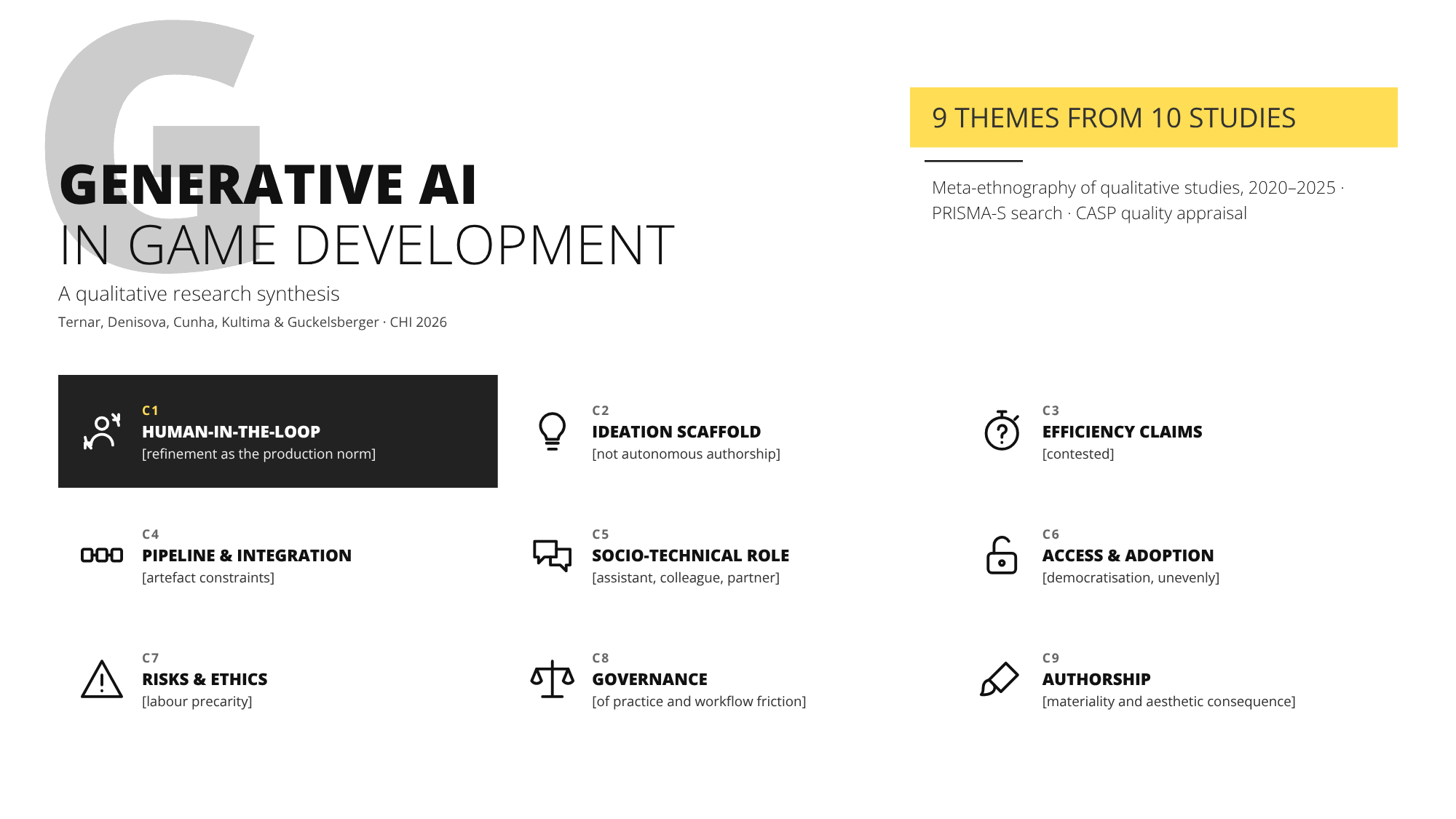
Generative AI in Game Development: A Qualitative Research Synthesis
Generative AI is changing how games are made, but the early qualitative studies of its use are scattered and rarely build on each other. We brought together the qualitative research published between 2020 and 2025 using meta-ethnography.
Summary and key findings: Generative AI in Game Development: A Qualitative Research Synthesis PDF of Generative AI in Game Development: A Qualitative Research Synthesis (accepted version) Publisher's version of Generative AI in Game Development: A Qualitative Research Synthesis
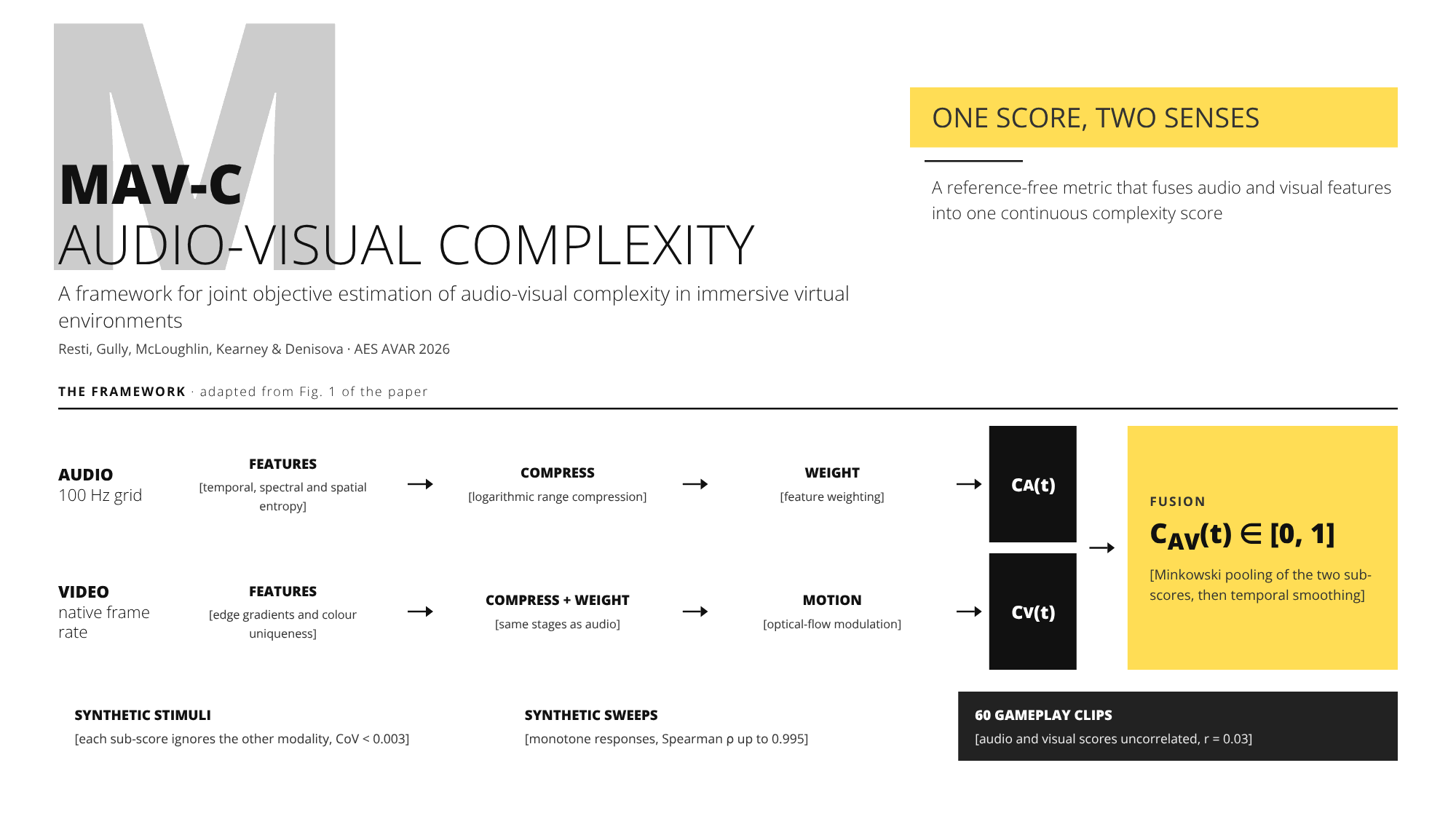
MAV-C: A Framework for the Joint Objective Estimation of Audio-Visual Complexity in Immersive Virtual Environments
MAV-C estimates how complex an immersive virtual environment is to see and hear. It combines audio features (temporal, spectral and spatial) with visual features (edges, colour and motion) into a single score that changes over time, without needing a reference recording.
Themes:
Game audio
Summary and key findings: MAV-C: A Framework for the Joint Objective Estimation of Audio-Visual Complexity in Immersive Virtual Environments PDF of MAV-C: A Framework for the Joint Objective Estimation of Audio-Visual Complexity in Immersive Virtual Environments (accepted version)
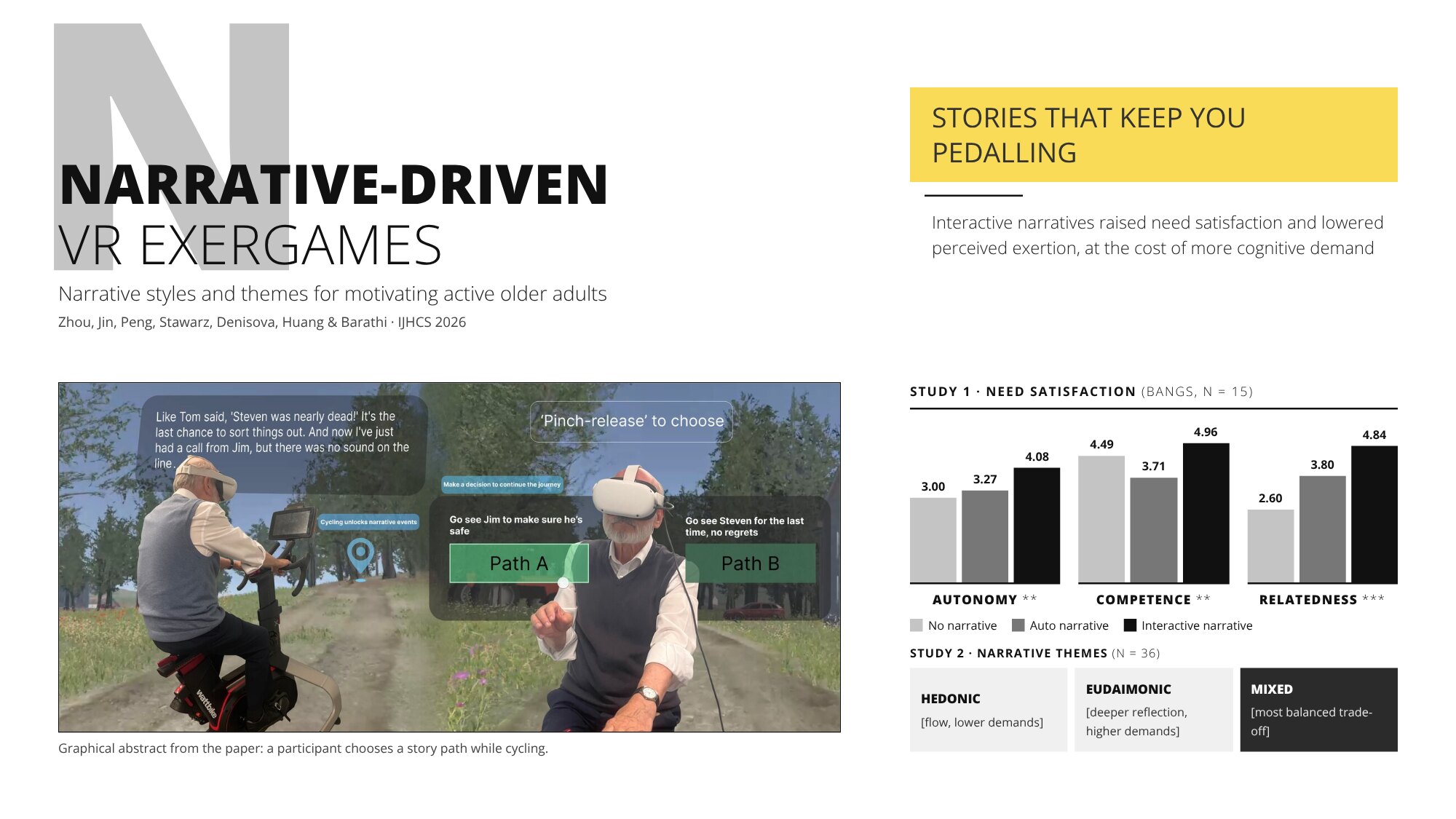
Narrative-Driven VR Exergames for Active Older Adults: Examining the Impact of Narrative Styles and Themes on Motivation and User Experience
Can a story keep active older adults motivated in a VR cycling exergame? Across two studies we compared narrative styles that asked for different amounts of interaction, and three kinds of story: hedonic, eudaimonic and mixed-affective.
Summary and key findings: Narrative-Driven VR Exergames for Active Older Adults: Examining the Impact of Narrative Styles and Themes on Motivation and User Experience PDF of Narrative-Driven VR Exergames for Active Older Adults: Examining the Impact of Narrative Styles and Themes on Motivation and User Experience (accepted version) Publisher's version of Narrative-Driven VR Exergames for Active Older Adults: Examining the Impact of Narrative Styles and Themes on Motivation and User Experience
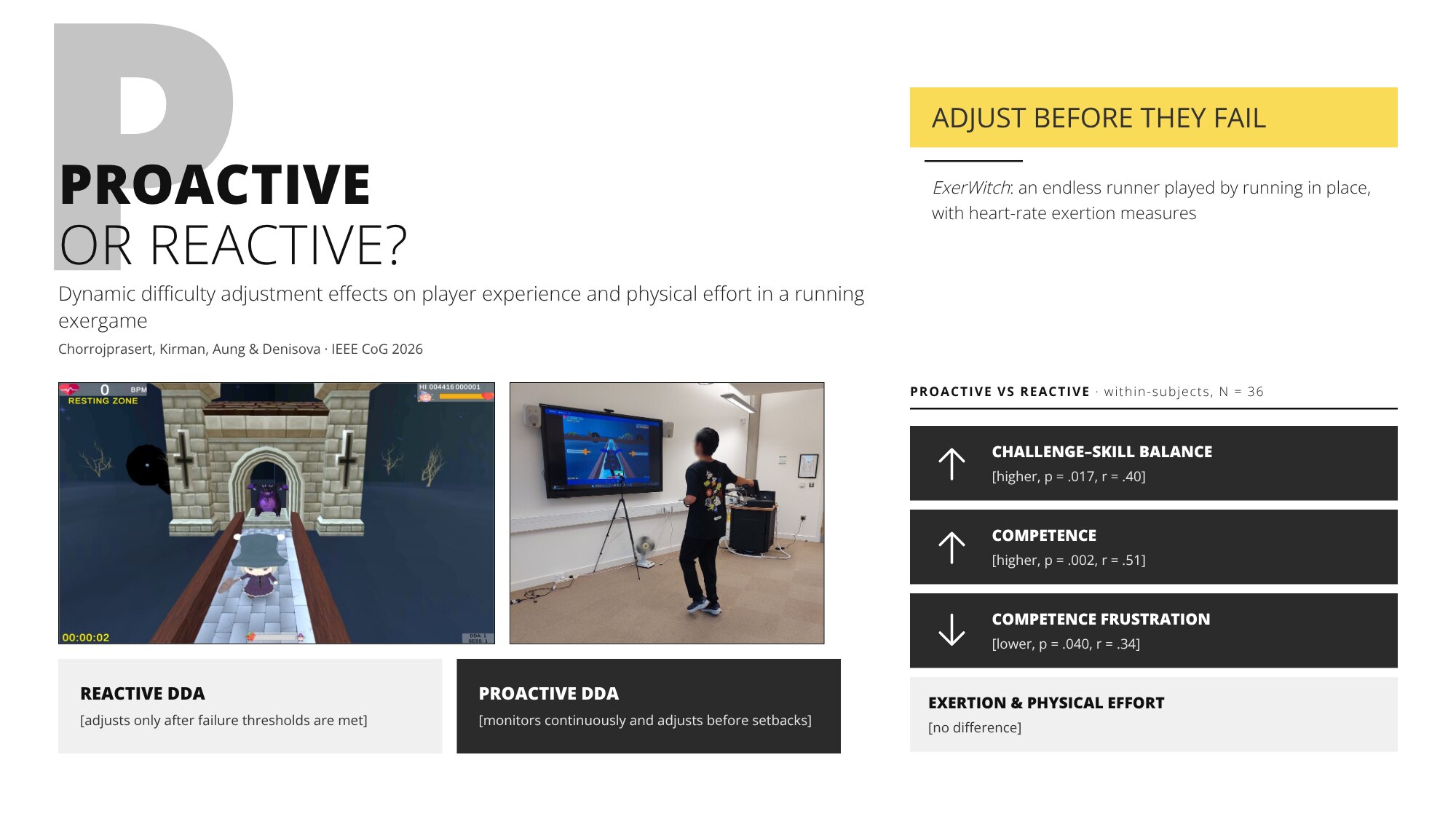
Proactive or Reactive? Comparison of Dynamic Difficulty Adjustment Effects on Player Experience and Physical Effort in a Running Exergame
Compares proactive and reactive dynamic difficulty adjustment in a running exergame, looking at the effects on player experience and on players' physical effort.
Themes:
Challenge and adaptation
Summary and key findings: Proactive or Reactive? Comparison of Dynamic Difficulty Adjustment Effects on Player Experience and Physical Effort in a Running Exergame PDF of Proactive or Reactive? Comparison of Dynamic Difficulty Adjustment Effects on Player Experience and Physical Effort in a Running Exergame (accepted version)
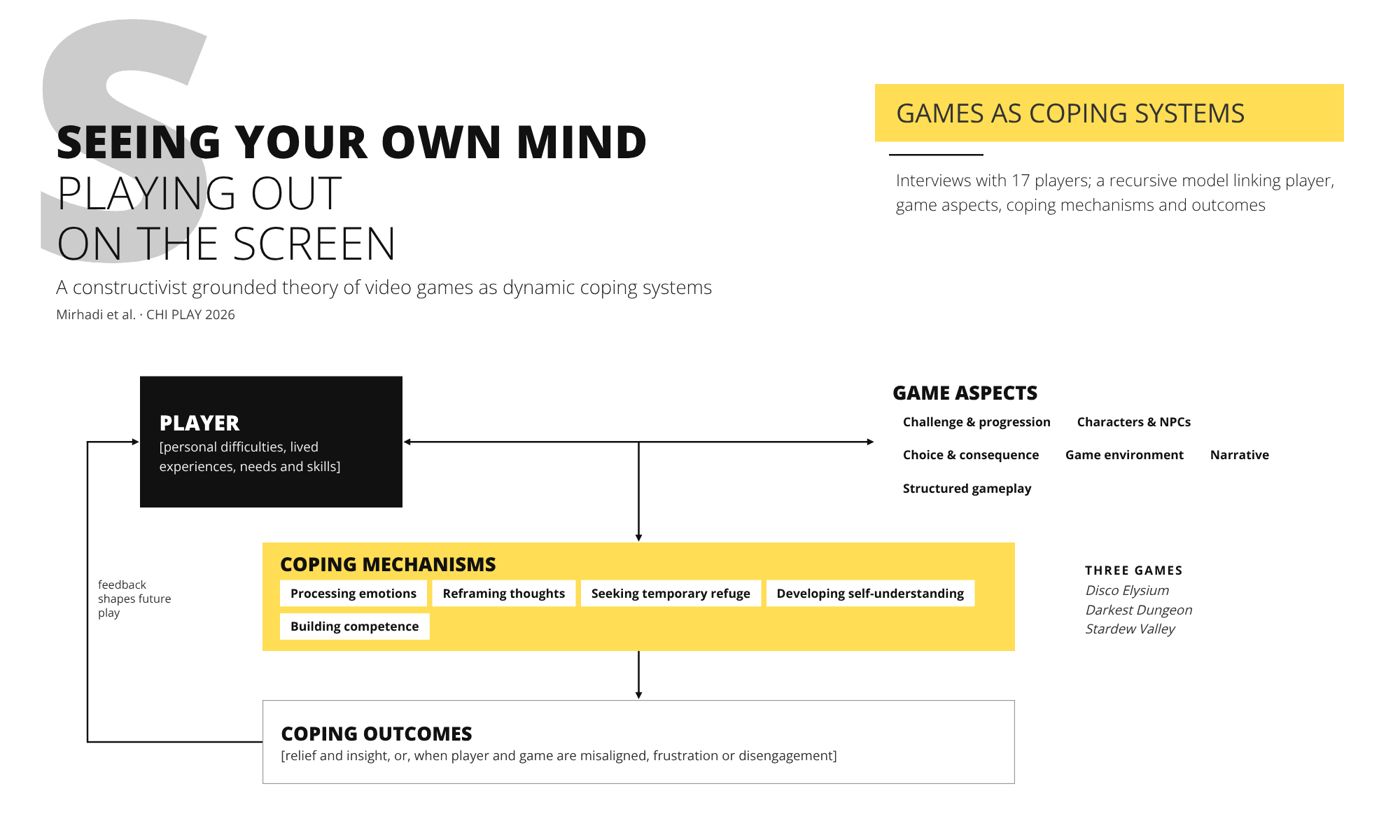
Seeing Your Own Mind Playing Out on the Screen: A Constructivist Grounded Theory of Video Games as Dynamic Coping Systems
Video games can help people cope during periods of personal difficulty, but we know little about exactly how they do so. In this constructivist grounded theory study, we interviewed 17 players of Disco Elysium, Darkest Dungeon and Stardew Valley about their lived experiences, and developed the Games as Dynamic Coping Systems model.
Summary and key findings: Seeing Your Own Mind Playing Out on the Screen: A Constructivist Grounded Theory of Video Games as Dynamic Coping Systems PDF of Seeing Your Own Mind Playing Out on the Screen: A Constructivist Grounded Theory of Video Games as Dynamic Coping Systems (accepted version) Publisher's version of Seeing Your Own Mind Playing Out on the Screen: A Constructivist Grounded Theory of Video Games as Dynamic Coping Systems
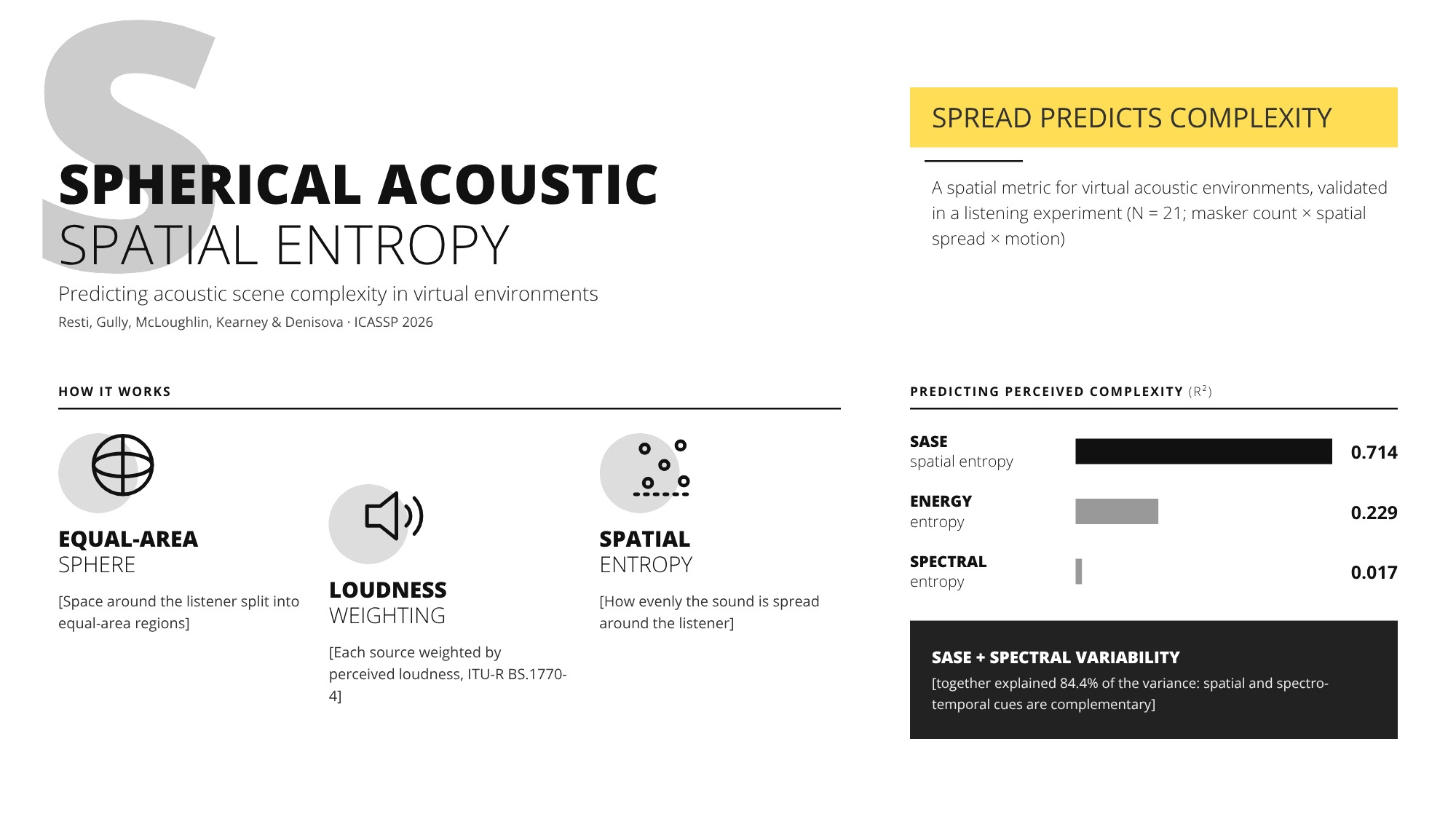
Spherical Acoustic Spatial Entropy: Predicting Acoustic Scene Complexity in Virtual Environments
How complex a soundscape feels depends not only on which sounds are present but on where they are. We introduce Spherical Acoustic Spatial Entropy (SASE), a measure that predicts how complex a virtual acoustic scene sounds from how loud each sound source is in each direction around the listener.
Themes:
Game audio
Summary and key findings: Spherical Acoustic Spatial Entropy: Predicting Acoustic Scene Complexity in Virtual Environments PDF of Spherical Acoustic Spatial Entropy: Predicting Acoustic Scene Complexity in Virtual Environments (accepted version) Publisher's version of Spherical Acoustic Spatial Entropy: Predicting Acoustic Scene Complexity in Virtual Environments
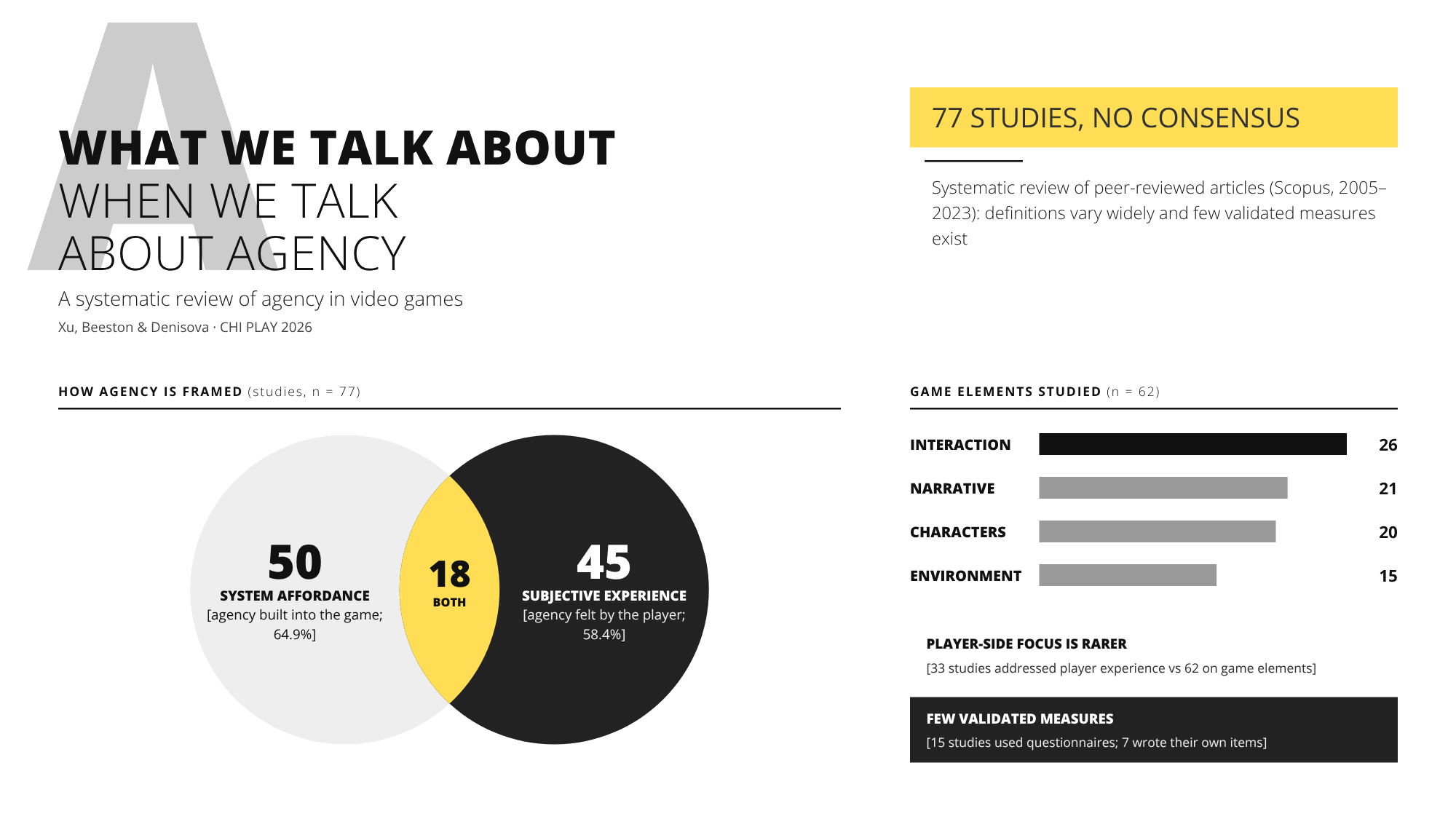
What We Talk About When We Talk About Agency: A Systematic Review of Agency in Video Games
Agency, players' capacity to make meaningful choices and see their consequences, is widely discussed in games research but has no agreed definition. We systematically reviewed 79 peer-reviewed articles to map how agency in video games is defined and measured.
Themes:
Measuring player experience
Summary and key findings: What We Talk About When We Talk About Agency: A Systematic Review of Agency in Video Games PDF of What We Talk About When We Talk About Agency: A Systematic Review of Agency in Video Games (accepted version) Publisher's version of What We Talk About When We Talk About Agency: A Systematic Review of Agency in Video Games
2025 (Full papers)
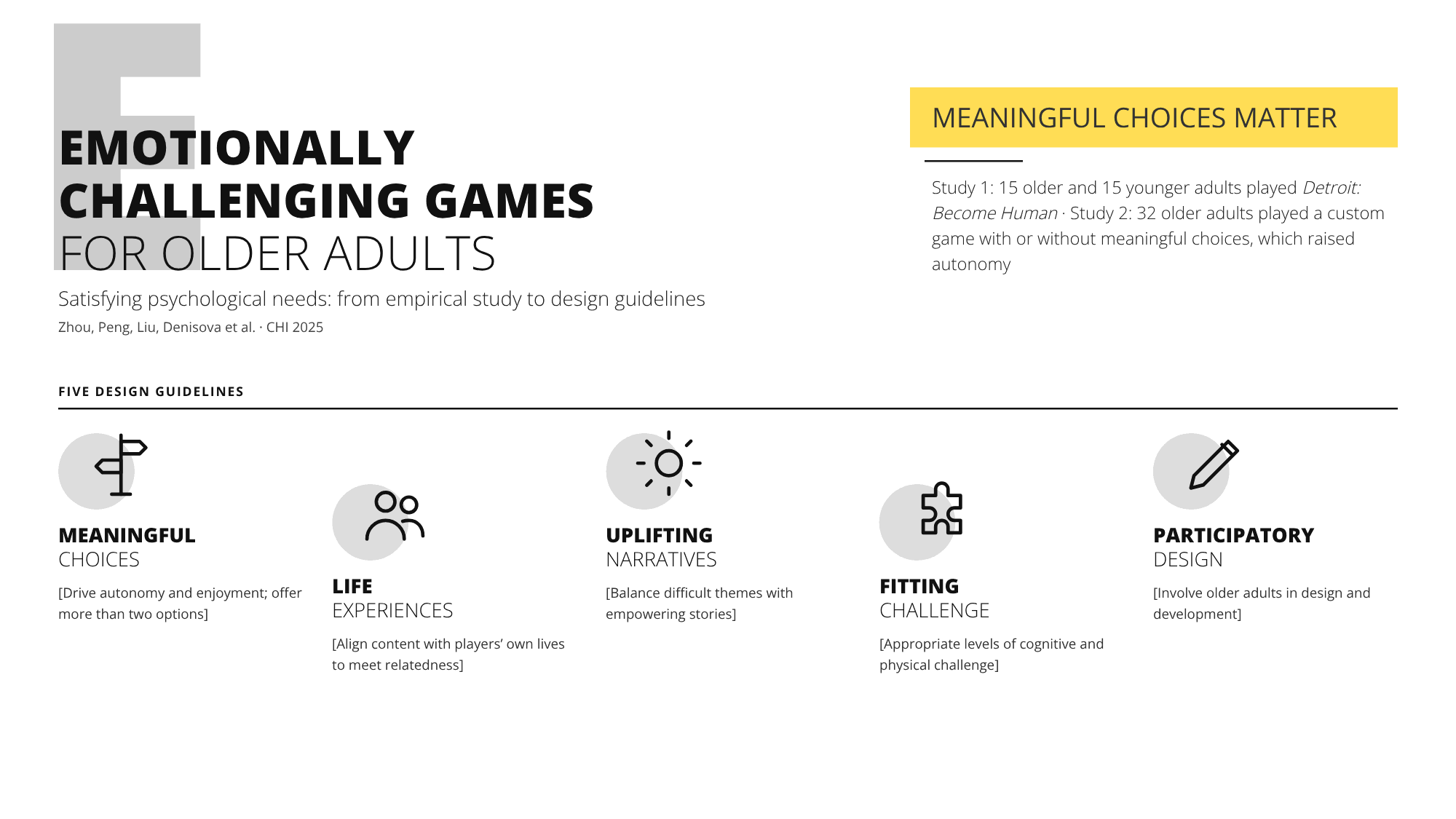
Emotionally Challenging Games Can Satisfy Older Adults' Psychological Needs: From Empirical Study to Design Guidelines
Retirement and living alone can make it harder for older adults to meet their psychological needs. We studied whether emotionally challenging games could help, first with a commercial game (Detroit: Become Human) and then with a game scenario designed for older adults.
Summary and key findings: Emotionally Challenging Games Can Satisfy Older Adults' Psychological Needs: From Empirical Study to Design Guidelines PDF of Emotionally Challenging Games Can Satisfy Older Adults' Psychological Needs: From Empirical Study to Design Guidelines (accepted version) Publisher's version of Emotionally Challenging Games Can Satisfy Older Adults' Psychological Needs: From Empirical Study to Design Guidelines
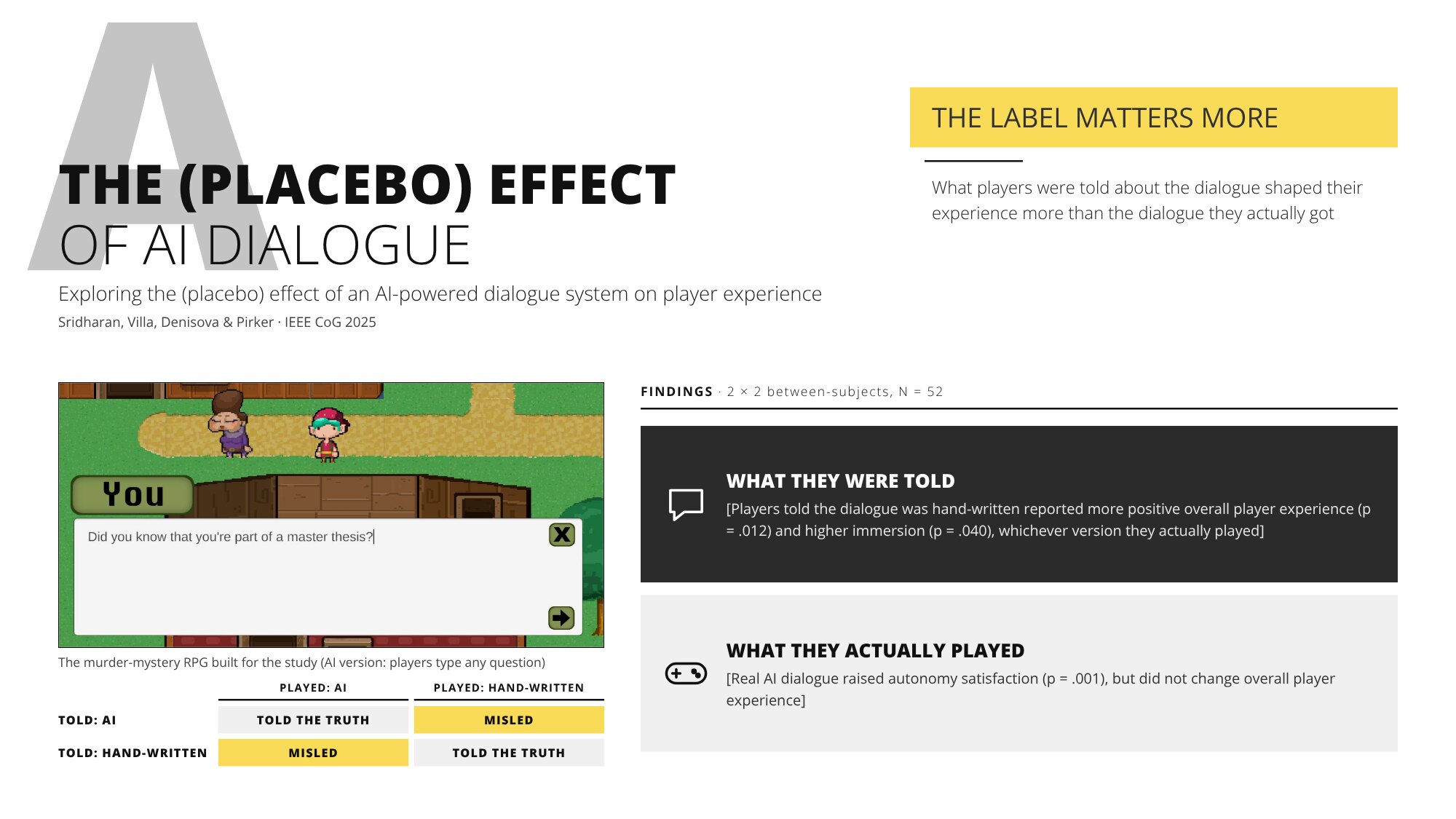
Exploring the (Placebo) Effect of an AI-Powered Dialogue System on Player Experience
Does AI-generated dialogue change how players experience a game, or is it what they believe about it? In a murder-mystery game, we varied both the dialogue players actually got (AI-generated or human-written) and how the game was described to them (labelled as AI or as human-written), and measured overall player experience, immersion and perceived autonomy.
Summary and key findings: Exploring the (Placebo) Effect of an AI-Powered Dialogue System on Player Experience PDF of Exploring the (Placebo) Effect of an AI-Powered Dialogue System on Player Experience (accepted version) Publisher's version of Exploring the (Placebo) Effect of an AI-Powered Dialogue System on Player Experience
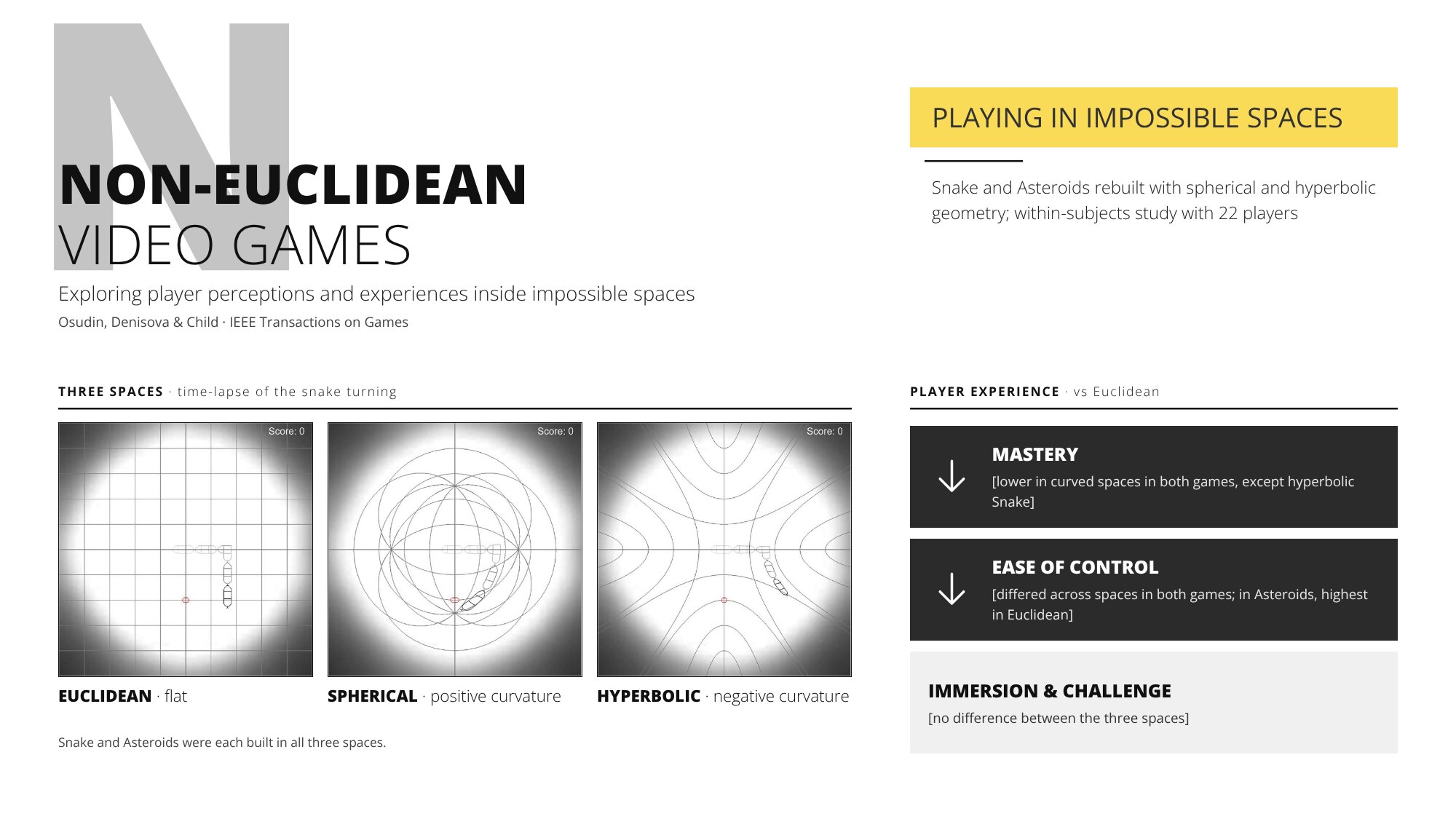
Non-Euclidean Video Games: Exploring Player Perceptions and Experiences inside Impossible Spaces
Non-Euclidean spaces can contain layouts that are impossible in the physical world. We adapted Snake and Asteroids to flat, hyperbolic and spherical spaces and asked each player to try all three versions.
Summary and key findings: Non-Euclidean Video Games: Exploring Player Perceptions and Experiences inside Impossible Spaces PDF of Non-Euclidean Video Games: Exploring Player Perceptions and Experiences inside Impossible Spaces (accepted version) Publisher's version of Non-Euclidean Video Games: Exploring Player Perceptions and Experiences inside Impossible Spaces
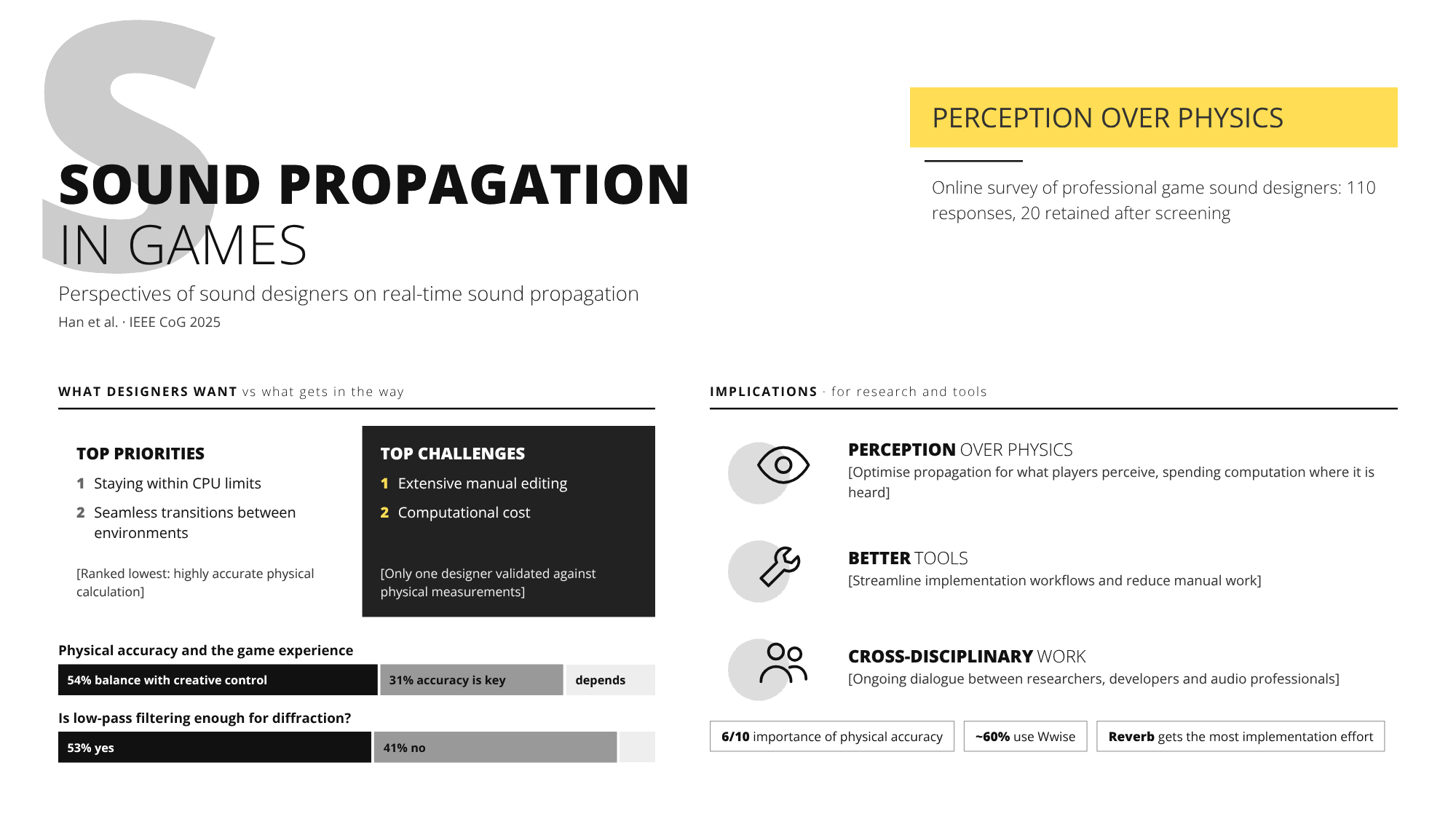
Perspectives of Sound Designers on Real-Time Sound Propagation in Games
Realistic sound propagation, how sound travels through and around a virtual space, matters for immersive game audio, but getting it right means balancing physical accuracy against creative design. We reviewed physics-based techniques for real-time sound propagation and surveyed professional game sound designers (20 complete responses after screening) about their approaches, priorities and the challenges they face.
Summary and key findings: Perspectives of Sound Designers on Real-Time Sound Propagation in Games PDF of Perspectives of Sound Designers on Real-Time Sound Propagation in Games (accepted version) Publisher's version of Perspectives of Sound Designers on Real-Time Sound Propagation in Games
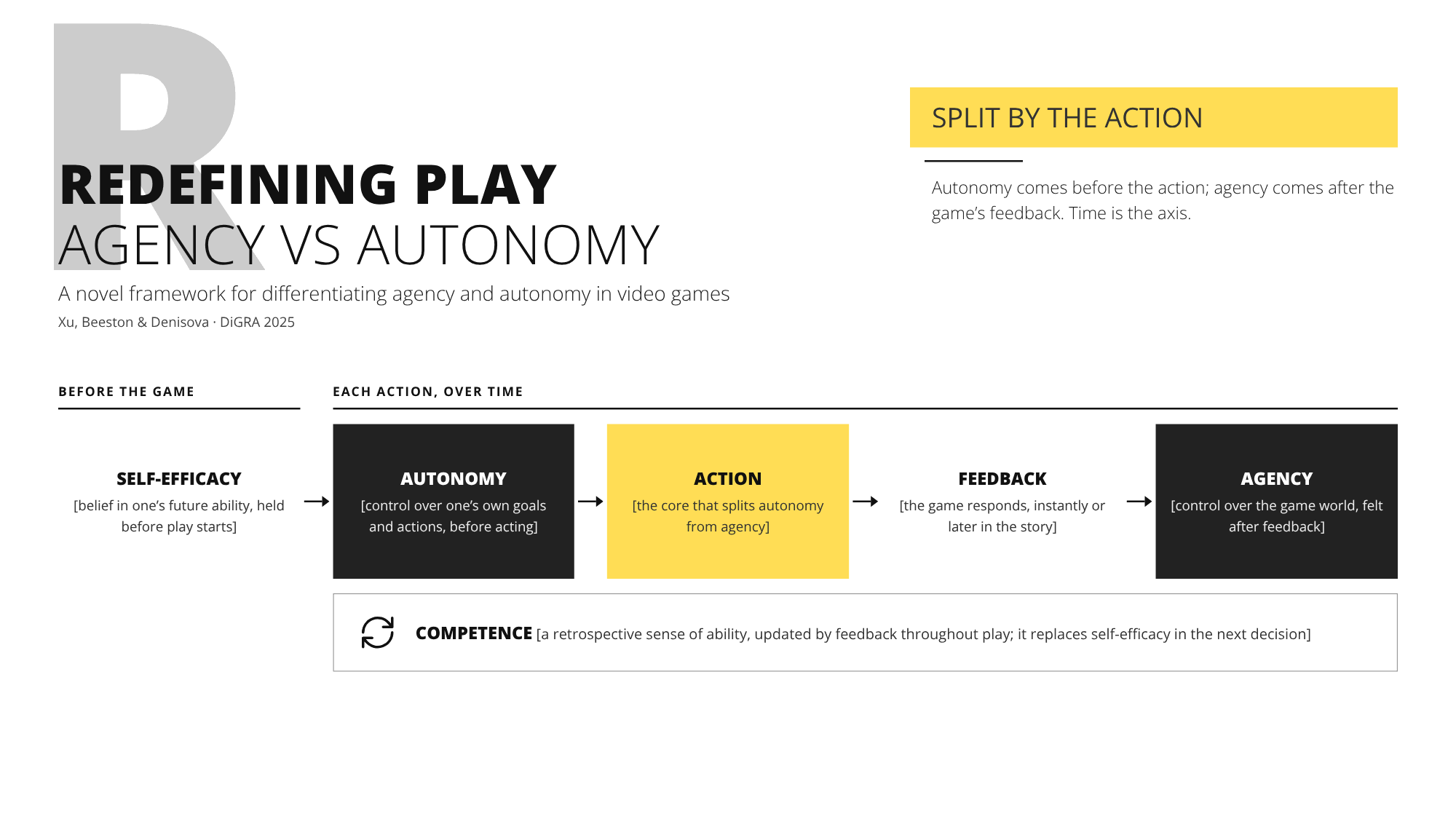
Redefining Play: A Novel Framework for Differentiating Agency and Autonomy in Video Games
Player agency is often confused with autonomy. Drawing on the literature, we propose a framework that separates the two, built around a single completed player action, and clarifies how self-efficacy and competence relate to them.
Summary and key findings: Redefining Play: A Novel Framework for Differentiating Agency and Autonomy in Video Games PDF of Redefining Play: A Novel Framework for Differentiating Agency and Autonomy in Video Games (accepted version) Publisher's version of Redefining Play: A Novel Framework for Differentiating Agency and Autonomy in Video Games
2024 (Full papers)
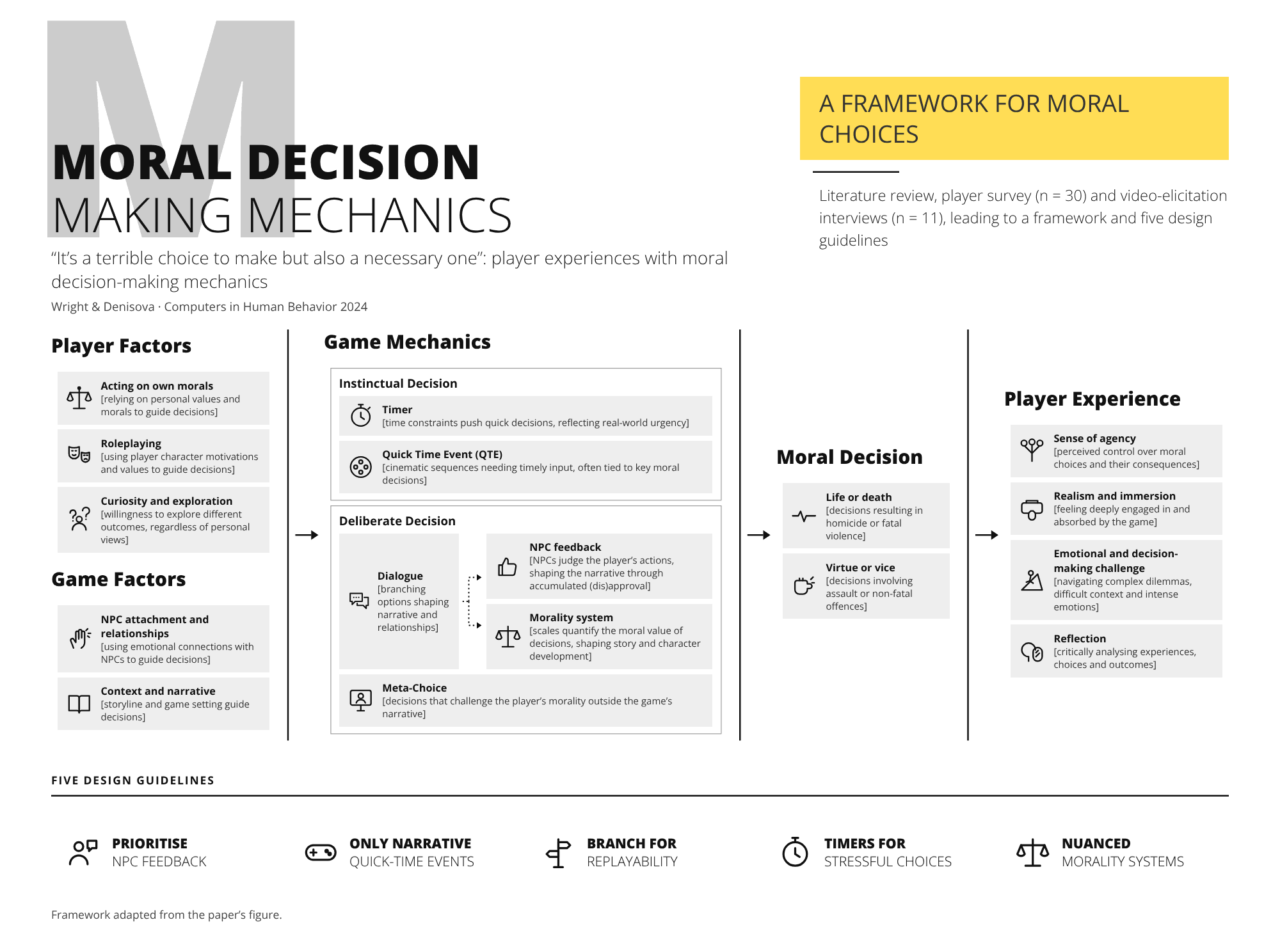
"It's a terrible choice to make but also a necessary one": Exploring player experiences with moral decision making mechanics in video games
Many games ask players to make difficult moral choices, but little is known about how players experience them or which game mechanics support them. We combined a literature review and a survey with video-elicitation interviews.
Summary and key findings: "It's a terrible choice to make but also a necessary one": Exploring player experiences with moral decision making mechanics in video games PDF of "It's a terrible choice to make but also a necessary one": Exploring player experiences with moral decision making mechanics in video games (accepted version) Publisher's version of "It's a terrible choice to make but also a necessary one": Exploring player experiences with moral decision making mechanics in video games
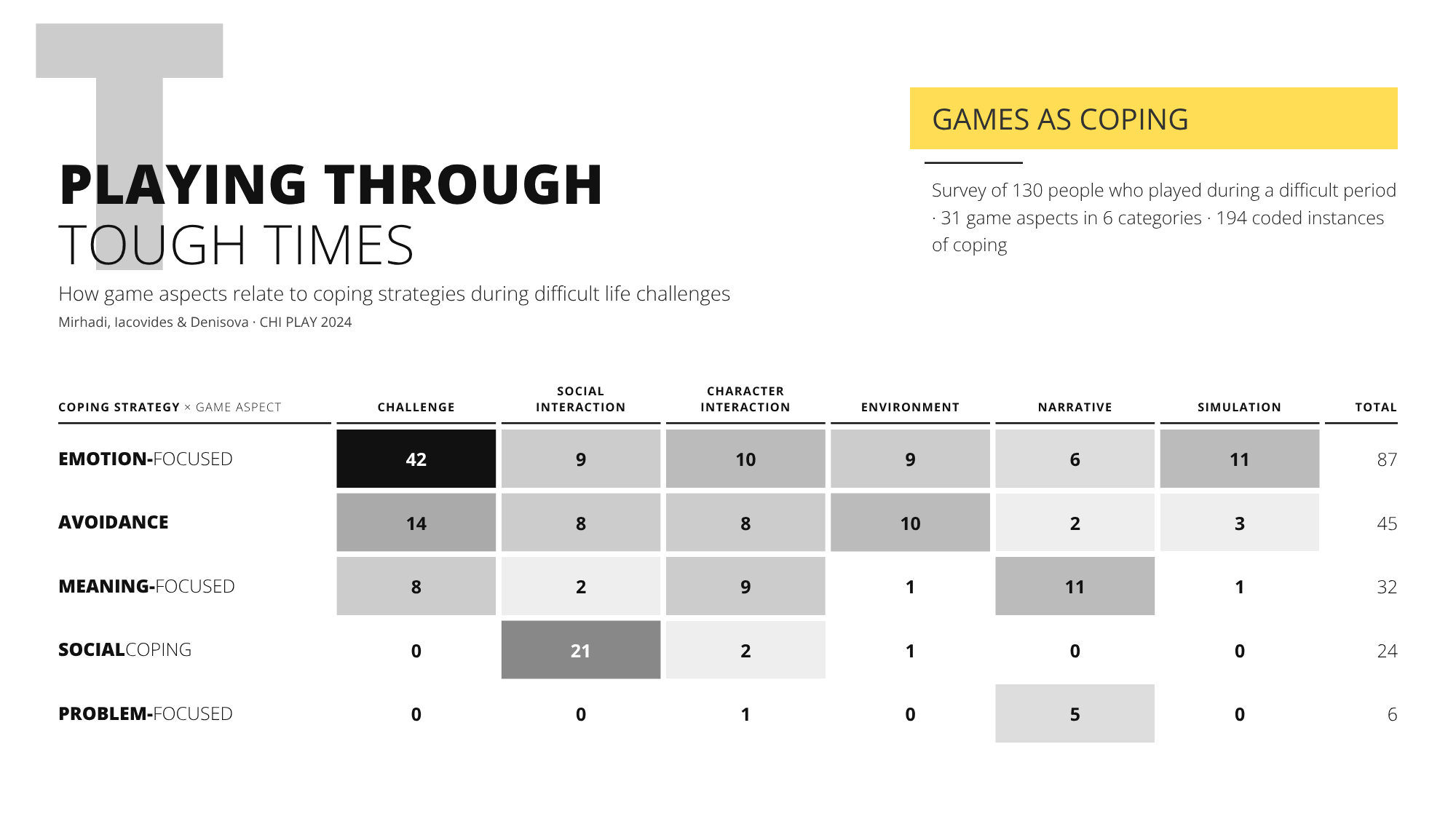
Playing Through Tough Times: Exploring the Relationship between Game Aspects and Coping Strategies during Difficult Life Challenges
Games can help people through hard times, but which parts of a game help, and how? We surveyed 130 people about the games they played during difficult life challenges.
Themes:
Games for good
Summary and key findings: Playing Through Tough Times: Exploring the Relationship between Game Aspects and Coping Strategies during Difficult Life Challenges PDF of Playing Through Tough Times: Exploring the Relationship between Game Aspects and Coping Strategies during Difficult Life Challenges (accepted version) Publisher's version of Playing Through Tough Times: Exploring the Relationship between Game Aspects and Coping Strategies during Difficult Life Challenges
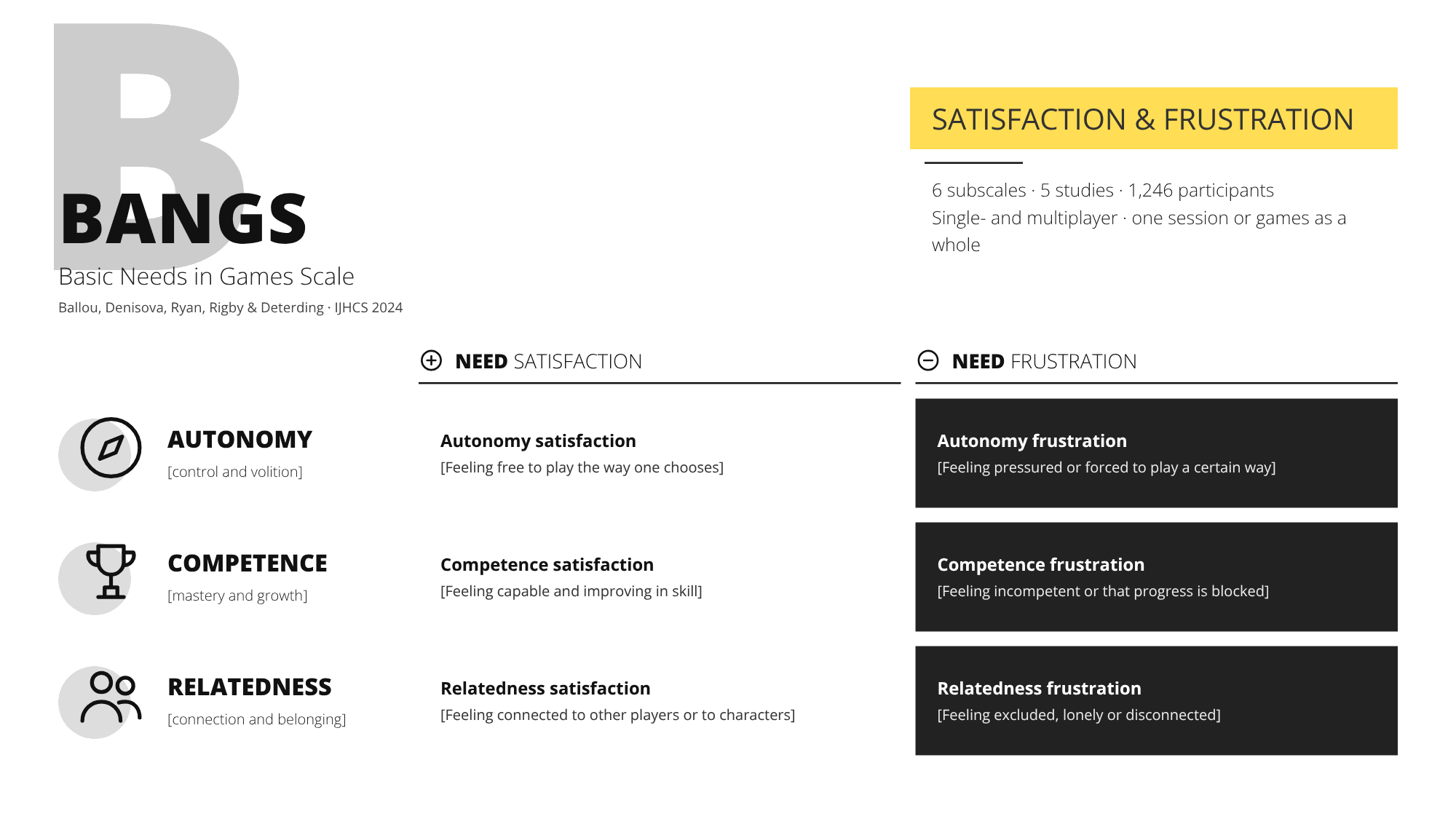
The Basic Needs in Games Scale (BANGS): A new tool for investigating positive and negative video game experiences
Existing measures of players' basic psychological needs often ignore need frustration and struggle to capture relatedness in single-player games. The Basic Needs in Games Scale (BANGS) measures both satisfaction and frustration of autonomy, competence and relatedness in games.
Themes:
Measuring player experience
Summary and key findings: The Basic Needs in Games Scale (BANGS): A new tool for investigating positive and negative video game experiences PDF of The Basic Needs in Games Scale (BANGS): A new tool for investigating positive and negative video game experiences (accepted version) Publisher's version of The Basic Needs in Games Scale (BANGS): A new tool for investigating positive and negative video game experiences
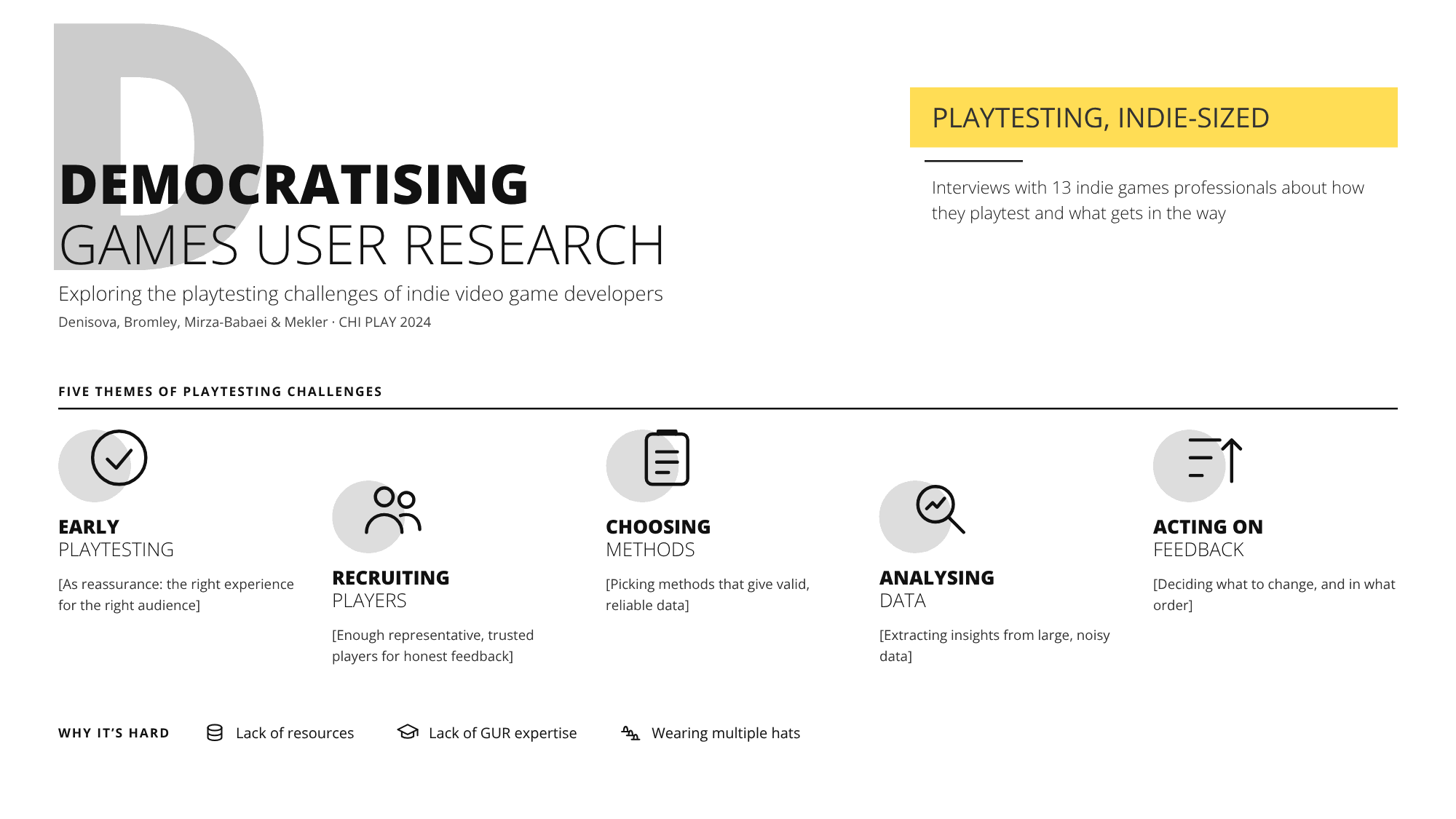
Towards Democratisation of Games User Research: Exploring Playtesting Challenges of Indie Video Game Developers
Playtesting is a core games user research method, but recommended practices often assume resources and expertise that indie developers lack. We interviewed 13 indie games professionals about how they playtest and what gets in the way.
Summary and key findings: Towards Democratisation of Games User Research: Exploring Playtesting Challenges of Indie Video Game Developers PDF of Towards Democratisation of Games User Research: Exploring Playtesting Challenges of Indie Video Game Developers (accepted version) Publisher's version of Towards Democratisation of Games User Research: Exploring Playtesting Challenges of Indie Video Game Developers
2023 (Full papers)
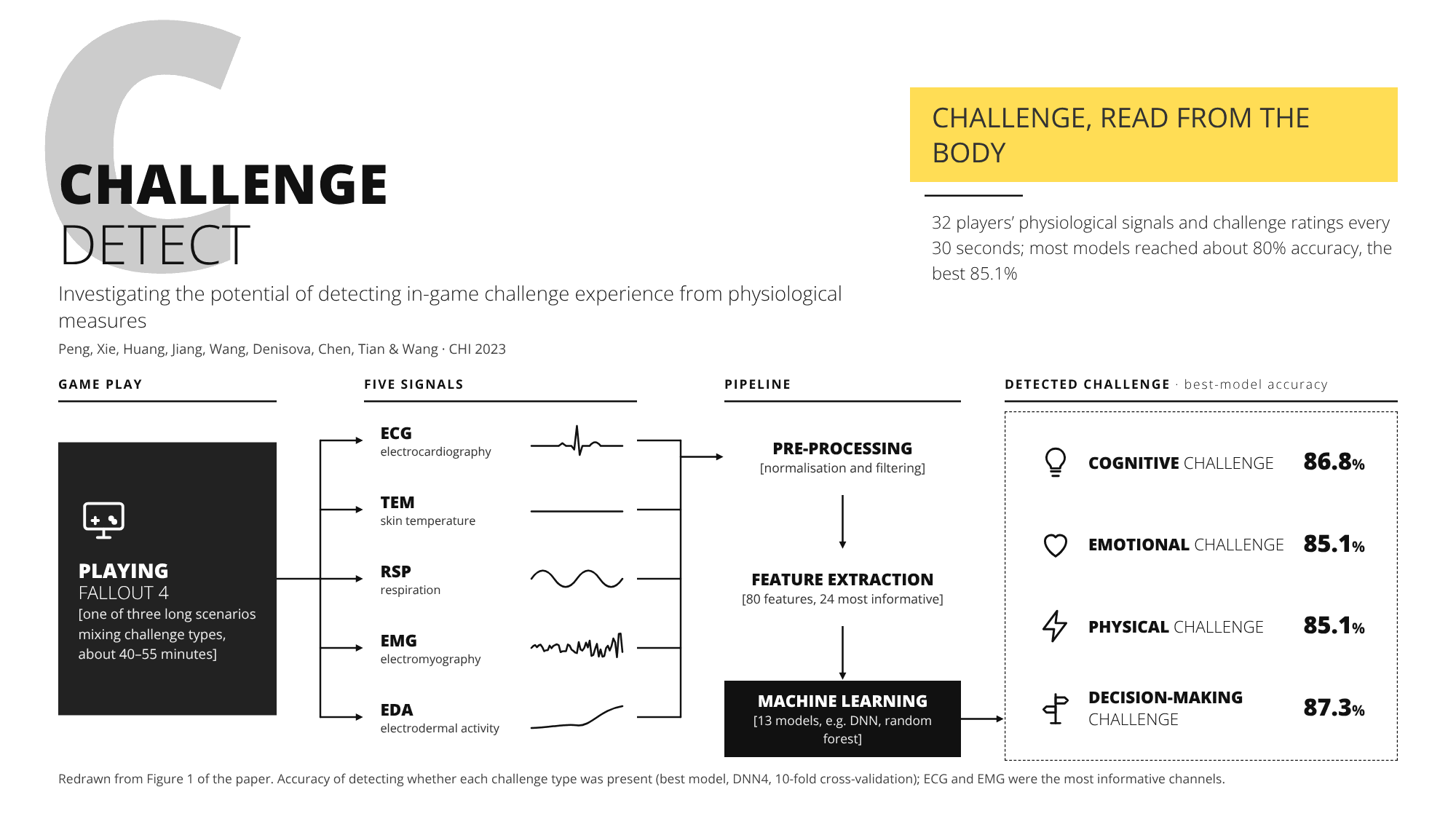
ChallengeDetect: Investigating the Potential of Detecting In-Game Challenge Experience from Physiological Measures
Questionnaires only capture challenge after play has ended. ChallengeDetect explores whether perceived challenge can instead be detected from players' physiological signals, moment to moment.
Summary and key findings: ChallengeDetect: Investigating the Potential of Detecting In-Game Challenge Experience from Physiological Measures PDF of ChallengeDetect: Investigating the Potential of Detecting In-Game Challenge Experience from Physiological Measures (accepted version) Publisher's version of ChallengeDetect: Investigating the Potential of Detecting In-Game Challenge Experience from Physiological Measures
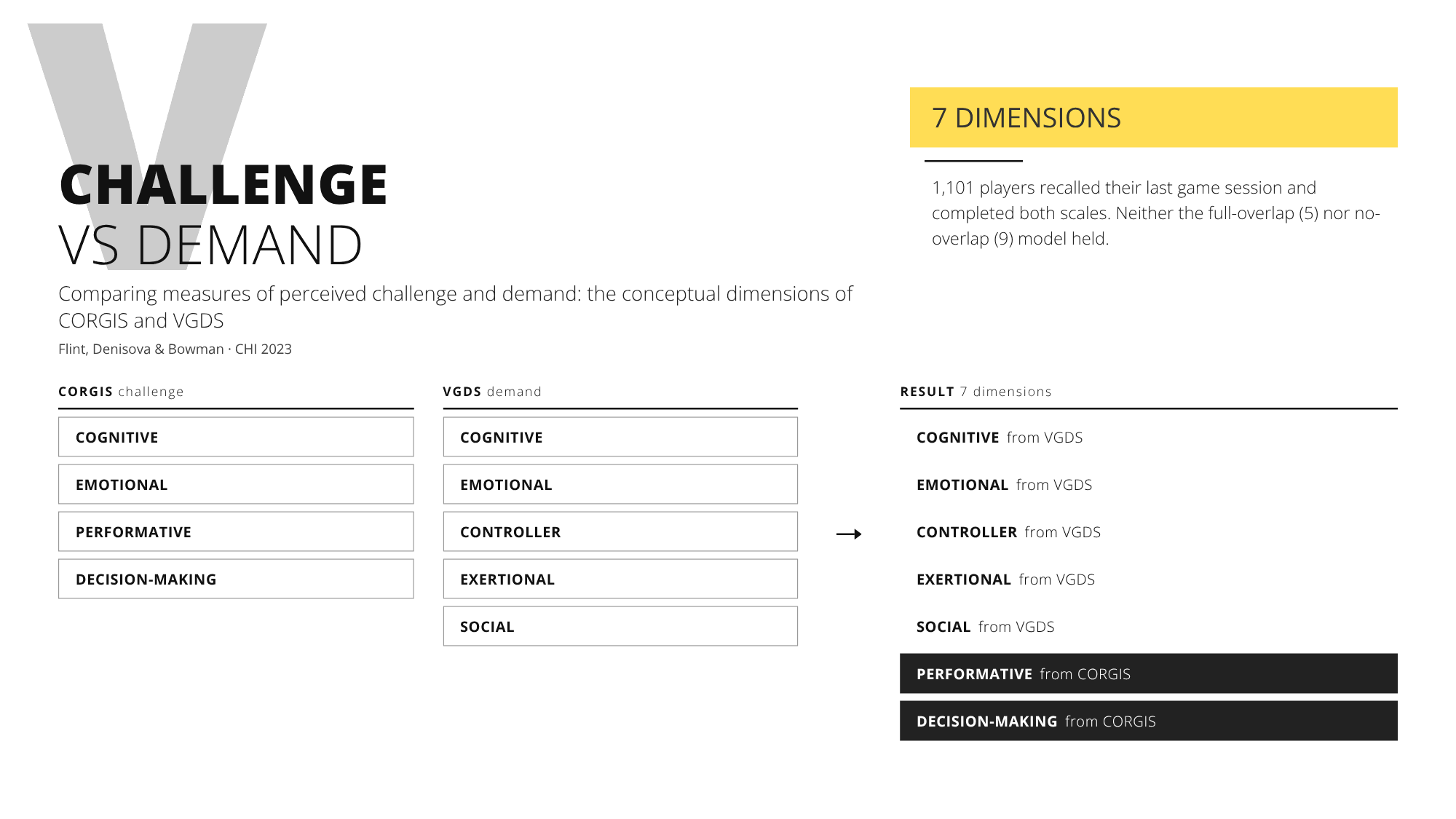
Comparing Measures of Perceived Challenge and Demand in Video Games: Exploring the Conceptual Dimensions of CORGIS and VGDS
CORGIS measures perceived challenge and the Video Game Demand Scale (VGDS) measures demand, and the two appear to overlap. We tested how the two questionnaires relate to each other.
Summary and key findings: Comparing Measures of Perceived Challenge and Demand in Video Games: Exploring the Conceptual Dimensions of CORGIS and VGDS PDF of Comparing Measures of Perceived Challenge and Demand in Video Games: Exploring the Conceptual Dimensions of CORGIS and VGDS (accepted version) Publisher's version of Comparing Measures of Perceived Challenge and Demand in Video Games: Exploring the Conceptual Dimensions of CORGIS and VGDS
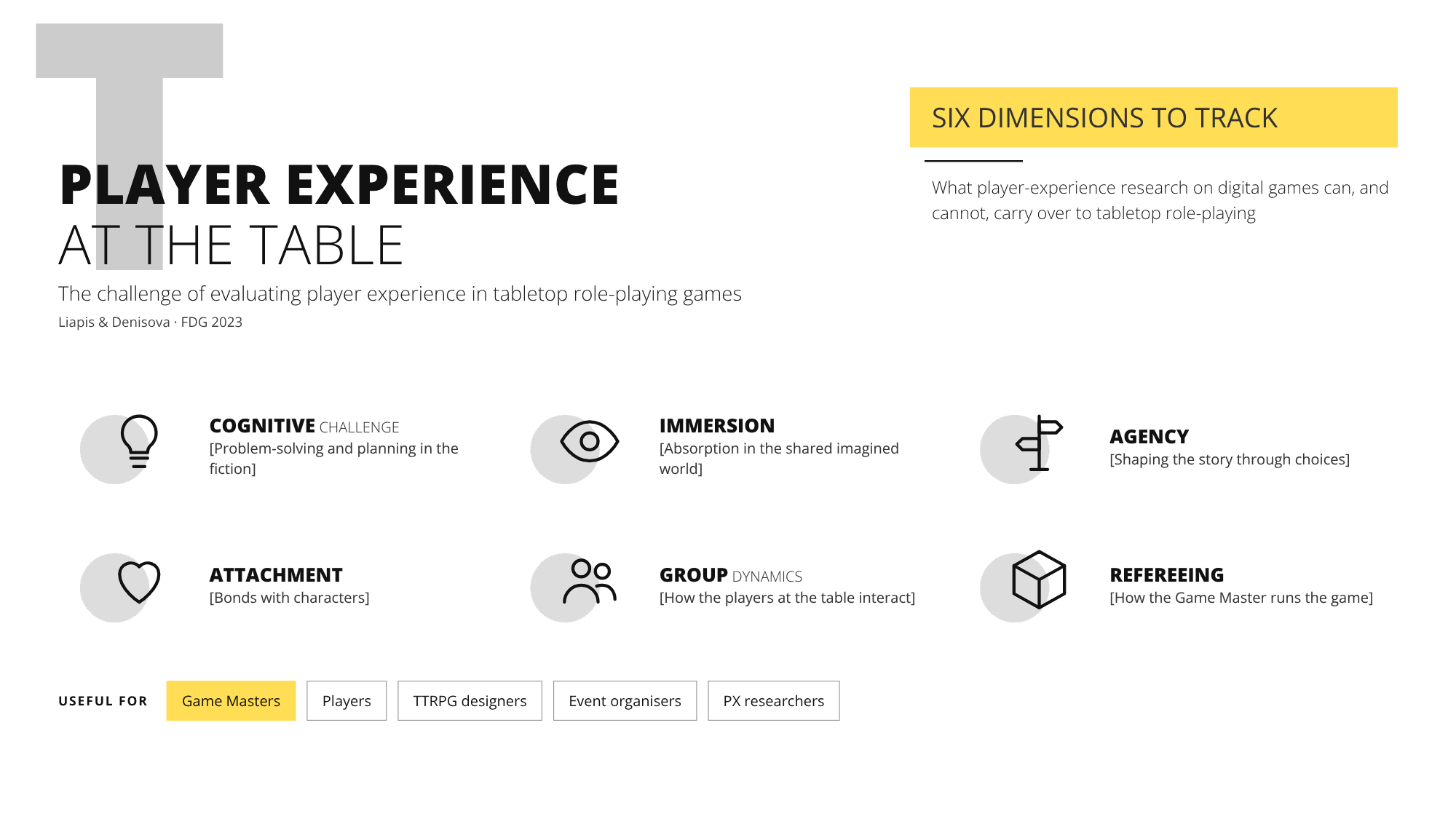
The Challenge of Evaluating Player Experience in Tabletop Role-Playing Games
Evaluating player experience could help game masters, players and designers of tabletop role-playing games, but no formal method exists. We compared player experience measures from digital games with what happens around the table.
Summary and key findings: The Challenge of Evaluating Player Experience in Tabletop Role-Playing Games PDF of The Challenge of Evaluating Player Experience in Tabletop Role-Playing Games (accepted version) Publisher's version of The Challenge of Evaluating Player Experience in Tabletop Role-Playing Games
2022 (Full papers)

Keep Calm and Aim for the Head: Biofeedback-Controlled Dynamic Difficulty Adjustment in a Horror Game
We built “Caroline”, a horror game that reads the player's heart rate and adjusts its difficulty in real time: stressed players get a harder game and relaxed players an easier one. We compared it with a version of the game without the adjustment.
Summary and key findings: Keep Calm and Aim for the Head: Biofeedback-Controlled Dynamic Difficulty Adjustment in a Horror Game PDF of Keep Calm and Aim for the Head: Biofeedback-Controlled Dynamic Difficulty Adjustment in a Horror Game (accepted version) Publisher's version of Keep Calm and Aim for the Head: Biofeedback-Controlled Dynamic Difficulty Adjustment in a Horror Game
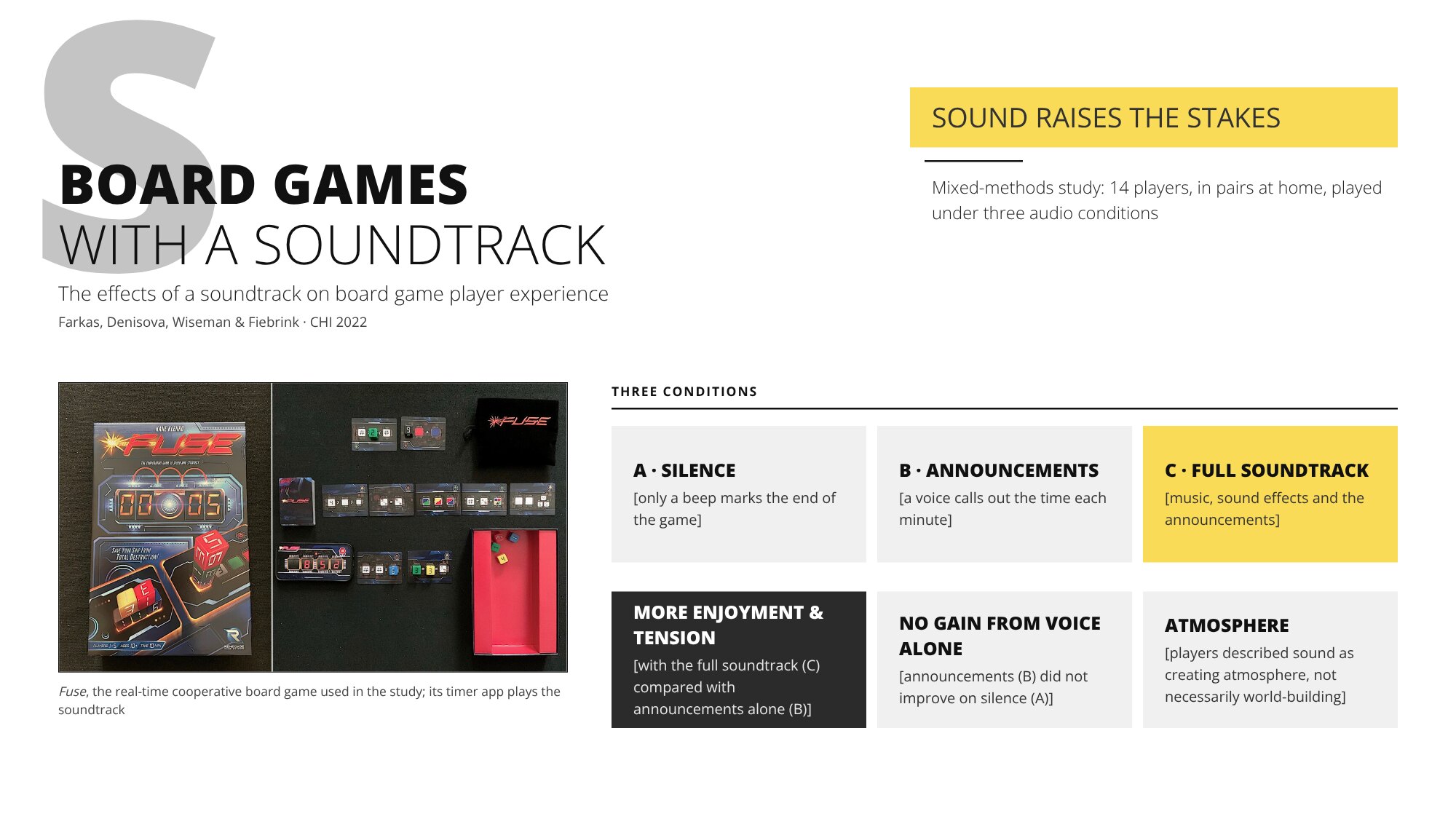
The Effects of a Soundtrack on Board Game Player Experience
Board games are increasingly augmented with apps and soundtracks, but little is known about how this changes play. We ran a mixed-methods study of how music and sound effects affect the experience of playing a board game.
Summary and key findings: The Effects of a Soundtrack on Board Game Player Experience PDF of The Effects of a Soundtrack on Board Game Player Experience (accepted version) Publisher's version of The Effects of a Soundtrack on Board Game Player Experience
2021 (Full papers)
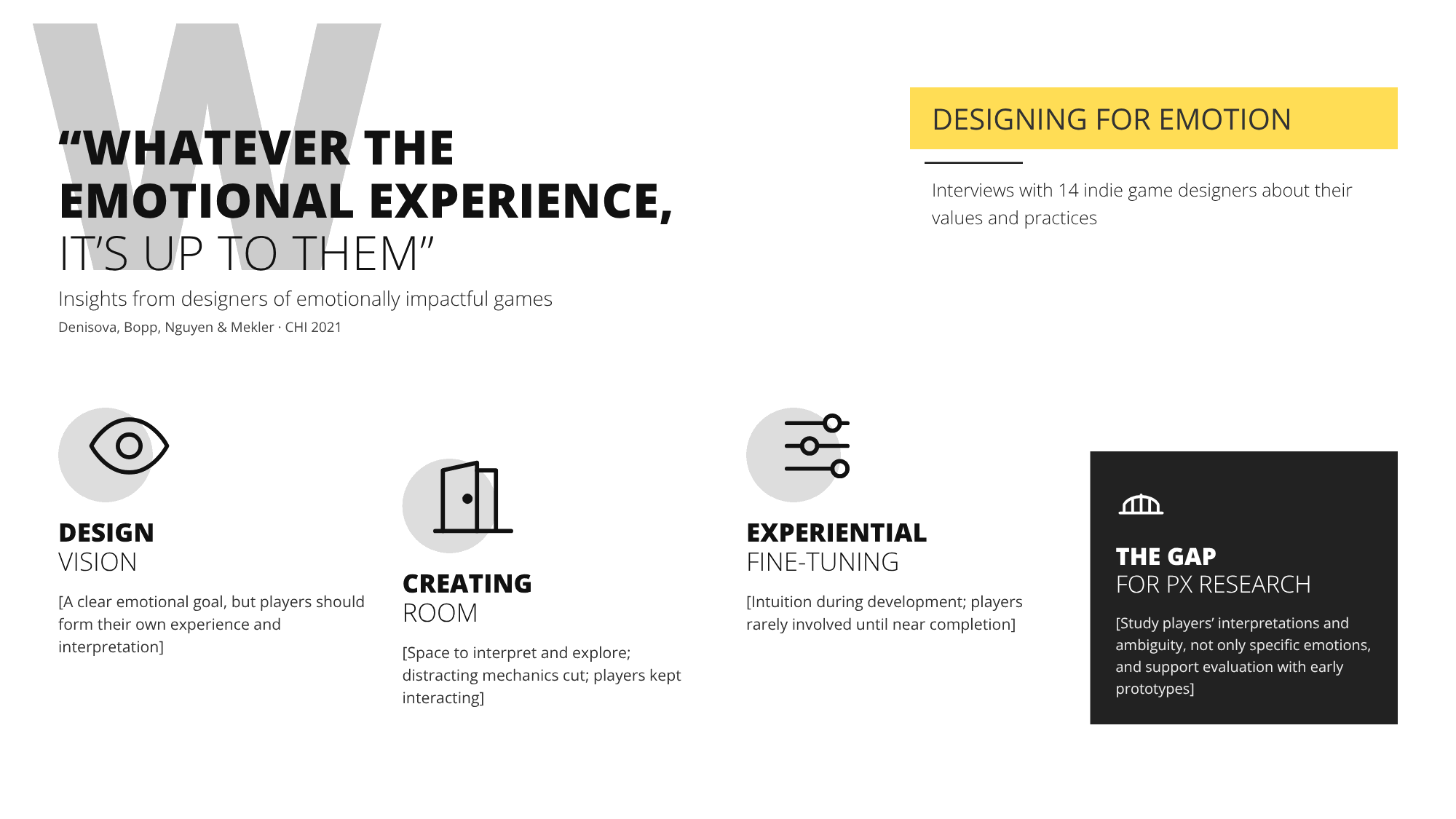
"Whatever the Emotional Experience, It's Up to Them": Insights from Designers of Emotionally Impactful Games
Research on emotionally impactful games has mostly studied players. We interviewed 14 indie game designers about their values and practices when creating emotionally impactful games.
Summary and key findings: "Whatever the Emotional Experience, It's Up to Them": Insights from Designers of Emotionally Impactful Games PDF of "Whatever the Emotional Experience, It's Up to Them": Insights from Designers of Emotionally Impactful Games (accepted version) Publisher's version of "Whatever the Emotional Experience, It's Up to Them": Insights from Designers of Emotionally Impactful Games
2020 (Full papers)
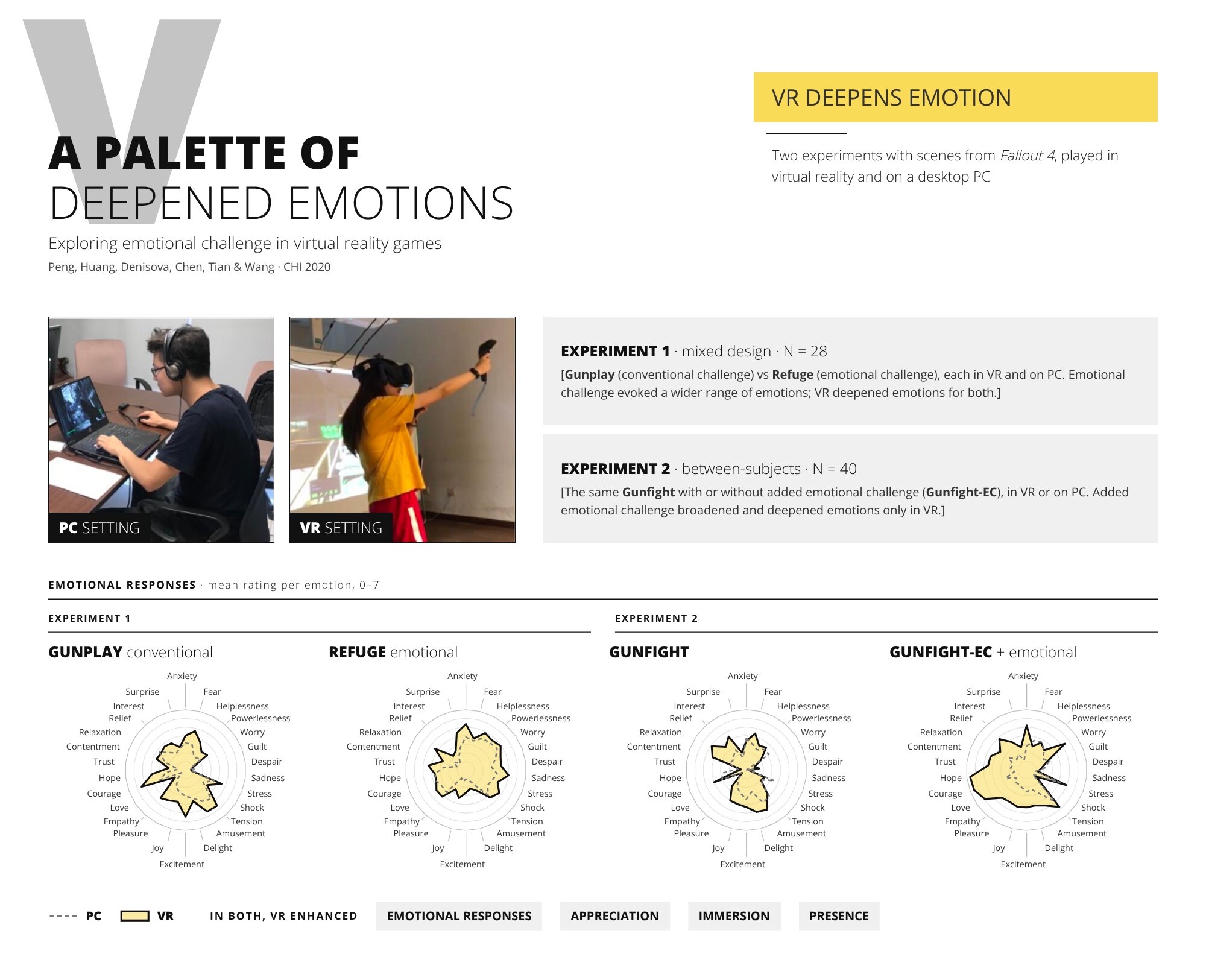
A Palette of Deepened Emotions: Exploring Emotional Challenge in Virtual Reality Games
Emotional challenge asks players to deal with difficult emotions rather than difficult gameplay. Across two experiments we compared emotional challenge, alone and combined with conventional challenge, in virtual reality and on a PC.
Summary and key findings: A Palette of Deepened Emotions: Exploring Emotional Challenge in Virtual Reality Games PDF of A Palette of Deepened Emotions: Exploring Emotional Challenge in Virtual Reality Games (accepted version) Publisher's version of A Palette of Deepened Emotions: Exploring Emotional Challenge in Virtual Reality Games
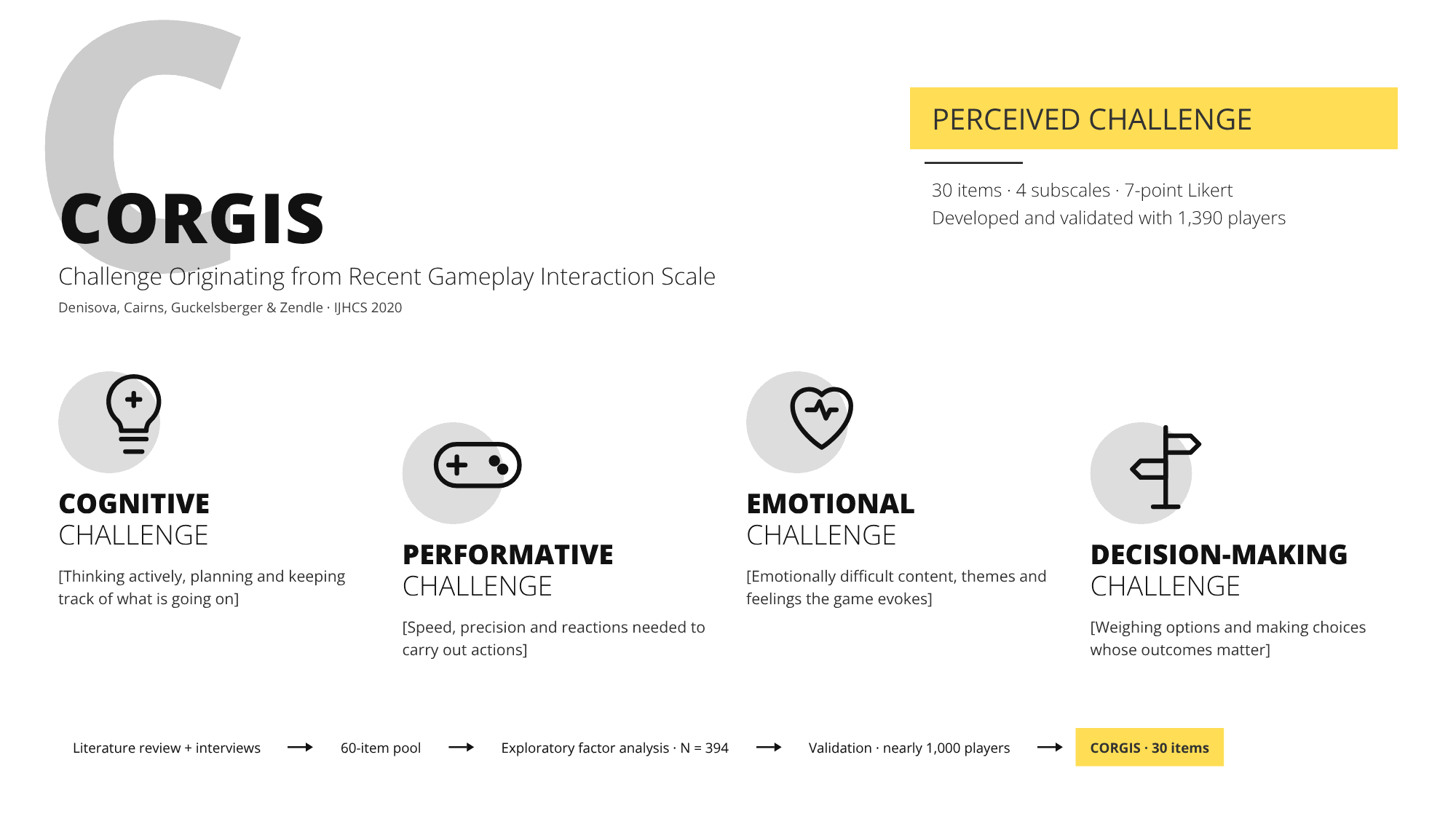
Measuring Perceived Challenge in Digital Games: Development & Validation of the Challenge Originating from Recent Gameplay Interaction Scale (CORGIS)
Players can find a game challenging in more ways than needing quick reflexes. This paper presents CORGIS, the Challenge Originating from Recent Gameplay Interaction Scale: a questionnaire that measures how challenging players found the game they just played. Its items came from a review of games user research, game design and game AI literature, and from interviews with researchers and players.
Summary and key findings: Measuring Perceived Challenge in Digital Games: Development & Validation of the Challenge Originating from Recent Gameplay Interaction Scale (CORGIS) PDF of Measuring Perceived Challenge in Digital Games: Development & Validation of the Challenge Originating from Recent Gameplay Interaction Scale (CORGIS) (accepted version) Publisher's version of Measuring Perceived Challenge in Digital Games: Development & Validation of the Challenge Originating from Recent Gameplay Interaction Scale (CORGIS)
2019 (Full papers)
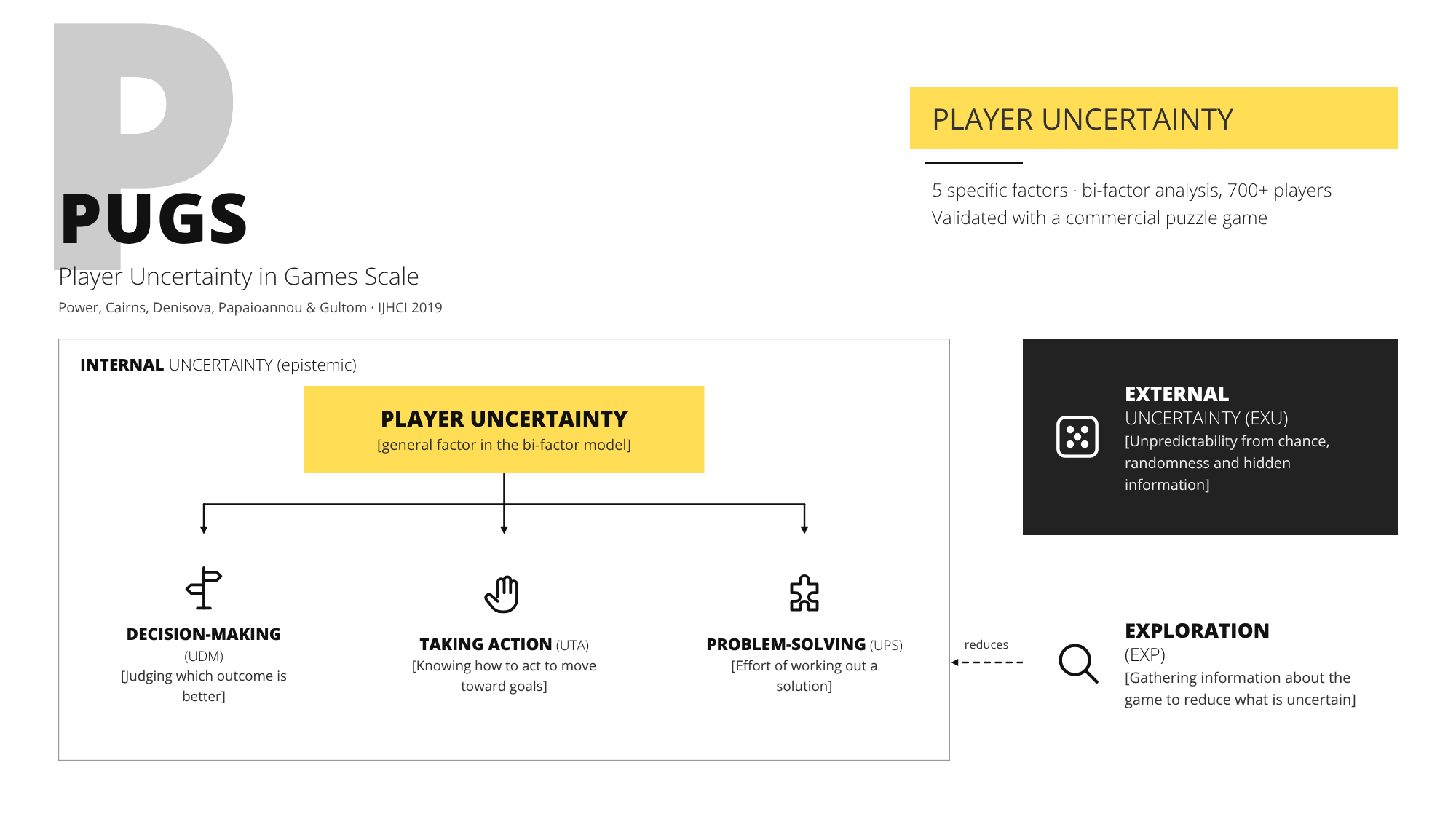
Lost at the Edge of Uncertainty: Measuring Player Uncertainty in Digital Games
Uncertainty makes games engaging, but it can feel good or bad, and there was no way to measure it. Using survey data from over 700 players, we developed a questionnaire of how players experience uncertainty and validated it with a commercial puzzle game.
Themes:
Measuring player experience
Summary and key findings: Lost at the Edge of Uncertainty: Measuring Player Uncertainty in Digital Games PDF of Lost at the Edge of Uncertainty: Measuring Player Uncertainty in Digital Games (accepted version) Publisher's version of Lost at the Edge of Uncertainty: Measuring Player Uncertainty in Digital Games
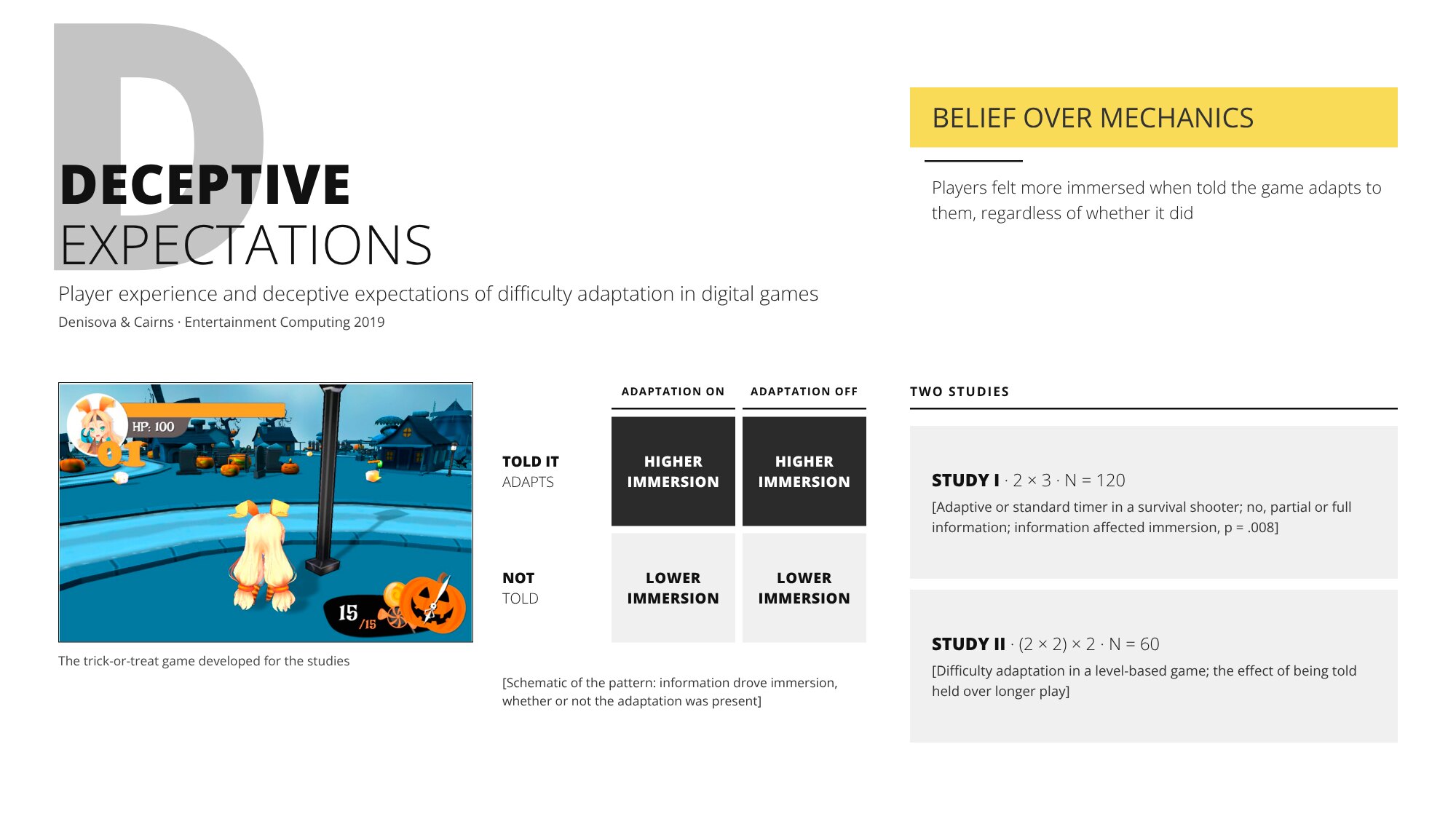
Player Experience and Deceptive Expectations of Difficulty Adaptation in Digital Games
Does telling players that a game adapts to them change their experience, whether or not it really does? In two studies with two games using different performance-based adaptations, we varied both what players were told and whether adaptation was present.
Summary and key findings: Player Experience and Deceptive Expectations of Difficulty Adaptation in Digital Games PDF of Player Experience and Deceptive Expectations of Difficulty Adaptation in Digital Games (accepted version) Publisher's version of Player Experience and Deceptive Expectations of Difficulty Adaptation in Digital Games
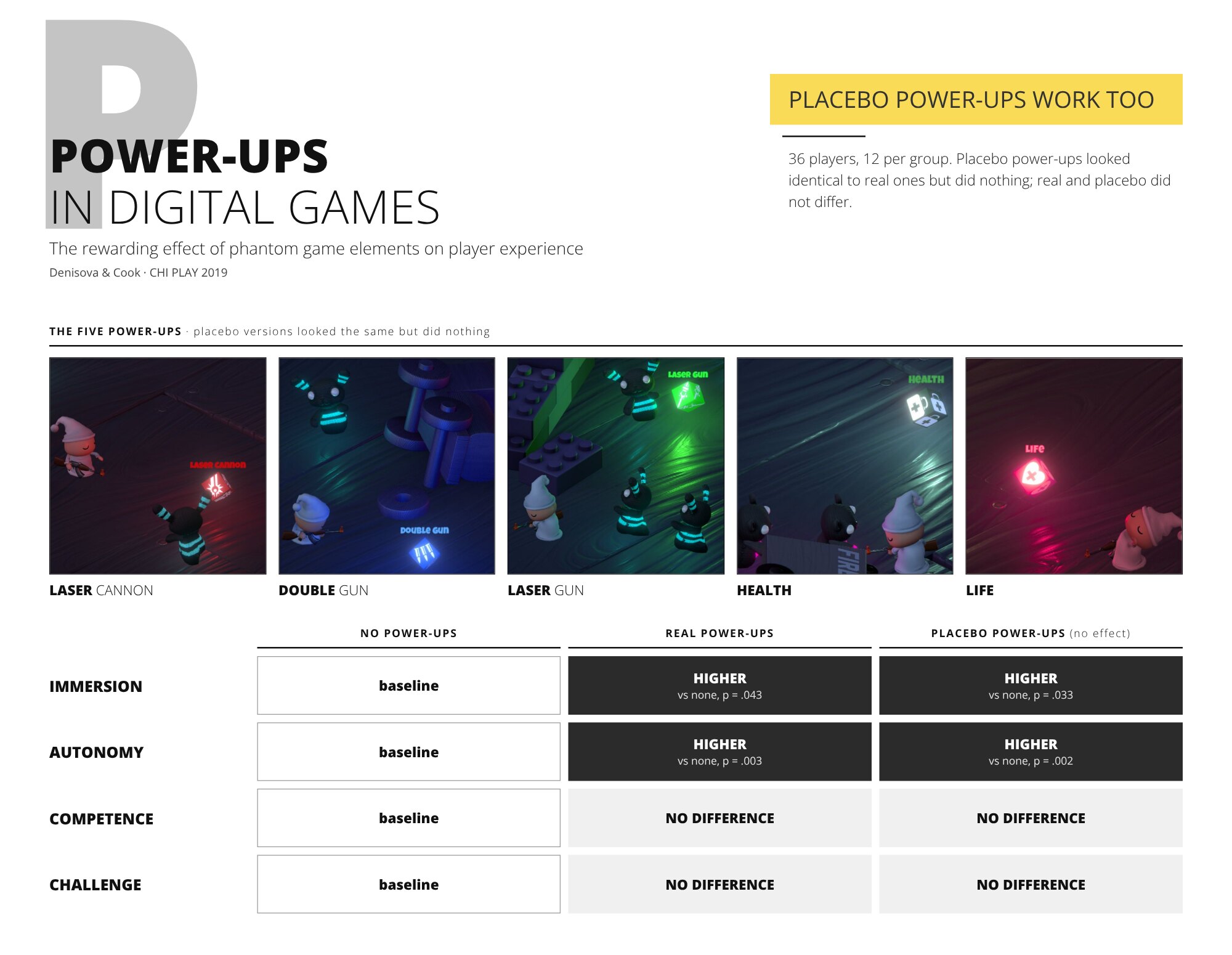
Power-Ups in Digital Games: The Rewarding Effect of Phantom Game Elements on Player Experience
Power-ups are everywhere in games, but their effect on player experience is poorly understood. We compared playing with power-ups, without them, and with 'placebo' power-ups that did nothing at all.
Summary and key findings: Power-Ups in Digital Games: The Rewarding Effect of Phantom Game Elements on Player Experience PDF of Power-Ups in Digital Games: The Rewarding Effect of Phantom Game Elements on Player Experience (accepted version) Publisher's version of Power-Ups in Digital Games: The Rewarding Effect of Phantom Game Elements on Player Experience
2015 (Full papers)
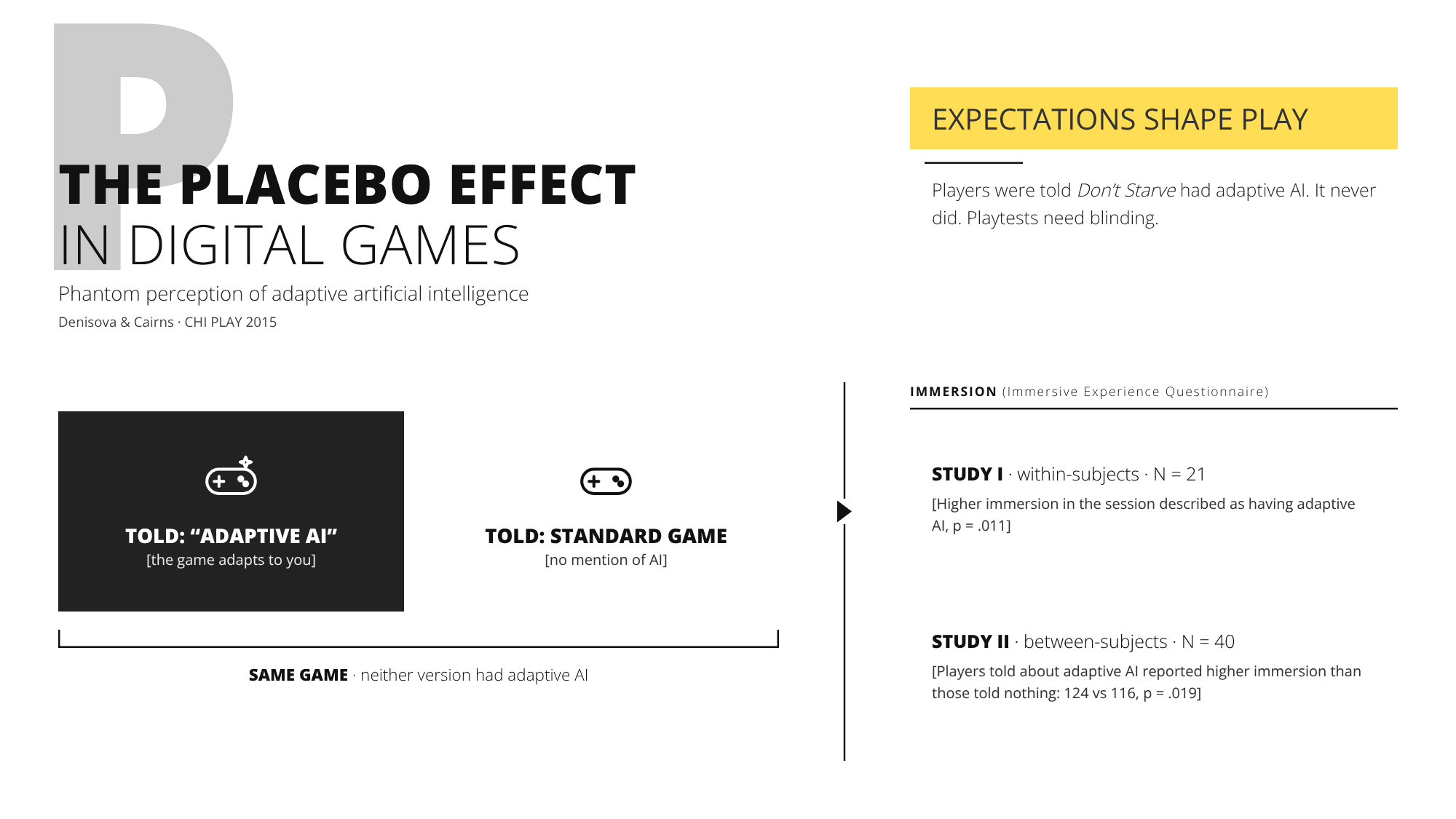
The Placebo Effect in Digital Games: Phantom Perception of Adaptive Artificial Intelligence
Can simply telling players that a game has adaptive AI change their experience? In two studies, players were told the game contained adaptive artificial intelligence, although it did not.
Summary and key findings: The Placebo Effect in Digital Games: Phantom Perception of Adaptive Artificial Intelligence PDF of The Placebo Effect in Digital Games: Phantom Perception of Adaptive Artificial Intelligence (accepted version) Publisher's version of The Placebo Effect in Digital Games: Phantom Perception of Adaptive Artificial Intelligence
Short papers and work in progress 6
Late-breaking work, short papers, posters and doctoral symposium papers.
2017 (Short papers and work in progress)
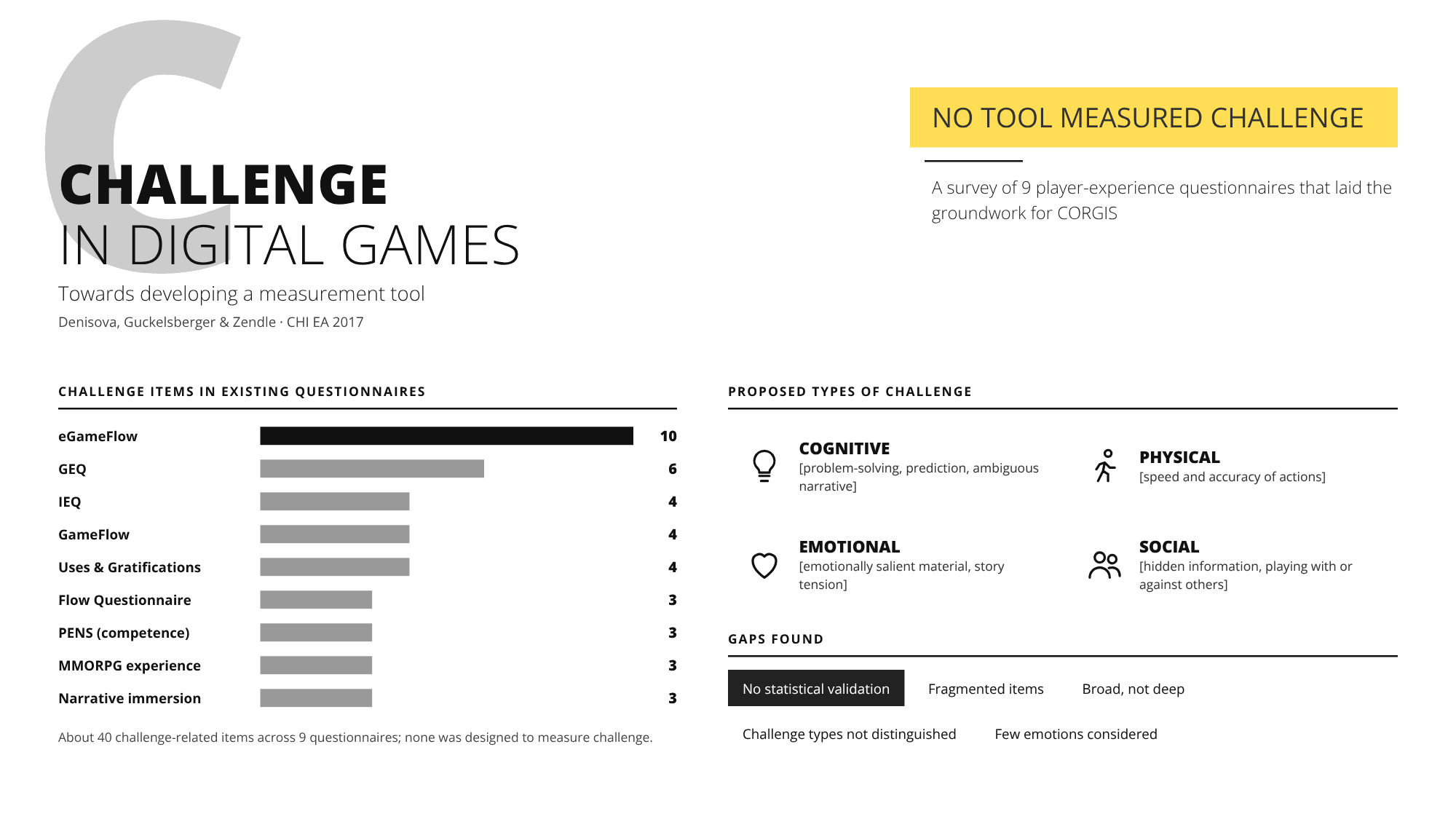
Challenge in Digital Games: Towards Developing a Measurement Tool
Reviews how challenge in games is defined, what types of challenge exist and how they relate to player experience, drawing on game design, HCI and game AI. This review laid the groundwork for the CORGIS questionnaire.
Summary and key findings: Challenge in Digital Games: Towards Developing a Measurement Tool PDF of Challenge in Digital Games: Towards Developing a Measurement Tool (accepted version) Publisher's version of Challenge in Digital Games: Towards Developing a Measurement Tool
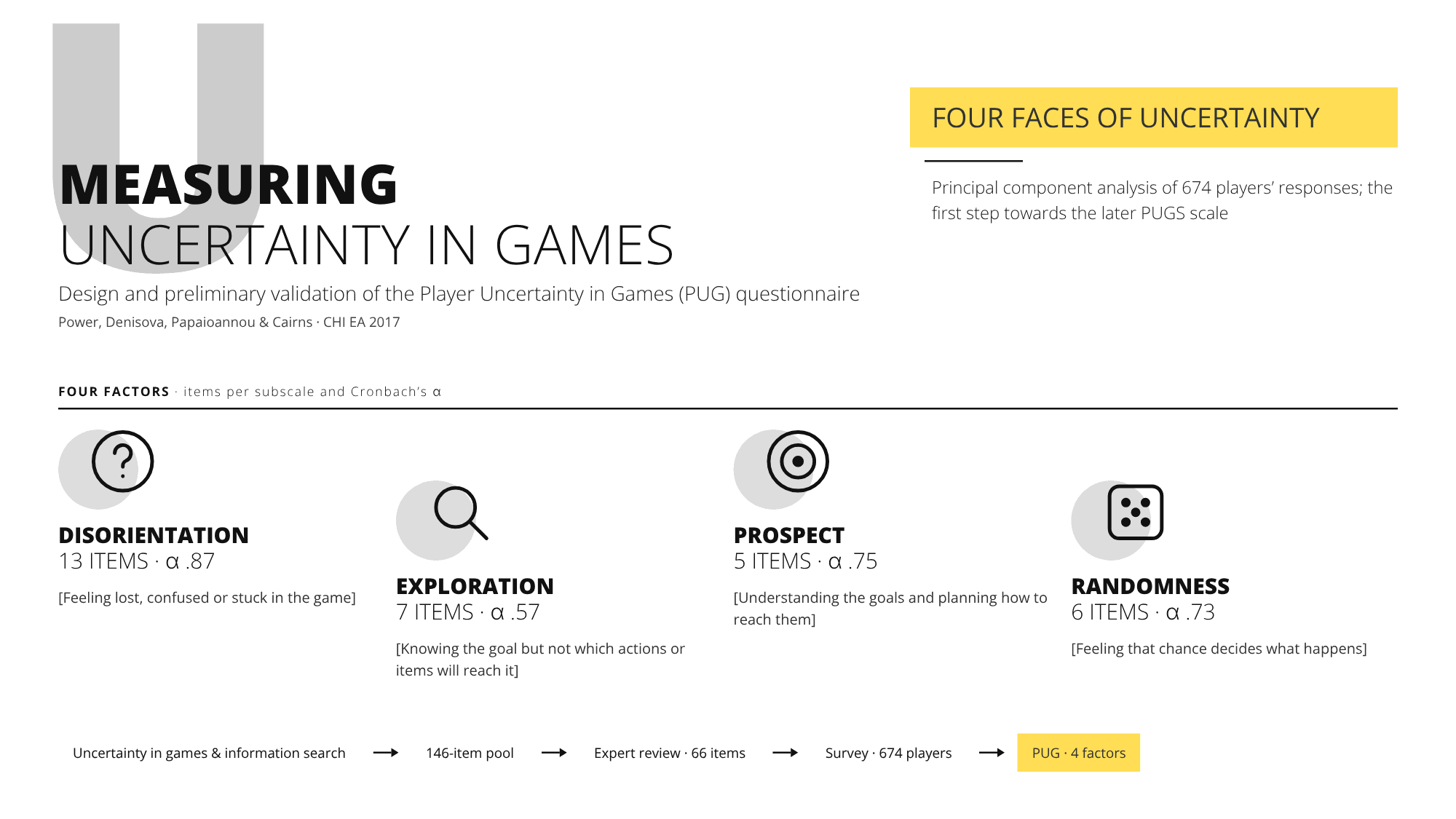
Measuring Uncertainty in Games: Design and Preliminary Validation
An early version of the uncertainty questionnaire that became PUGS. The 66-item scale, refined through player interviews and expert review and tested in an online survey, showed four factors: disorientation, exploration, prospect and randomness.
Themes:
Measuring player experience
Summary and key findings: Measuring Uncertainty in Games: Design and Preliminary Validation PDF of Measuring Uncertainty in Games: Design and Preliminary Validation (accepted version) Publisher's version of Measuring Uncertainty in Games: Design and Preliminary Validation
2016 (Short papers and work in progress)
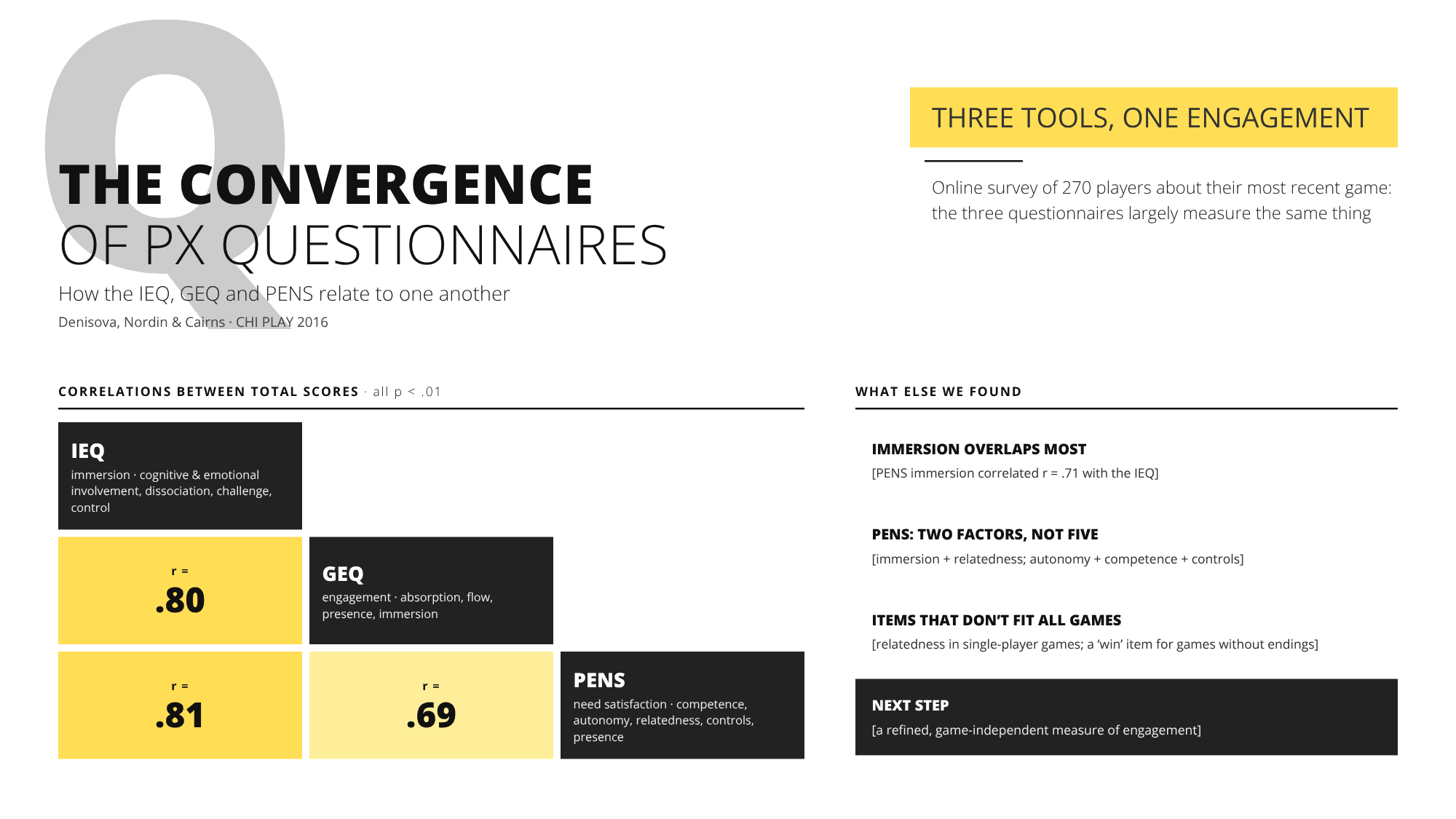
The Convergence of Player Experience Questionnaires
Compares three widely used player experience questionnaires (IEQ, GEQ and PENS) using 270 players' reports of their most recent game. The three overlap considerably, leaving room to refine them into one broader measure of game engagement.
Themes:
Measuring player experience
Summary and key findings: The Convergence of Player Experience Questionnaires PDF of The Convergence of Player Experience Questionnaires (accepted version) Publisher's version of The Convergence of Player Experience Questionnaires
2015 (Short papers and work in progress)
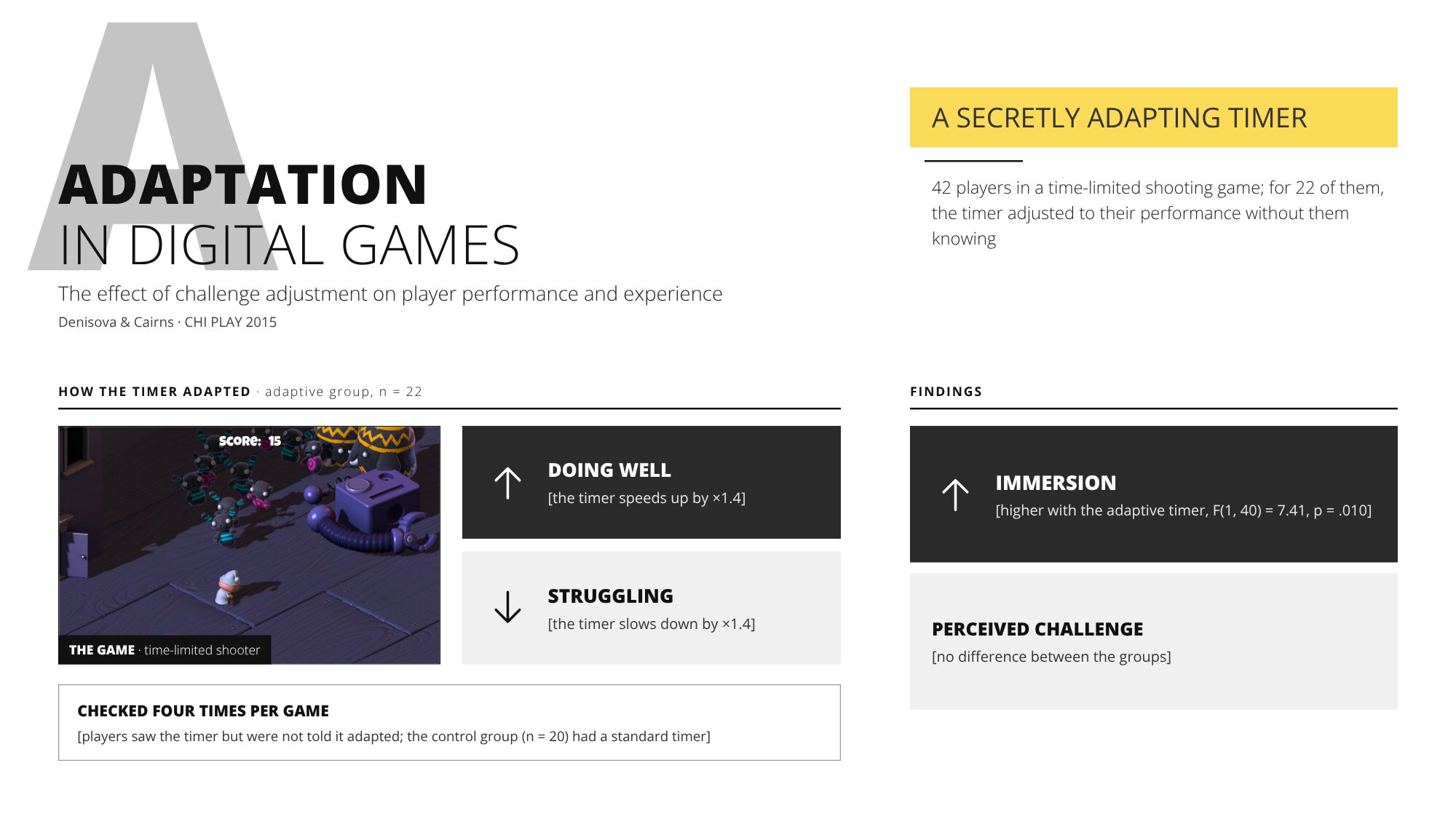
Adaptation in Digital Games: The Effect of Challenge Adjustment on Player Performance and Experience
Good gaming experiences depend on balancing challenge against the player's skill. We tested a simple form of dynamic difficulty adjustment: changing a game's timer based on each player's performance, without telling players it was happening.
Themes:
Challenge and adaptation
Summary and key findings: Adaptation in Digital Games: The Effect of Challenge Adjustment on Player Performance and Experience PDF of Adaptation in Digital Games: The Effect of Challenge Adjustment on Player Performance and Experience (accepted version) Publisher's version of Adaptation in Digital Games: The Effect of Challenge Adjustment on Player Performance and Experience
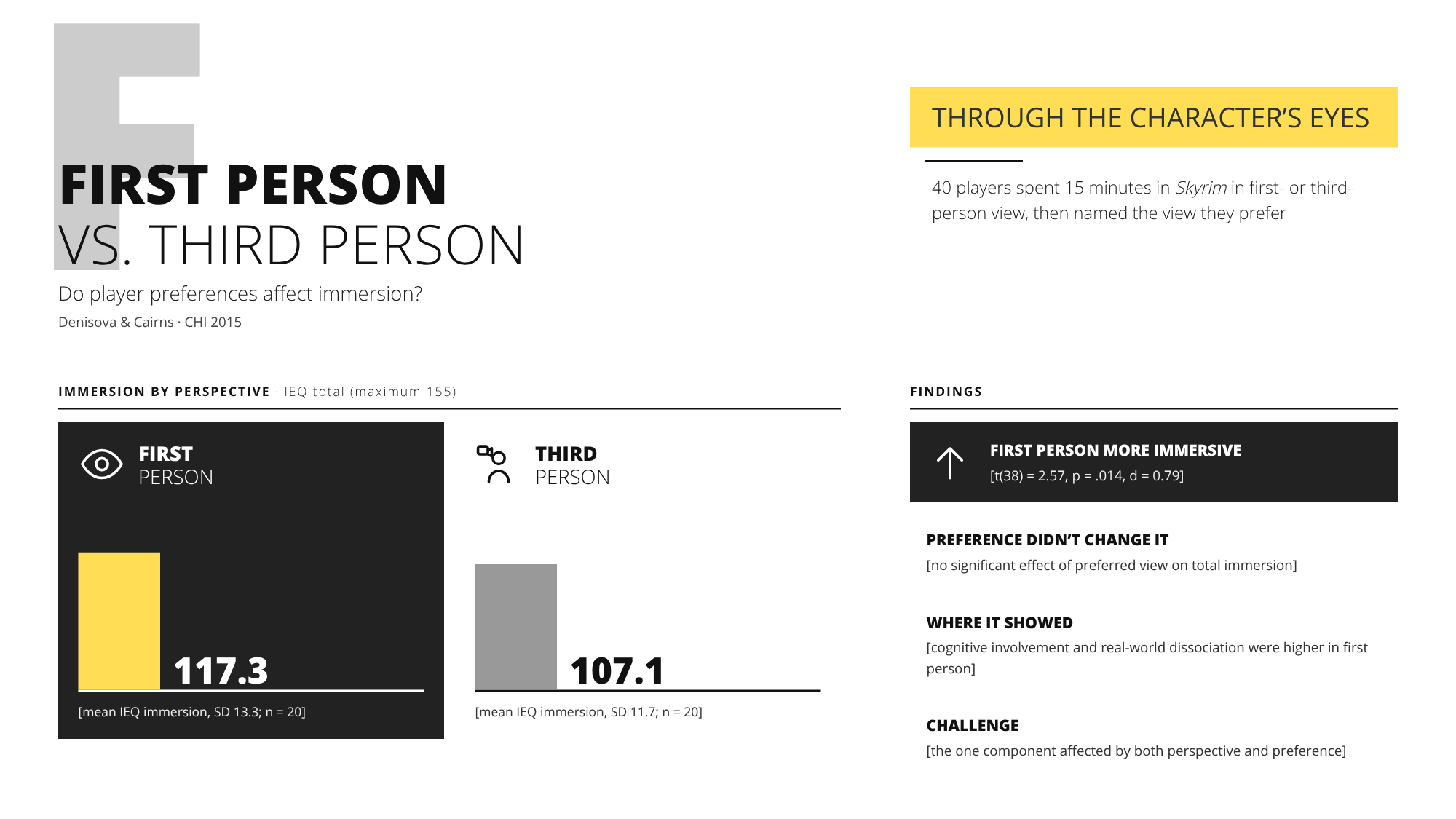
First Person vs. Third Person Perspective in Digital Games: Do Player Preferences Affect Immersion?
Do players feel more immersed in first-person or third-person view? Participants played a role-playing game in one of the two perspectives and rated their immersion. First person was more immersive, whichever perspective players said they preferred.
Themes:
Immersion and game features
Summary and key findings: First Person vs. Third Person Perspective in Digital Games: Do Player Preferences Affect Immersion? PDF of First Person vs. Third Person Perspective in Digital Games: Do Player Preferences Affect Immersion? (accepted version) Publisher's version of First Person vs. Third Person Perspective in Digital Games: Do Player Preferences Affect Immersion?
2014 (Short papers and work in progress)
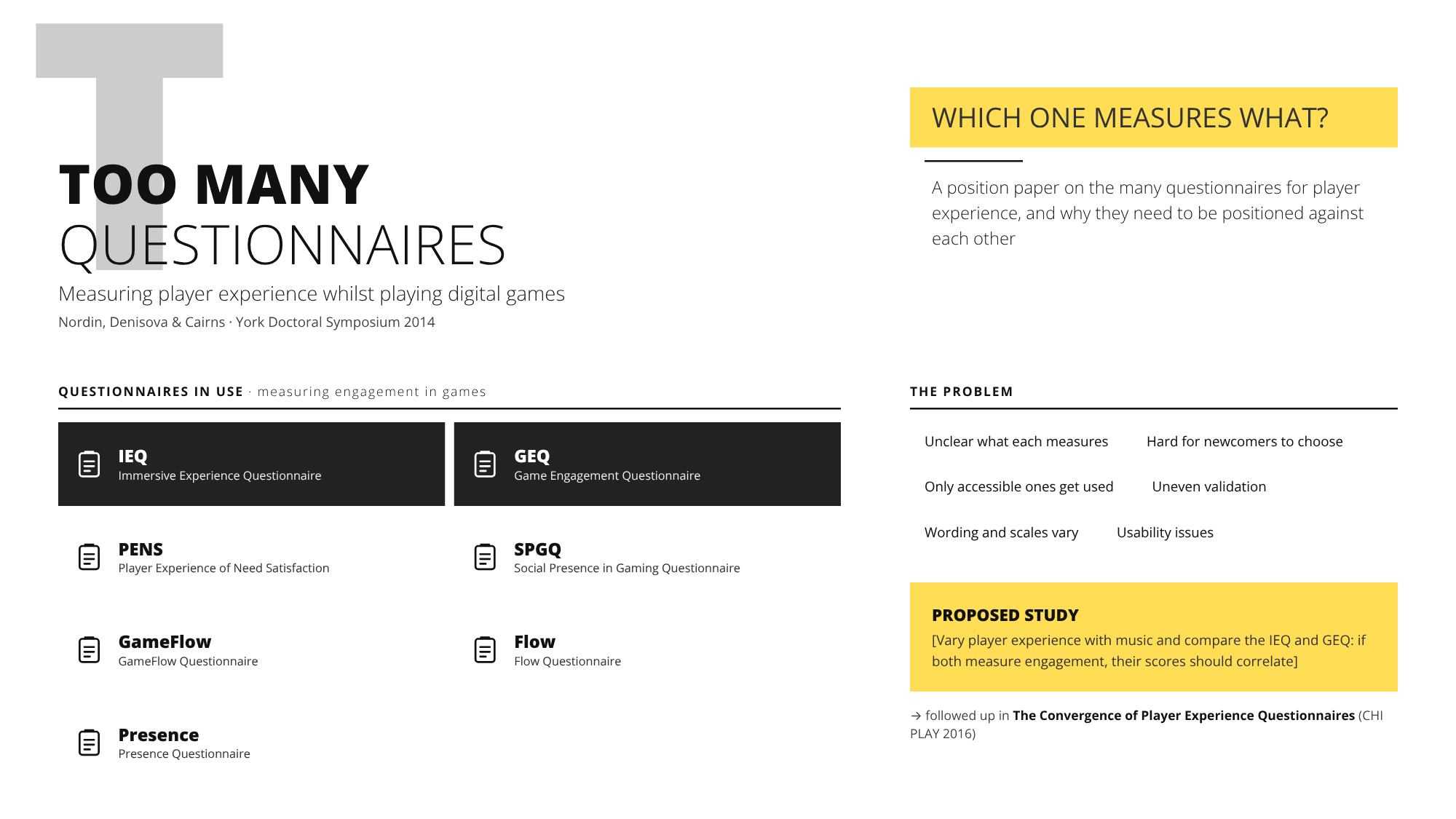
Too Many Questionnaires: Measuring Player Experience Whilst Playing Digital Games
Lists the questionnaires available for measuring engagement in digital games and argues that they need to be positioned against each other, so researchers know which aspect of experience each one measures.
Themes:
Measuring player experience
Summary and key findings: Too Many Questionnaires: Measuring Player Experience Whilst Playing Digital Games PDF of Too Many Questionnaires: Measuring Player Experience Whilst Playing Digital Games (accepted version)
Other full papers 6
Earlier and collaborative full papers.
- P-Lite: A Study of Parallel Coordinate Plot Literacy PDF of P-Lite: A Study of Parallel Coordinate Plot LiteracyPublisher's version of P-Lite: A Study of Parallel Coordinate Plot Literacy
- Evaluating the Use of Persuasive Design Cards for Novice Designers PDF of Evaluating the Use of Persuasive Design Cards for Novice Designers
- Treemap Literacy: A Classroom-Based Investigation PDF of Treemap Literacy: A Classroom-Based InvestigationPublisher's version of Treemap Literacy: A Classroom-Based Investigation
- Acceptability of a Plasticity-Focused Serious Game Intervention for Posttraumatic Stress Disorder: User Requirements Analysis PDF of Acceptability of a Plasticity-Focused Serious Game Intervention for Posttraumatic Stress Disorder: User Requirements AnalysisPublisher's version of Acceptability of a Plasticity-Focused Serious Game Intervention for Posttraumatic Stress Disorder: User Requirements Analysis
- Perceptions of Telepresence Robot Form
- The Effect of Time Manipulation on Immersion in Digital Games PDF of The Effect of Time Manipulation on Immersion in Digital GamesPublisher's version of The Effect of Time Manipulation on Immersion in Digital Games
Workshops, SIGs and panels 9
Workshops I co-organised or contributed to, special interest groups and panels.
- Designing for Playfulness in Human-AI Authoring Tools Publisher's version of Designing for Playfulness in Human-AI Authoring Tools
- Envisioning and Co-Creating Generative AI for Future Creative Workers in Gaming: A CHI PLAY 2026 Workshop Publisher's version of Envisioning and Co-Creating Generative AI for Future Creative Workers in Gaming: A CHI PLAY 2026 Workshop
- Leveling Up Leadership: Emerging Voices and Evolving Practices in the Games & Play Community Publisher's version of Leveling Up Leadership: Emerging Voices and Evolving Practices in the Games & Play Community
- Evaluating Interactive AI: Understanding and Controlling Placebo Effects in Human-AI Interaction Publisher's version of Evaluating Interactive AI: Understanding and Controlling Placebo Effects in Human-AI Interaction
- Games and Play SIG: Connecting Games Research to the Broader HCI Context Publisher's version of Games and Play SIG: Connecting Games Research to the Broader HCI Context
- Human-AI Interaction through Play Workshop
- The Second Workshop on Eudaimonia in Digital Games
- The First Workshop on Eudaimonia in Digital Games
- The First Workshop on Human-AI Interaction through Play
Dagstuhl reports and manifestos 7
Extended abstracts and manifestos from Dagstuhl seminars and workshops.
- The Future of Games in Society (Manifesto from Dagstuhl Perspectives Workshop 25102) Dagstuhl 25102 pagePDF of The Future of Games in Society (Manifesto from Dagstuhl Perspectives Workshop 25102)Publisher's version of The Future of Games in Society (Manifesto from Dagstuhl Perspectives Workshop 25102)
- Arts & Crafts & Generative AI Dagstuhl 24261 page
- Evaluating the Generative Space of Procedural Narrative Generators Dagstuhl 24261 page
- Designing Playfulness in Human-AI Authoring Tools Dagstuhl 23033 page
- AI for Romantic Comedies Dagstuhl 22251 pagePublisher's version of AI for Romantic Comedies
- Artificial Intelligence for Audiences Dagstuhl 22251 pagePublisher's version of Artificial Intelligence for Audiences
- Personalized Long-Term Game Adaptation Assistant AI Dagstuhl 22251 pagePublisher's version of Personalized Long-Term Game Adaptation Assistant AI
Thesis, preprints, posters and articles 5
My PhD thesis, preprints, posters and magazine articles.
- Acoustic Indicators of Join Quality in Concatenated Sports Video Game Commentary
- Exploring the Effects of Dynamic Difficulty Adjustment Functions on Player Experience and Physical Effort in a Running Exergame
- From Pixels to Play: Opportunities and Challenges of a Diverse and Democratized Games Industry Publisher's version of From Pixels to Play: Opportunities and Challenges of a Diverse and Democratized Games Industry
- Breaking a Game to Prove a Point About Medicinal Maggots
- Adaptive Technologies in Digital Games: The Influence of Perception of Adaptivity on Immersion