Towards Democratisation of Games User Research: Exploring Playtesting Challenges of Indie Video Game Developers
JournalSCImago Journal Rank: PACM HCI, first quartile: SJR Q1Proceedings of the ACM on Human-Computer Interaction (CHI PLAY 2024), 2024
In short
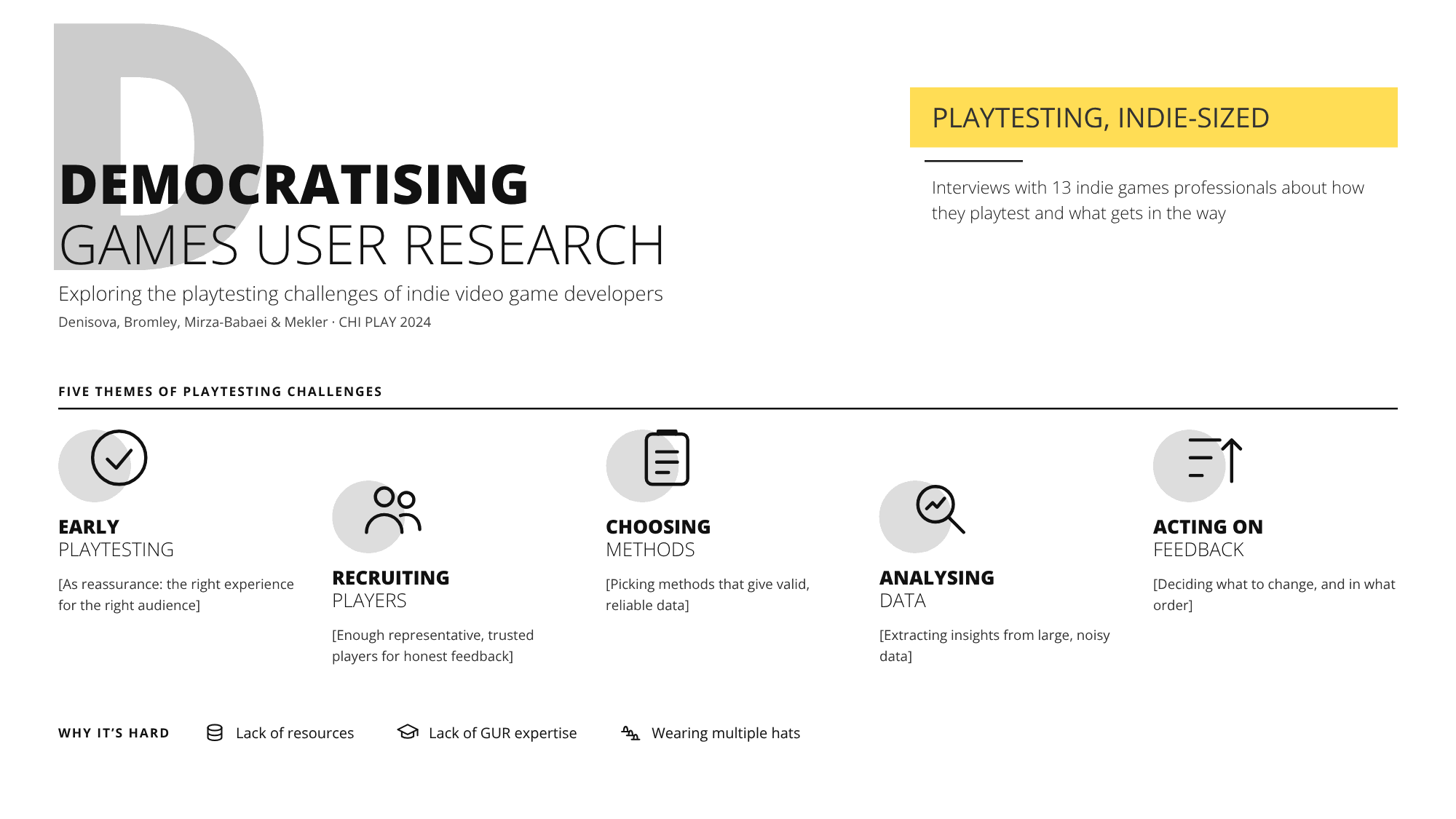
Playtesting is a core games user research method, but recommended practices often assume resources and expertise that indie developers lack. We interviewed 13 indie games professionals about how they playtest and what gets in the way.
How the study worked
- Participants
- 13 indie game developers, mostly in North America, Australia and Europe; none had formal training in user research
- Studios
- Team sizes ranged from 2 to 35 people
- Recruitment
- Social media, personal inquiries and developer communities, such as the IGDA Games Research and User Experience SIG Discord
- Interviews
- Semi-structured video interviews lasting between 45 minutes and 1 hour
- Analysis
- A codebook approach to thematic analysis
In developers’ words
Not having people playtesting something and giving feedback that is honest
P1
I don’t have their email address, so making those connections with other people
P8, on recruiting new players
Oh my God, somebody said this, we can simplify this and make it clear
P2, on reacting to feedback
Key findings
- Finding suitable playtest participants is a key challenge for indie developers.
- So is handling the data that playtests generate.
- We discuss how games user research practices could be adapted to make playtesting more accessible and useful for indie developers.
The challenges indie developers described
The five themes from the interviews, as named in the paper.
- Regular and early playtesting as reassurance: creating the right experiences for the right audience
- Recruiting enough representative and trusted players to gather objective and honest feedback
- Choosing appropriate research methods to gather valid and reliable data
- Interpreting and analysing collected data to extract valuable insights
- Dealing with feedback and prioritising actions
Suggestions from the paper
By tracking how many people sign up and participate, developers can determine the initial level of interest.
Dual purpose of playtesting: enhancing game quality and validating market potential
Real-time feedback can offer valuable insights into players' moment-to-moment experiences.
Exploring new tools and research methods for evaluating new and unique player experiences
Combining methods like data analytics and observations can be effective for pinpointing relevant information
Handling large amounts of unstructured data to extract relevant insights
Creating and sharing research guidelines is another area that academic researchers can contribute.
Democratising user research to empower indie developers to conduct research themselves
Educating and empowering others to be able to do research could be also seen as a researcher's main duty.
Democratising user research to empower indie developers to conduct research themselves
Read and cite
APA citation
Denisova, A., Bromley, S., Mirza-Babaei, P., & Mekler, E. D. (2024). Towards Democratisation of Games User Research: Exploring Playtesting Challenges of Indie Video Game Developers. Proceedings of the ACM on Human-Computer Interaction, 8(CHI PLAY), Article 343. https://doi.org/10.1145/3677108
- Generative AI in Game Development: A Qualitative Research Synthesis PDF of Generative AI in Game Development: A Qualitative Research SynthesisPublisher's version of Generative AI in Game Development: A Qualitative Research Synthesis
- From Pixels to Play: Opportunities and Challenges of a Diverse and Democratized Games Industry Publisher's version of From Pixels to Play: Opportunities and Challenges of a Diverse and Democratized Games Industry
- Envisioning and Co-Creating Generative AI for Future Creative Workers in Gaming: A CHI PLAY 2026 Workshop Publisher's version of Envisioning and Co-Creating Generative AI for Future Creative Workers in Gaming: A CHI PLAY 2026 Workshop