Indie developers and the games industry

How indie developers playtest their games, and what research can do to help.

How do indie developers evaluate the experiences their games create, and what gets in the way? This work focuses on evaluating subjective experience rather than quality assurance.

We look closely at hard-to-evaluate elements such as narrative, and ask whether low-cost or free tools could help developers adopt good practice. We also study how developers are adopting generative AI.

Papers

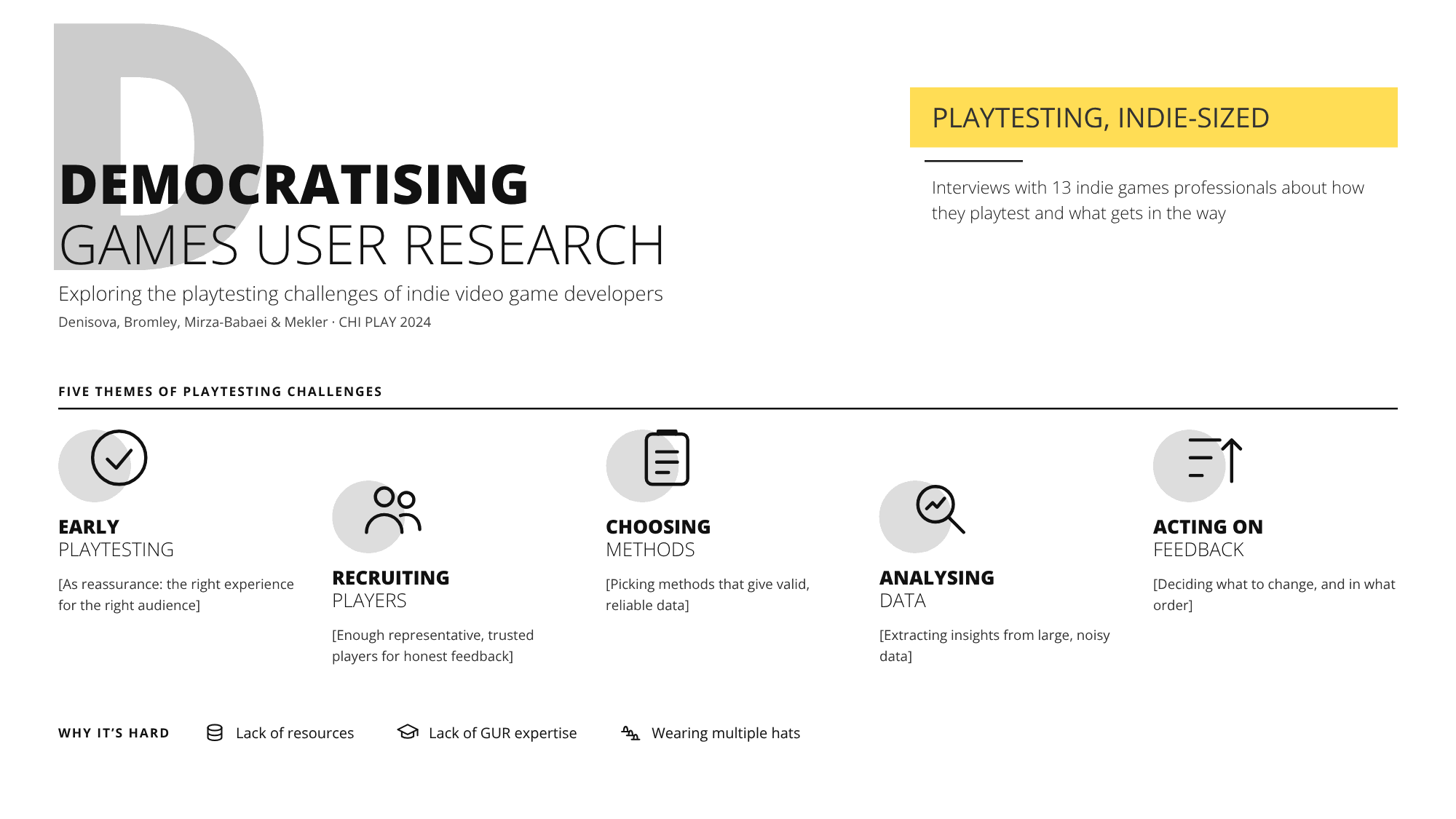
Teaser figure: Democratising games user research. Interviews with 13 indie games professionals revealed five themes of playtesting challenges: early playtesting, recruiting players, choosing methods, analysing data and acting on feedback. These are hard because of lack of resources, lack of GUR expertise and wearing multiple hats.

JournalSCImago Journal Rank: PACM HCI, first quartile: SJR Q12024 · Proceedings of the ACM on Human-Computer Interaction (CHI PLAY 2024)

Towards Democratisation of Games User Research: Exploring Playtesting Challenges of Indie Video Game Developers
Denisova, A., Bromley, S., Mirza-Babaei, P., & Mekler, E. D.

Playtesting is a core games user research method, but recommended practices often assume resources and expertise that indie developers lack. We interviewed 13 indie games professionals about how they playtest and what gets in the way.

Themes:
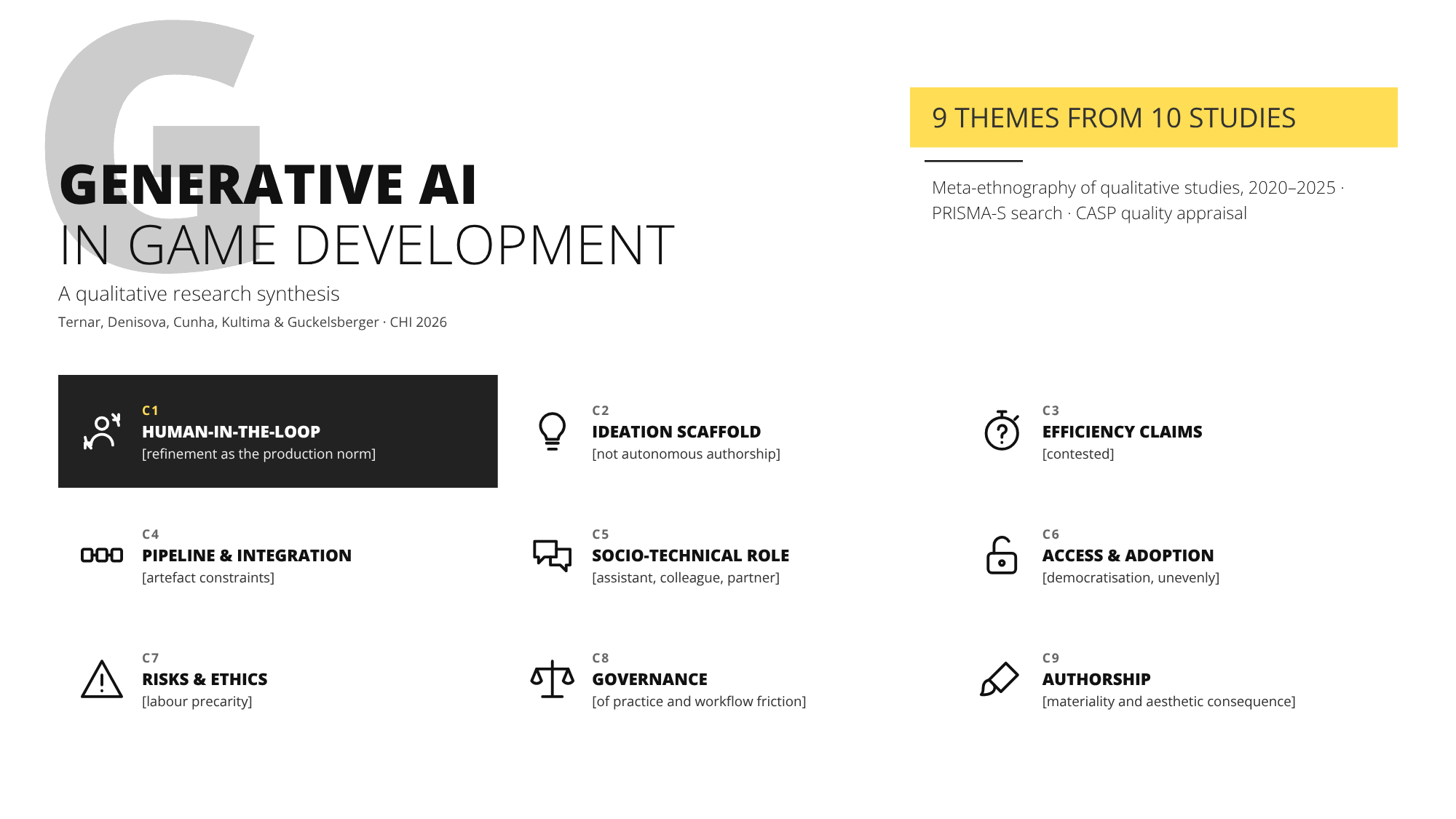
Teaser figure: Generative AI in game development, a qualitative research synthesis of 10 studies. Nine themes are shown with icons: human-in-the-loop refinement, ideation scaffold, contested efficiency claims, pipeline and integration, socio-technical role, access and adoption, risks and ethics, governance, and authorship.

ConferenceCORE conference ranking: CORE A*2026 · Proceedings of the 2026 CHI Conference on Human Factors in Computing Systems (CHI'26)

Generative AI in Game Development: A Qualitative Research Synthesis

Ternar, D. A., Denisova, A., Cunha, J. M., Kultima, A., & Guckelsberger, C.

Generative AI is changing how games are made, but the early qualitative studies of its use are scattered and rarely build on each other. We brought together the qualitative research published between 2020 and 2025 using meta-ethnography.

Other publications

Also relevant

Papers whose main theme is elsewhere but which also contribute here.