Perspectives of Sound Designers on Real-Time Sound Propagation in Games
ConferenceIEEE Conference on Games (CoG'25), 2025
In short
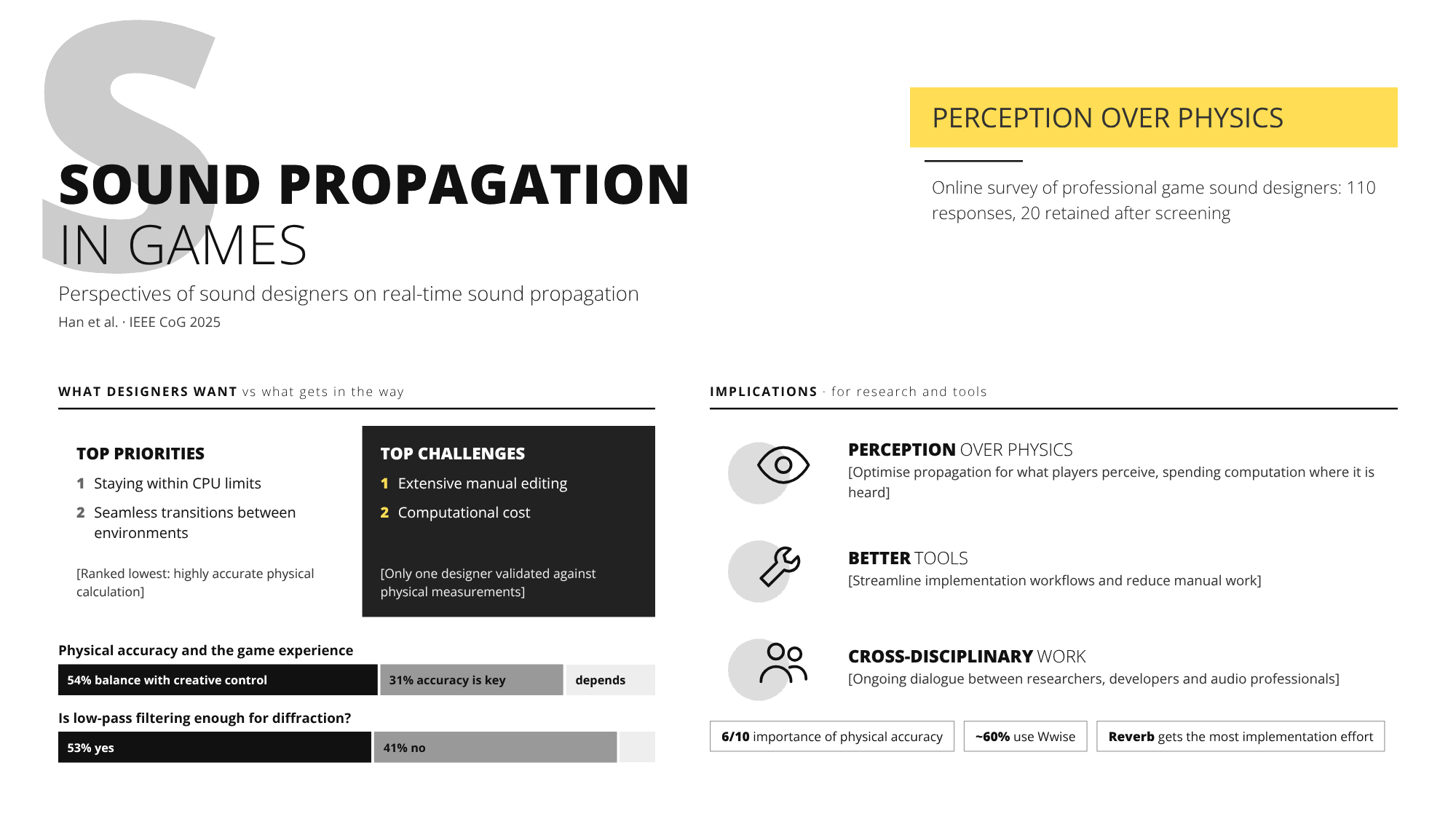
Realistic sound propagation, how sound travels through and around a virtual space, matters for immersive game audio, but getting it right means balancing physical accuracy against creative design. We reviewed physics-based techniques for real-time sound propagation and surveyed professional game sound designers (20 complete responses after screening) about their approaches, priorities and the challenges they face.
Key findings
- Designers’ top priorities were staying within CPU limits and seamless transitions between environments; highly accurate physical calculation ranked lowest.
- The biggest challenges were extensive manual editing and computational cost, and only one designer validated their work against physical measurements.
- Most wanted a balance between physical accuracy and creative control, pointing to perception-driven methods, better tools and closer collaboration between researchers and the industry.
What this means for game audio
Reverb is a good example of an area where sound designers waste far too much time worrying about how accurate and realistic it is, only for it to be lost in the mix of music and effects
A sound designer in the survey
Not many players will be able to tell the difference, even when asked to comment on this in a playtest
A sound designer in the survey
Pursuing increasing realism is not necessarily a priority in game audio development.
Discussion
While physics-based models provide a valuable foundation, practical implementation prioritizes perceptual plausibility, computational efficiency, and workflow adaptability.
Conclusion
Read and cite
APA citation
Han, Y., Denisova, A., Vasiliou, C., Schembri, D., Jones, M., & Murphy, D. (2025). Perspectives of Sound Designers on Real-Time Sound Propagation in Games. In IEEE Conference on Games (CoG'25) (pp. 1-8).
- Generative AI in Game Development: A Qualitative Research Synthesis PDF of Generative AI in Game Development: A Qualitative Research SynthesisPublisher's version of Generative AI in Game Development: A Qualitative Research Synthesis
- MAV-C: A Framework for the Joint Objective Estimation of Audio-Visual Complexity in Immersive Virtual Environments PDF of MAV-C: A Framework for the Joint Objective Estimation of Audio-Visual Complexity in Immersive Virtual Environments
- Spherical Acoustic Spatial Entropy: Predicting Acoustic Scene Complexity in Virtual Environments PDF of Spherical Acoustic Spatial Entropy: Predicting Acoustic Scene Complexity in Virtual EnvironmentsPublisher's version of Spherical Acoustic Spatial Entropy: Predicting Acoustic Scene Complexity in Virtual Environments