MAV-C: A Framework for the Joint Objective Estimation of Audio-Visual Complexity in Immersive Virtual Environments
ConferenceProceedings of the AES 6th International Conference on Audio for Virtual and Augmented Reality and Immersive Games (AVARIG 2026), 2026
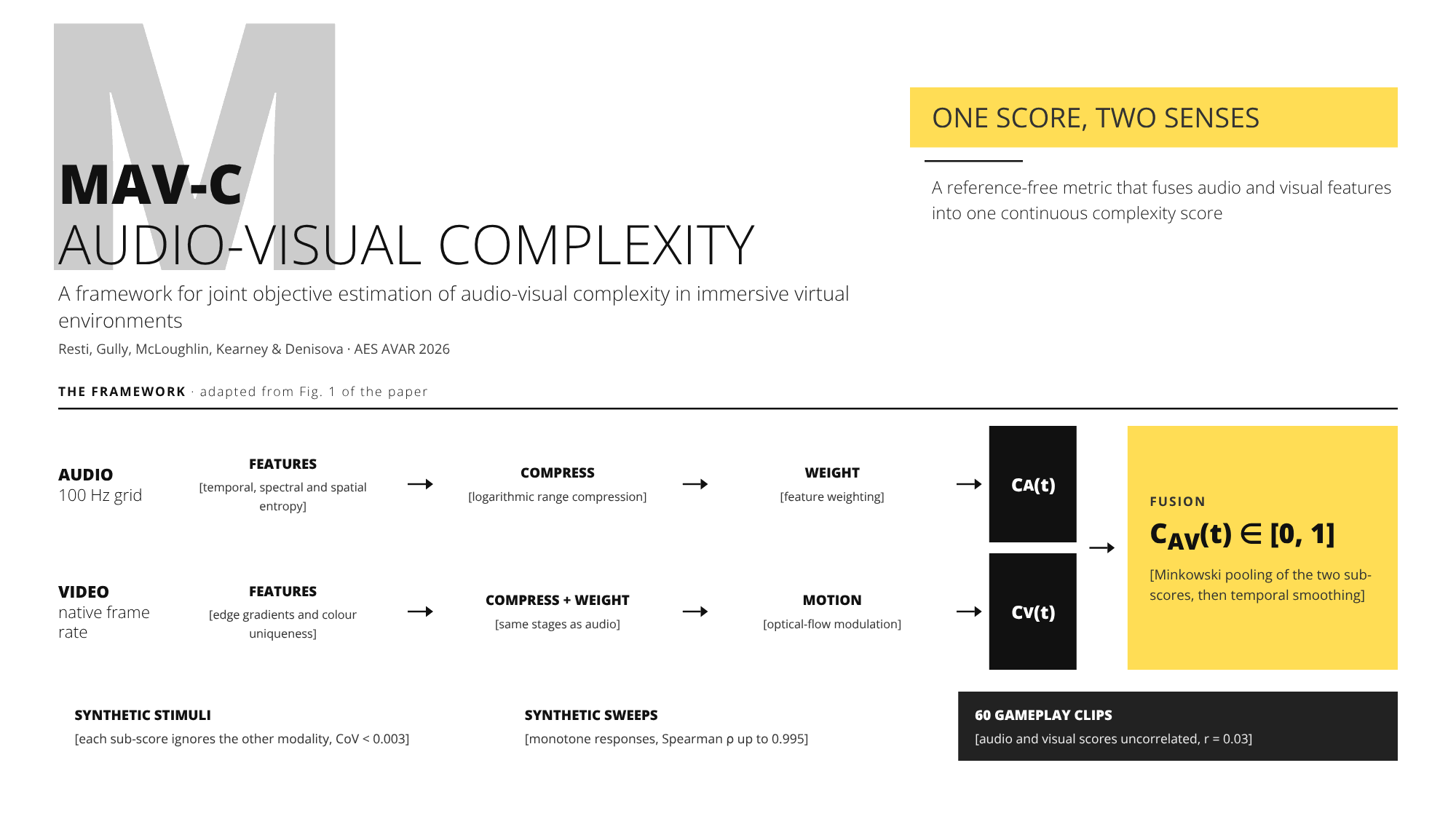
In short
MAV-C estimates how complex an immersive virtual environment is to see and hear. It combines audio features (temporal, spectral and spatial) with visual features (edges, colour and motion) into a single score that changes over time, without needing a reference recording.
Key findings
- On a controlled synthetic dataset, the audio and visual sub-scores each responded only to their own modality, and changing one feature at a time changed the score consistently.
- On 60 gameplay clips, visual complexity differed between types of content while audio complexity did not, and the two were essentially uncorrelated (r = 0.03).
- Calibrating the score against human ratings is the next step.
Read and cite
APA citation
Resti, L., Gully, A., McLoughlin, M., Kearney, G., & Denisova, A. (2026). MAV-C: A Framework for the Joint Objective Estimation of Audio-Visual Complexity in Immersive Virtual Environments. In Proceedings of the AES 6th International Conference on Audio for Virtual and Augmented Reality and Immersive Games (AVARIG 2026).
- Spherical Acoustic Spatial Entropy: Predicting Acoustic Scene Complexity in Virtual Environments PDF of Spherical Acoustic Spatial Entropy: Predicting Acoustic Scene Complexity in Virtual EnvironmentsPublisher's version of Spherical Acoustic Spatial Entropy: Predicting Acoustic Scene Complexity in Virtual Environments
- Acoustic Indicators of Join Quality in Concatenated Sports Video Game Commentary
- Perspectives of Sound Designers on Real-Time Sound Propagation in Games PDF of Perspectives of Sound Designers on Real-Time Sound Propagation in GamesPublisher's version of Perspectives of Sound Designers on Real-Time Sound Propagation in Games