Spherical Acoustic Spatial Entropy: Predicting Acoustic Scene Complexity in Virtual Environments
JournalIEEE Open Journal of Signal Processing, 2026
In short
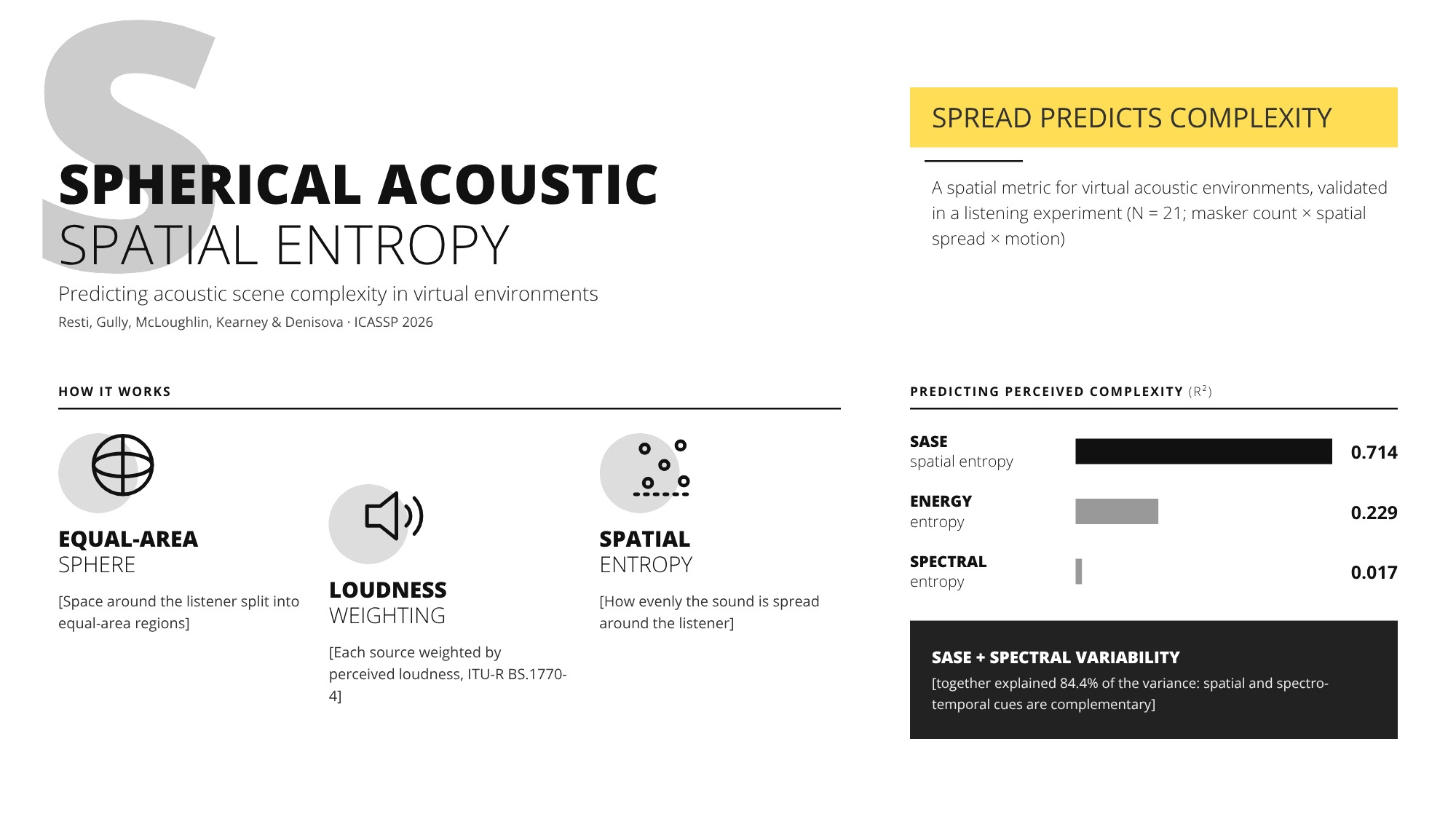
How complex a soundscape feels depends not only on which sounds are present but on where they are. We introduce Spherical Acoustic Spatial Entropy (SASE), a measure that predicts how complex a virtual acoustic scene sounds from how loud each sound source is in each direction around the listener.
Key findings
- In a listening experiment with 21 participants, SASE predicted perceived complexity better than spectral or energy entropy (R² = 0.71).
- The relationship also held for individual participants (pseudo-R² = 0.74).
- Combined with a measure of spectral variability, SASE explained 84% of the variance in perceived complexity, so spatial and spectral measures capture complementary aspects of a scene.
Read and cite
APA citation
Resti, L., Gully, A., McLoughlin, M., Kearney, G., & Denisova, A. (2026). Spherical Acoustic Spatial Entropy: Predicting Acoustic Scene Complexity in Virtual Environments. IEEE Open Journal of Signal Processing.
- MAV-C: A Framework for the Joint Objective Estimation of Audio-Visual Complexity in Immersive Virtual Environments PDF of MAV-C: A Framework for the Joint Objective Estimation of Audio-Visual Complexity in Immersive Virtual Environments
- Acoustic Indicators of Join Quality in Concatenated Sports Video Game Commentary
- Perspectives of Sound Designers on Real-Time Sound Propagation in Games PDF of Perspectives of Sound Designers on Real-Time Sound Propagation in GamesPublisher's version of Perspectives of Sound Designers on Real-Time Sound Propagation in Games