"It's a terrible choice to make but also a necessary one": Exploring player experiences with moral decision making mechanics in video games
JournalComputers in Human Behavior, 2024
In short
Many games ask players to make difficult moral choices, but little is known about how players experience them or which game mechanics support them. We combined a literature review and a survey with video-elicitation interviews.
In games
Games in the study
-
In the paper
Detroit: Become Human
Shown as a video clip in the interviews, and the game survey respondents mentioned most (10).
-
In the paper
The Walking Dead
Shown as a video clip in the interviews, and mentioned by 9 survey respondents.
-
In the paper
Red Dead Redemption 2
Shown as a video clip in the interviews.
-
In the paper
Spec Ops: The Line
Shown as a video clip in the interviews.
-
In the paper
Until Dawn
Mentioned by 8 survey respondents.
How the study worked
- Literature review
- A review of related literature on moral decision making in games
- Survey
- Qualitative responses from 30 players who had played at least one game with prominent moral decision making
- Interviews
- 11 semi-structured, video-elicitation interviews
- Video clips
- Red Dead Redemption 2, The Walking Dead, Detroit: Become Human and Spec Ops: The Line. All participants watched all clips, in the same order.
Moral decision making mechanics
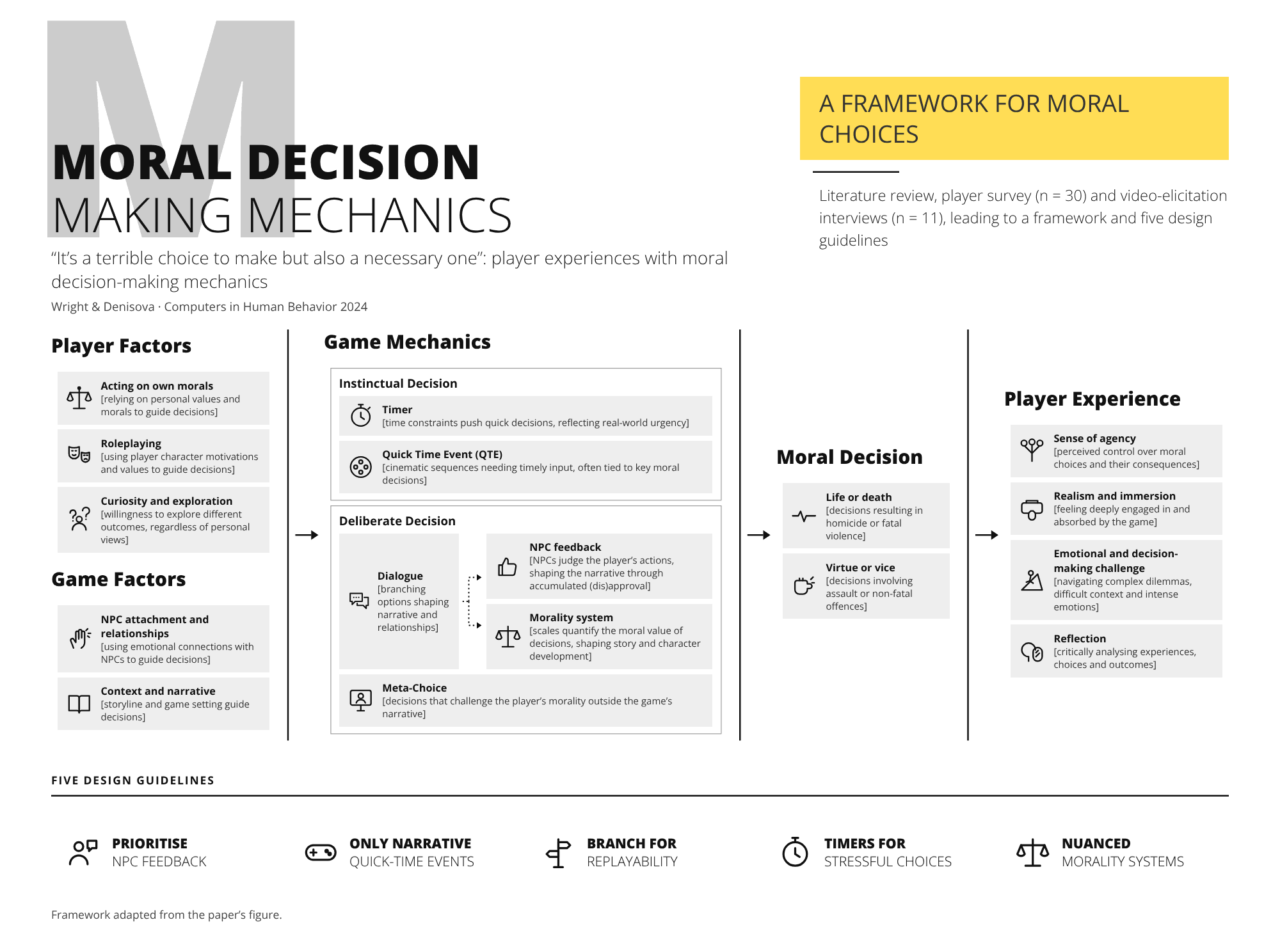
The framework the paper proposes, with each mechanic in the paper’s words.
Timer
“Participants faced time pressure in decision making, with a timer mechanic heightening urgency.”
Quick time events
“Cinematic sequences that the player interacts with by pressing specified buttons within a time limit.”
Morality system
“Tracks the morality of players’ decisions using a weighted moral scale.”
NPC feedback
“NPCs judging player actions based on their beliefs, with judgements weighted on an approval scale.”
Dialogue choices
“Allow players to select dialogue options from a list.”
Meta-choice
“Offer an unusual way to present moral decision making by placing the decision directly on the player.”
Context for moral decisions
“Players’ views of the morality of the decisions were shaped by the broader narrative context of the depicted games and the NPCs involved.”
Key findings
- A survey with 30 respondents identified game mechanics that support moral decision making.
- Interviews with 11 players showed how those mechanics shaped their decisions and overall experience.
- The result is a theoretical framework and design guidelines for future moral decision-making games.
What shapes moral decisions
Context
Life or death
“Decisions that players have to make that result in homicide or fatal violence.”
Context
Virtue or vice
“Decisions involving helping or harming other characters, choosing between violence or peace, and deciding whether to commit a non-violent crime.”
Factors influencing players’ decisions
- Personal morals
- Exploring endings
- Roleplaying
- Character relationships
- Context and narrative
Player experiences
- Sense of agency
- Realism and immersion
- Reflection on moral decision
In players’ words
It’s a terrible choice to make but also a necessary one
Interview participant 9
The first thing I try to do in any game is try to help
Interview participant 1
Not enough time to really think through all the implications
Interview participant 3
Design guidelines
Five guidelines for developing moral decision making games.
Prioritise the NPC feedback mechanic
“Emphasising the NPC feedback mechanic holds promise for enhancing immersion and engagement with the game’s moral decisions.”
Only include QTEs that relate to the narrative
“It is recommended to integrate QTEs and button-mashing mechanics as integral narrative features.”
Facilitate replayability through branching narratives
“It is strongly recommended to incorporate branching moral decisions.”
Use timers to emphasise stressful decisions
“If the objective is to foster moral reflection instead, the use of timers should be avoided.”
Allow for nuance in morality system weighting
“Eschew simplistic numerical ‘good’ or ‘bad’ morality systems.”
Read and cite
APA citation
Wright, S., & Denisova, A. (2024). "It's a terrible choice to make but also a necessary one": Exploring player experiences with moral decision making mechanics in video games. Computers in Human Behavior, 161, 108424. https://doi.org/10.1016/j.chb.2024.108424
- Emotionally Challenging Games Can Satisfy Older Adults' Psychological Needs: From Empirical Study to Design Guidelines PDF of Emotionally Challenging Games Can Satisfy Older Adults' Psychological Needs: From Empirical Study to Design GuidelinesPublisher's version of Emotionally Challenging Games Can Satisfy Older Adults' Psychological Needs: From Empirical Study to Design Guidelines
- "Whatever the Emotional Experience, It's Up to Them": Insights from Designers of Emotionally Impactful Games PDF of "Whatever the Emotional Experience, It's Up to Them": Insights from Designers of Emotionally Impactful GamesPublisher's version of "Whatever the Emotional Experience, It's Up to Them": Insights from Designers of Emotionally Impactful Games
- A Palette of Deepened Emotions: Exploring Emotional Challenge in Virtual Reality Games PDF of A Palette of Deepened Emotions: Exploring Emotional Challenge in Virtual Reality GamesPublisher's version of A Palette of Deepened Emotions: Exploring Emotional Challenge in Virtual Reality Games