Emotional challenge and meaningful play

Experiences beyond fun, from emotionally difficult content and moral choices to games that stay with you.

Games challenge players in more ways than puzzles and perfect kills. Many offer emotionally salient content, let players build complex relationships with characters, or ask them to make hard moral choices.

This theme studies these experiences "beyond fun". It covers how to measure emotional challenge, how designers create emotionally impactful moments, how players respond to moral decision-making mechanics, and how these experiences contribute to players' wellbeing.

Papers

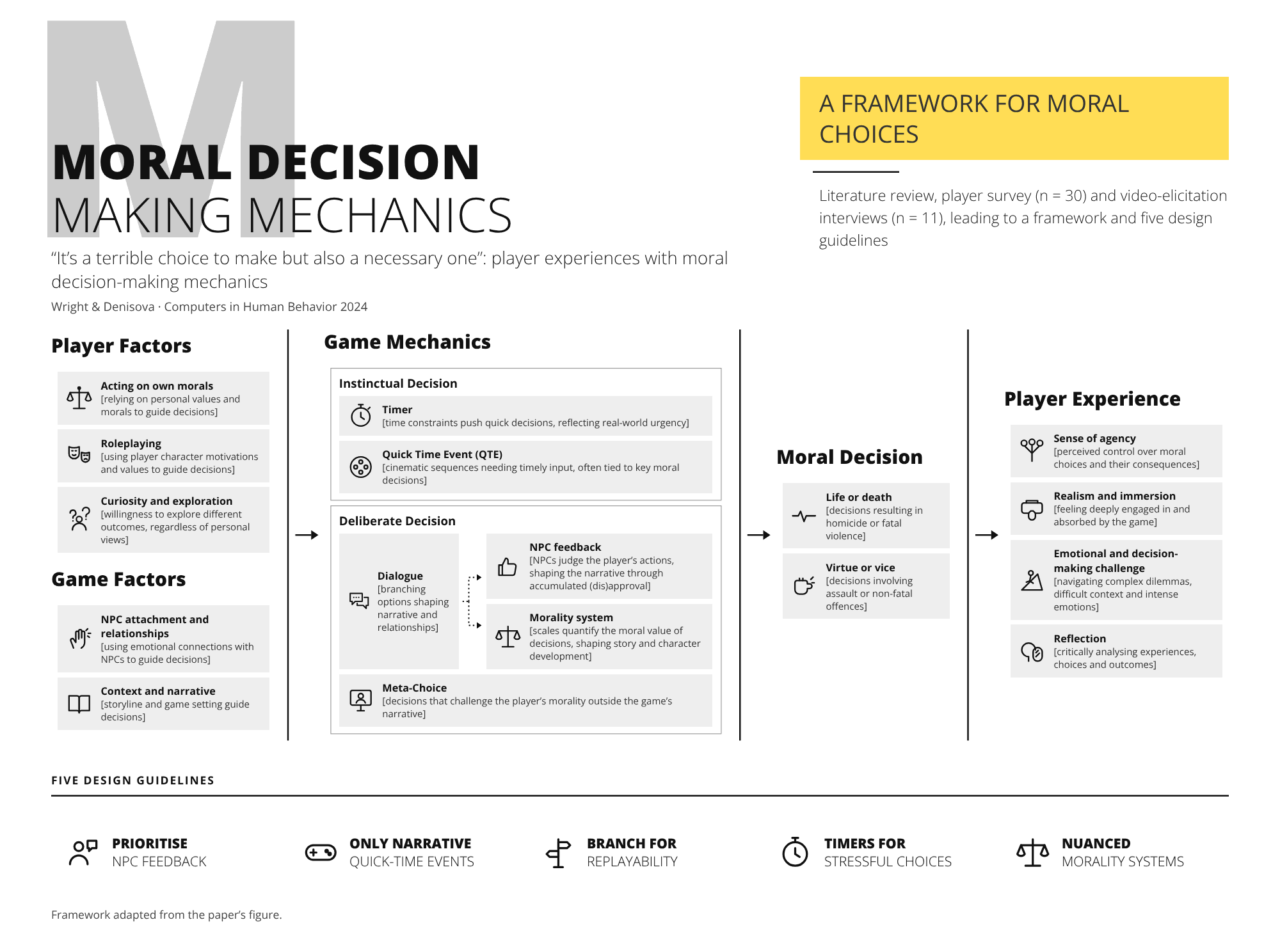
Teaser figure: Moral decision-making mechanics. A framework from a literature review, a player survey (n = 30) and video-elicitation interviews (n = 11). Player factors (acting on own morals, roleplaying, curiosity) and game factors (NPC attachment, context and narrative) feed into game mechanics: instinctual decisions (timers, quick-time events), deliberate decisions (dialogue, NPC feedback, morality systems) and meta-choices. These lead to moral decisions (life or death, virtue or vice) and player experiences of agency, realism and immersion, emotional and decision-making challenge, and reflection. Five design guidelines: prioritise NPC feedback, only narrative quick-time events, branch for replayability, timers for stressful choices, and nuanced morality systems.
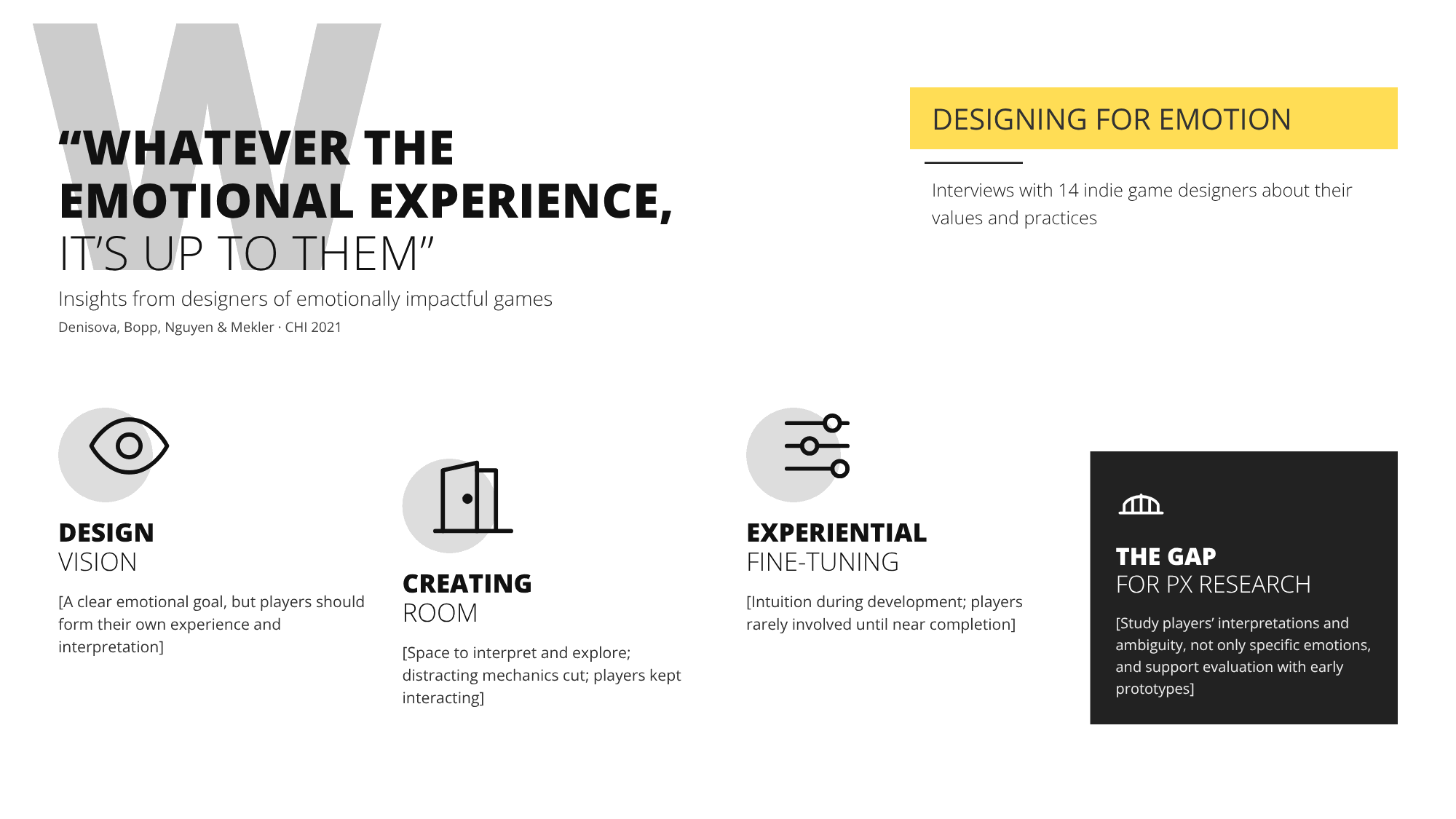
Four themes from interviews with 14 indie designers: design vision, creating room for interpretation, experiential fine-tuning, and the gap for player experience research.

ConferenceCORE conference ranking: CORE A*2021 · Proceedings of the 2021 CHI Conference on Human Factors in Computing Systems (CHI'21)

"Whatever the Emotional Experience, It's Up to Them": Insights from Designers of Emotionally Impactful Games

Denisova, A., Bopp, J. A., Nguyen, T. D., & Mekler, E. D.

Research on emotionally impactful games has mostly studied players. We interviewed 14 indie game designers about their values and practices when creating emotionally impactful games.

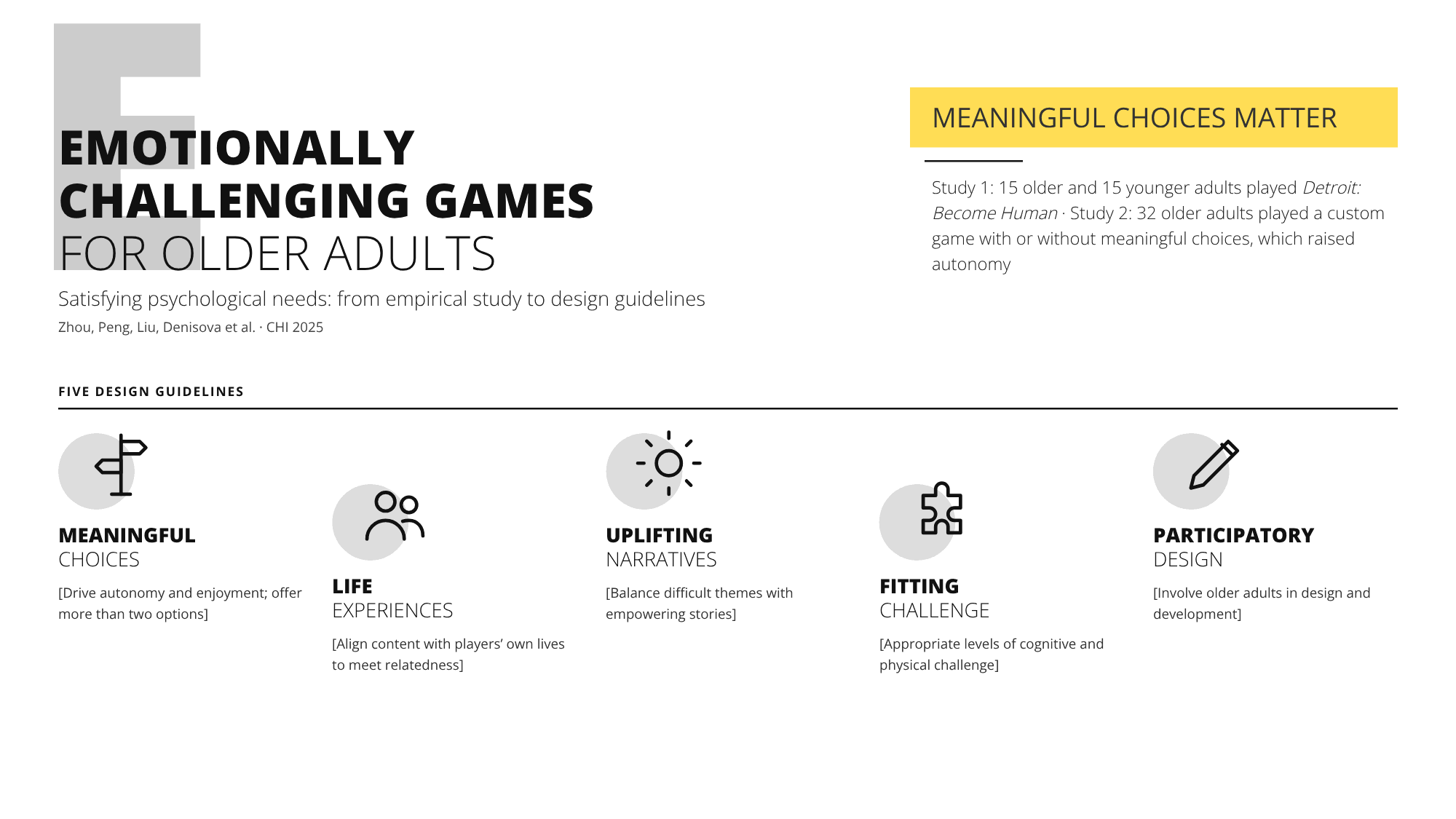
Five design guidelines for emotionally challenging games for older adults: meaningful choices, life experiences, uplifting narratives, fitting challenge and participatory design.

ConferenceCORE conference ranking: CORE A*2025 · Proceedings of the 2025 CHI Conference on Human Factors in Computing Systems (CHI'25)

Emotionally Challenging Games Can Satisfy Older Adults' Psychological Needs: From Empirical Study to Design Guidelines

Zhou, M., Peng, X., Liu, B., Denisova, A., Barathi, S. C., Li, Z., Xie, X., Huang, J., & Tian, F.

Retirement and living alone can make it harder for older adults to meet their psychological needs. We studied whether emotionally challenging games could help, first with a commercial game (Detroit: Become Human) and then with a game scenario designed for older adults.

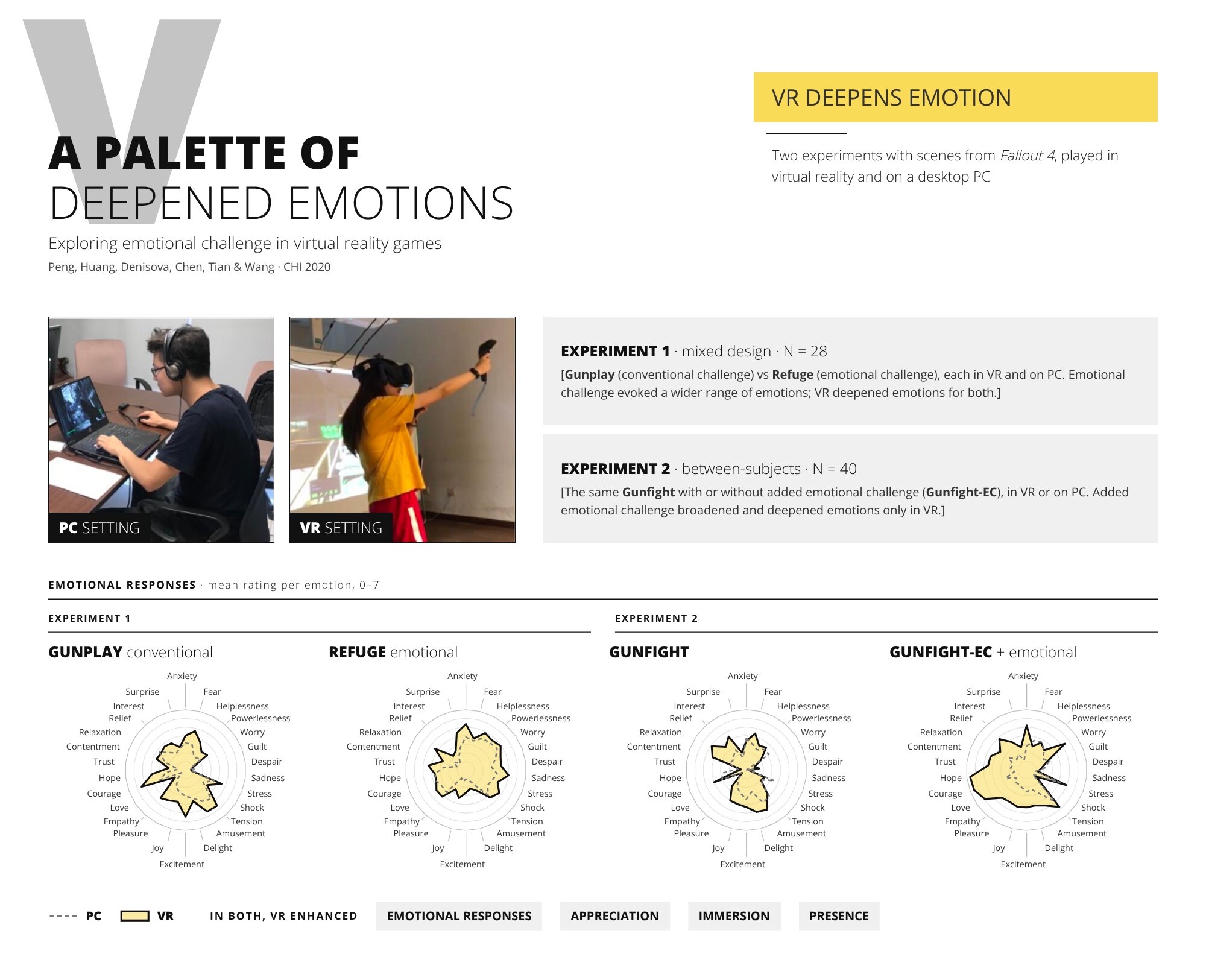
Teaser figure: A palette of deepened emotions. Photos of a participant playing on a PC and another in VR. Experiment 1 (N = 28) compared conventional and emotional challenge in Fallout 4 scenes; Experiment 2 (N = 40) added emotional challenge to the same scene. Radar charts of 24 emotions show VR enhanced emotional responses, appreciation, immersion and presence.

ConferenceCORE conference ranking: CORE A*2020 · Proceedings of the 2020 CHI Conference on Human Factors in Computing Systems (CHI'20)

A Palette of Deepened Emotions: Exploring Emotional Challenge in Virtual Reality Games

Peng, X., Huang, J., Denisova, A., Chen, H., Tian, F., & Wang, H.

Emotional challenge asks players to deal with difficult emotions rather than difficult gameplay. Across two experiments we compared emotional challenge, alone and combined with conventional challenge, in virtual reality and on a PC.

Themes:

Other publications

  • The Second Workshop on Eudaimonia in Digital Games Workshop Cole, T., Denisova, A., & Iacovides, J. · 2024 · Proceedings of the Foundations of Digital Games (FDG'24)
  • The First Workshop on Eudaimonia in Digital Games Workshop Cole, T., Denisova, A., & Iacovides, J. · 2023 · Proceedings of the Foundations of Digital Games (FDG'23)

Also relevant

Papers whose main theme is elsewhere but which also contribute here.