The Basic Needs in Games Scale (BANGS): A new tool for investigating positive and negative video game experiences
JournalCORE journal ranking: CORE AInternational Journal of Human-Computer Studies, 2024
In short
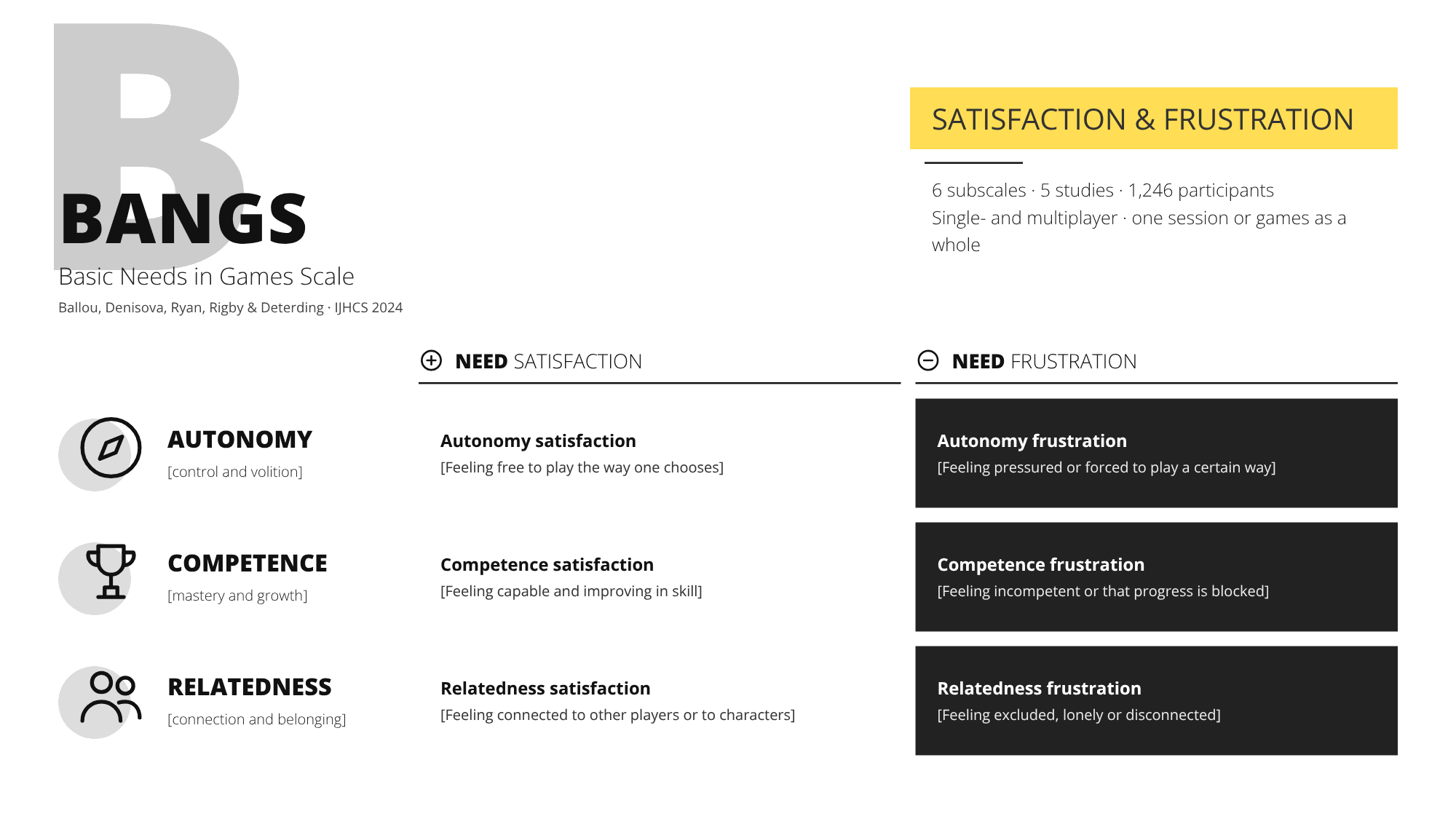
Existing measures of players' basic psychological needs often ignore need frustration and struggle to capture relatedness in single-player games. The Basic Needs in Games Scale (BANGS) measures both satisfaction and frustration of autonomy, competence and relatedness in games.
Key findings
- Six subscales, developed and validated across five studies with 1,246 participants.
- Results supported the scale's structure and showed discriminant, convergent and criterion validity.
- The scale works for a single session or many, and measures consistently over time.
BANGS · 18 items · 6 subscales
The questionnaire
Basic Needs in Games Scale (BANGS). Measures satisfaction and frustration of autonomy, competence and relatedness in games, for one session, one game over time, or gaming in general. Please cite the paper when you use it.
For one particular game, type its name, for example “Hades”. The items, copies and downloads update to match.
What do these give me?
- Copy items: just the statements, one per line, ready to paste into any survey tool.
- Copy everything or Download text: the full questionnaire with instructions, scale, scoring and citation.
- Download CSV: one row per item with its ID, subscale and whether it is reverse-scored. Opens in Excel, R or Python and helps with scoring.
- Qualtrics import: a file in Qualtrics' Advanced Format. In Qualtrics, choose Tools → Import/Export → Import survey. The items arrive as one matrix question; turn on statement randomisation if you want random order.
How to use it
- Replace [X] to fit what you are asking about: “the game” for a single session, “the games I played” for gaming in general, or the game's name (for example, piped in from an earlier question) for one game over time.
- Introduce the items with: “Below, we ask you about experiences of [X]. In [X]...”, where [X] describes the context, for example “the gaming session you described”, “gaming in general over the past 2 weeks”, or the name of the game.
- Present the items in random order, as in the validation studies.
- Use a 7-point agreement scale with the anchors 1 Strongly disagree, 4 Neither agree nor disagree and 7 Strongly agree.
Instructions for players
Below, we ask you about experiences of [X]. In [X]...
Response scale
- 1Strongly disagree
- 2
- 3
- 4Neither agree nor disagree
- 5
- 6
- 7Strongly agree
Items
Autonomy satisfaction 3 items
- bangs_01I could make choices regarding how to play [X].
- bangs_02I could play [X] in the way I wanted.
- bangs_03I could direct my own play experience in [X].
Autonomy frustration 3 items
- bangs_04I felt forced to take certain actions in [X].
- bangs_05Many actions in [X] were boring.
- bangs_06I often found myself wishing I could do something else within [X].
Competence satisfaction 3 items
- bangs_07I felt I was getting better at playing [X].
- bangs_08I felt that I made progress while playing [X].
- bangs_09I felt a sense of achievement while playing [X].
Competence frustration 3 items
- bangs_10I often felt that I lacked the skills necessary for [X].
- bangs_11I kept failing to accomplish what I wanted to while playing [X].
- bangs_12I felt disappointed with my performance in [X].
Relatedness satisfaction 3 items
- bangs_13I felt I formed relationships with other players and/or characters in [X].
- bangs_14Engaging with [X], I felt a connection to others, virtual or real.
- bangs_15I felt that other players and/or characters in [X] cared about me.
Relatedness frustration 3 items
- bangs_16Interactions with other players and/or characters in [X] felt toxic to me.
- bangs_17The community or virtual world in [X] made me feel unwelcome.
- bangs_18Others in [X] were unfriendly towards me.
Scoring
- There are no reverse-scored items. Satisfaction and frustration are scored as separate subscales.
- Score each of the six subscales as the mean of its three items.
Things to know
- The autonomy frustration subscale had lower reliability than the others, so use it with caution, particularly when asking about one particular game.
- The relatedness items work for both single-player and multiplayer games, because they refer to other players and/or characters.
More
Read and cite
APA citation
Ballou, N., Denisova, A., Ryan, R., Rigby, C. S., & Deterding, S. (2024). The Basic Needs in Games Scale (BANGS): A new tool for investigating positive and negative video game experiences. International Journal of Human-Computer Studies, 188, 103289. https://doi.org/10.1016/j.ijhcs.2024.103289
- What We Talk About When We Talk About Agency: A Systematic Review of Agency in Video Games PDF of What We Talk About When We Talk About Agency: A Systematic Review of Agency in Video GamesPublisher's version of What We Talk About When We Talk About Agency: A Systematic Review of Agency in Video Games
- ChallengeDetect: Investigating the Potential of Detecting In-Game Challenge Experience from Physiological Measures PDF of ChallengeDetect: Investigating the Potential of Detecting In-Game Challenge Experience from Physiological MeasuresPublisher's version of ChallengeDetect: Investigating the Potential of Detecting In-Game Challenge Experience from Physiological Measures
- Comparing Measures of Perceived Challenge and Demand in Video Games: Exploring the Conceptual Dimensions of CORGIS and VGDS PDF of Comparing Measures of Perceived Challenge and Demand in Video Games: Exploring the Conceptual Dimensions of CORGIS and VGDSPublisher's version of Comparing Measures of Perceived Challenge and Demand in Video Games: Exploring the Conceptual Dimensions of CORGIS and VGDS