Measuring player experience

Questionnaires and mixed methods for measuring challenge, uncertainty, agency and players' needs.

Much of my work develops and validates questionnaires for video games, board games and tabletop role-playing games. These cover perceived challenge (CORGIS), perceived uncertainty (PUGS), and the satisfaction and frustration of players' basic needs (BANGS), as well as how different questionnaires overlap.

More recent work examines what agency means in games and how it differs from autonomy, and combines questionnaires with physiological measures to detect experiences such as challenge as they happen.

Papers

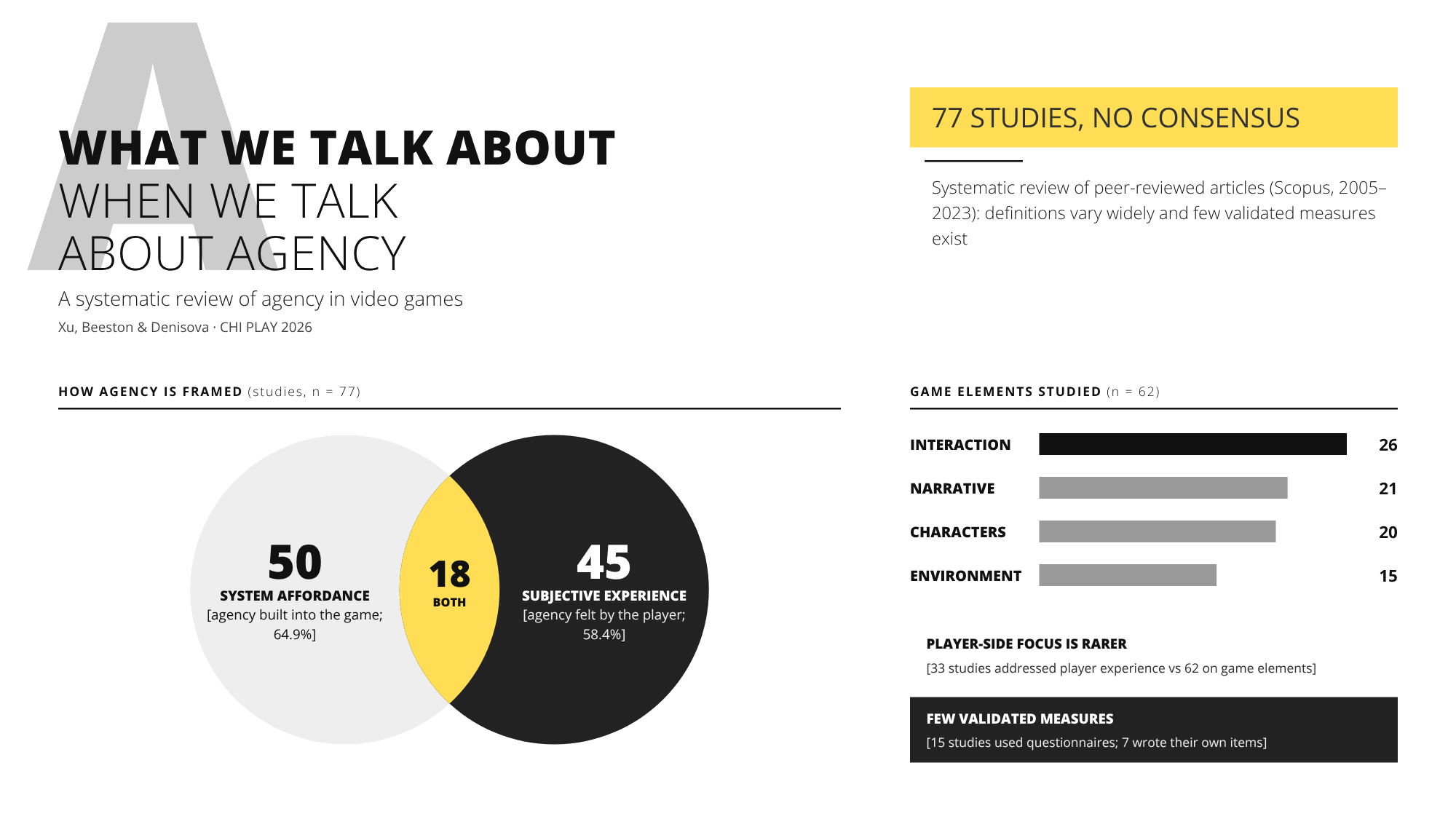
Teaser figure: What we talk about when we talk about agency. A Venn diagram of 77 studies shows 50 frame agency as a system affordance, 45 as a subjective experience, and 18 as both. Bar chart of game elements studied: interaction 26, narrative 21, characters 20, environment 15. Only 33 studies addressed player experience, and few used validated measures.

JournalSCImago Journal Rank: PACM HCI, first quartile: SJR Q12026 · Proceedings of the ACM on Human-Computer Interaction (CHI PLAY 2026)

What We Talk About When We Talk About Agency: A Systematic Review of Agency in Video Games
Xu, X., Beeston, J., & Denisova, A.

Agency, players' capacity to make meaningful choices and see their consequences, is widely discussed in games research but has no agreed definition. We systematically reviewed 79 peer-reviewed articles to map how agency in video games is defined and measured.

Themes:
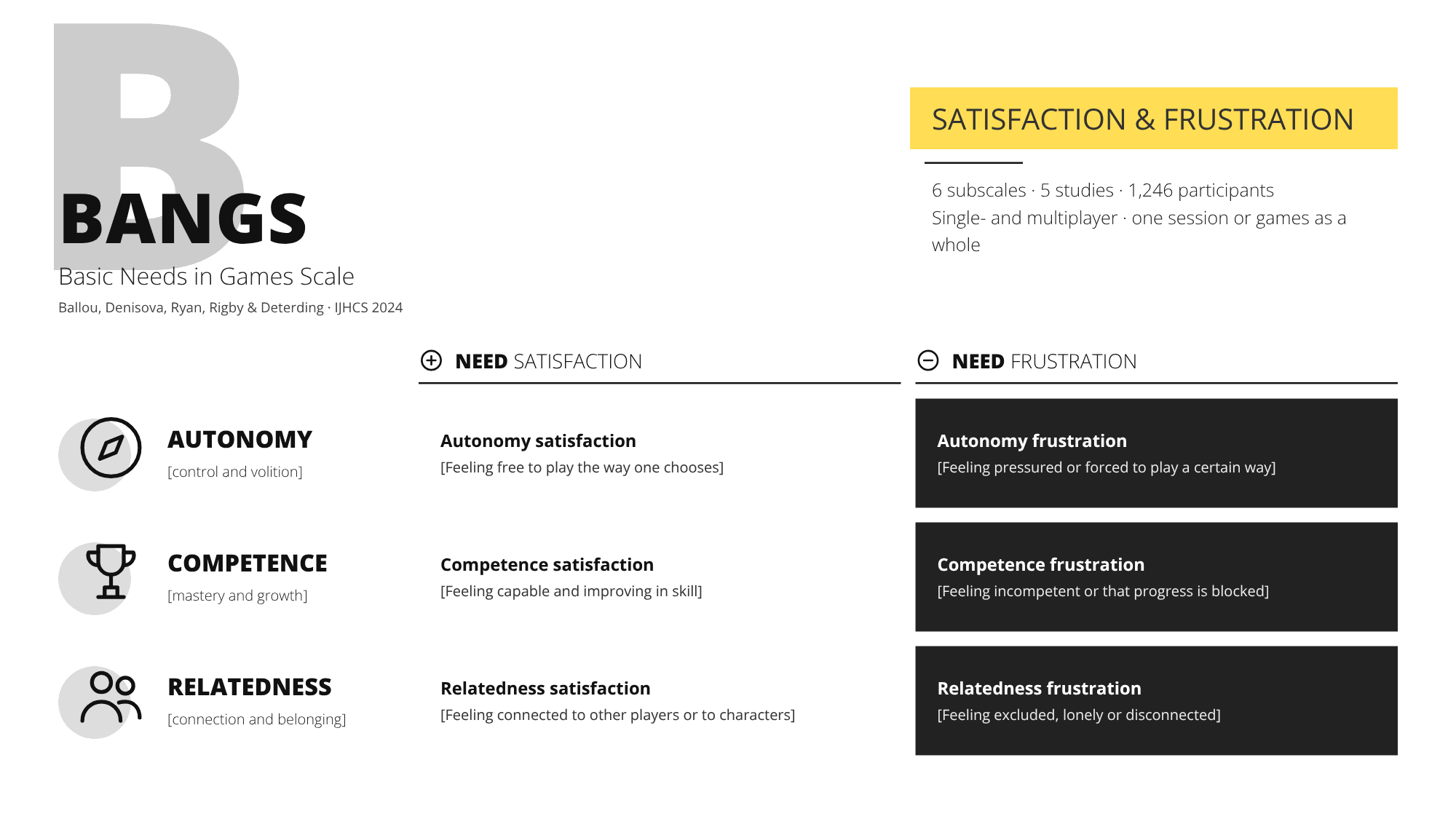
BANGS, the Basic Needs in Games Scale: six subscales measuring satisfaction and frustration of autonomy, competence and relatedness, validated across 5 studies with 1,246 participants.

JournalCORE journal ranking: CORE A2024 · International Journal of Human-Computer Studies

The Basic Needs in Games Scale (BANGS): A new tool for investigating positive and negative video game experiences

Ballou, N., Denisova, A., Ryan, R., Rigby, C. S., & Deterding, S.

Existing measures of players' basic psychological needs often ignore need frustration and struggle to capture relatedness in single-player games. The Basic Needs in Games Scale (BANGS) measures both satisfaction and frustration of autonomy, competence and relatedness in games.

Themes:
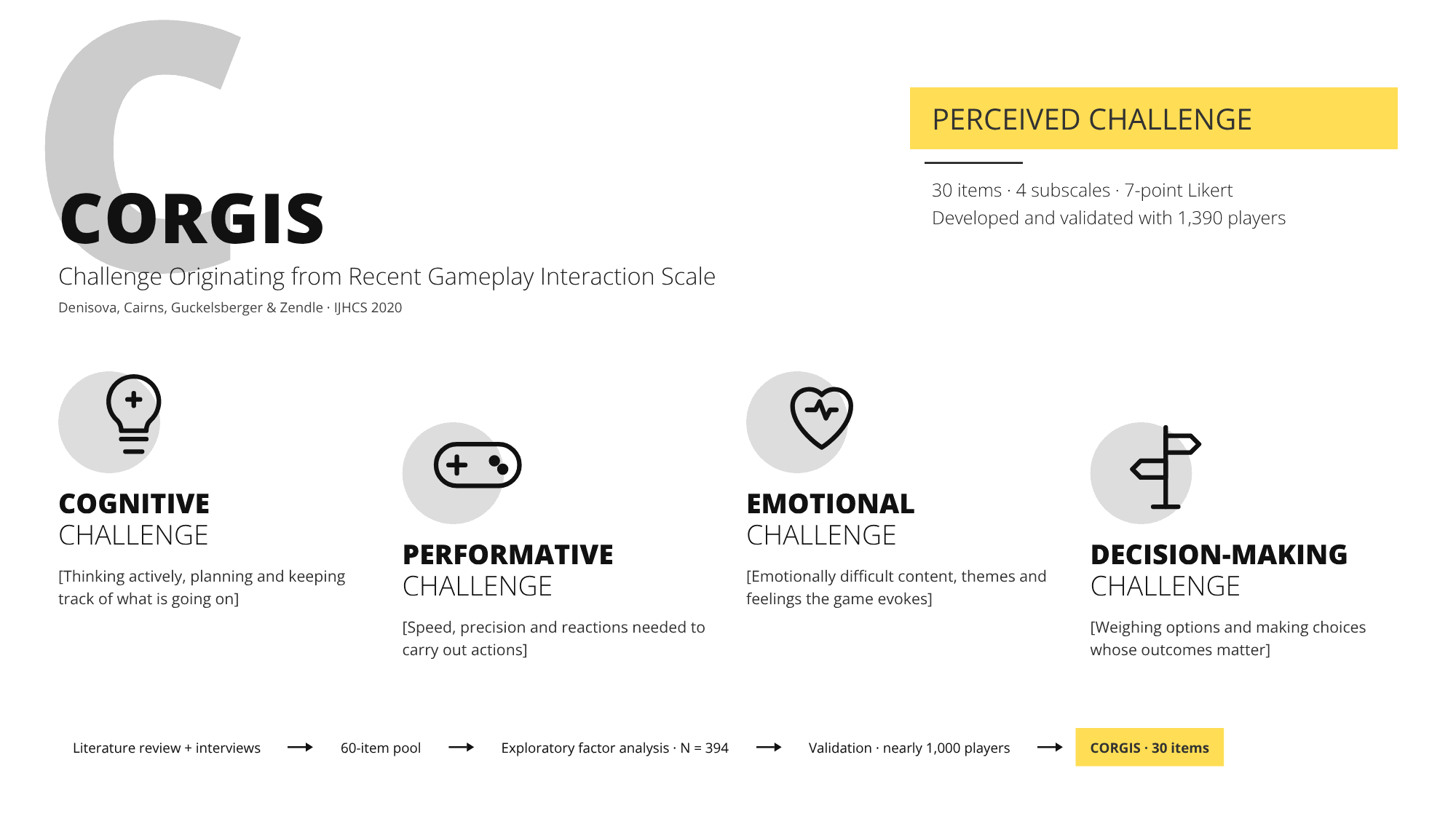
CORGIS, the Challenge Originating from Recent Gameplay Interaction Scale: 30 items measuring four kinds of perceived challenge (cognitive, performative, emotional and decision-making), developed from a literature review and interviews, a 60-item pool, factor analysis with 394 players and validation with nearly 1,000 players.

JournalCORE journal ranking: CORE A2020 · International Journal of Human-Computer Studies

Measuring Perceived Challenge in Digital Games: Development & Validation of the Challenge Originating from Recent Gameplay Interaction Scale (CORGIS)

Denisova, A., Cairns, P., Guckelsberger, C., & Zendle, D.

Players can find a game challenging in more ways than needing quick reflexes. This paper presents CORGIS, the Challenge Originating from Recent Gameplay Interaction Scale: a questionnaire that measures how challenging players found the game they just played. Its items came from a review of games user research, game design and game AI literature, and from interviews with researchers and players.

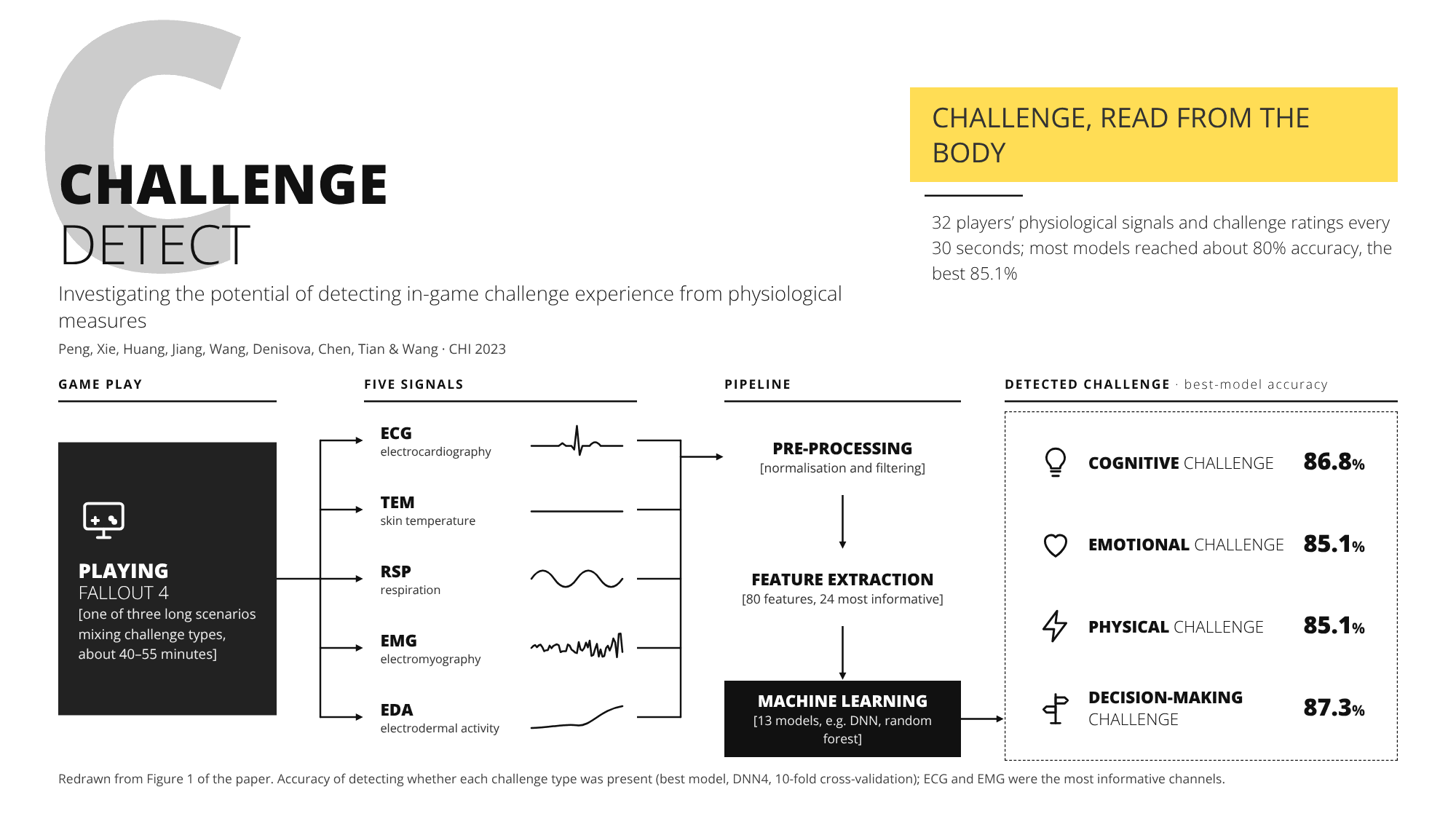
Teaser figure: ChallengeDetect. 32 players played Fallout 4 while five physiological signals were recorded (ECG, skin temperature, respiration, EMG and electrodermal activity). After pre-processing, feature extraction (80 features, 24 most informative) and machine learning (13 models), the best model detected cognitive challenge with 86.8% accuracy, emotional and physical challenge with 85.1%, and decision-making challenge with 87.3%.

ConferenceCORE conference ranking: CORE A*2023 · Proceedings of the 2023 CHI Conference on Human Factors in Computing Systems (CHI'23)

ChallengeDetect: Investigating the Potential of Detecting In-Game Challenge Experience from Physiological Measures

Peng, X., Xie, X., Huang, J., Jiang, C., Wang, H., Denisova, A., Chen, H., Tian, F., & Wang, H.

Questionnaires only capture challenge after play has ended. ChallengeDetect explores whether perceived challenge can instead be detected from players' physiological signals, moment to moment.

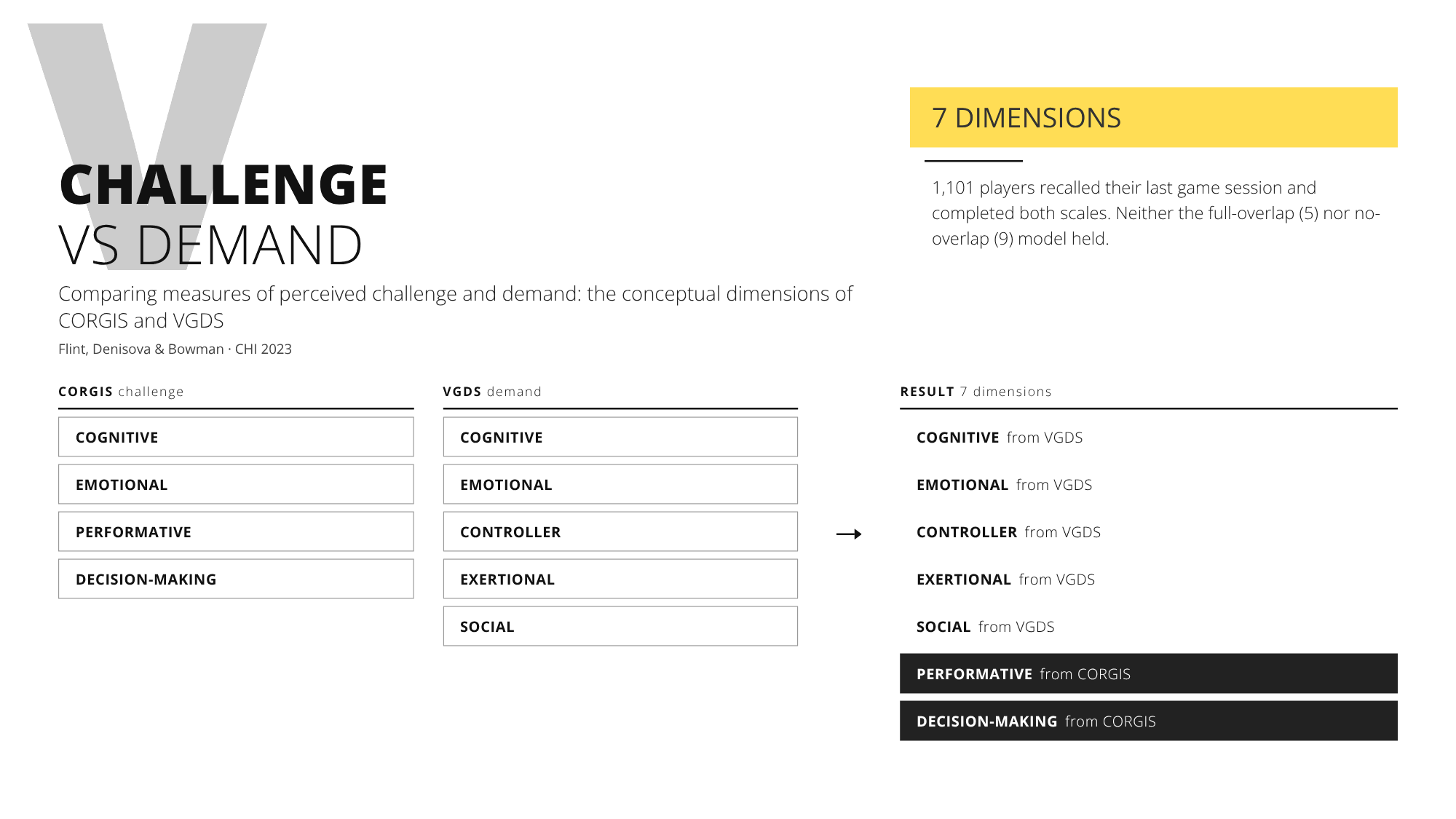
How the four CORGIS dimensions and five VGDS dimensions combine into seven: the five VGDS dimensions plus performative and decision-making challenge from CORGIS.
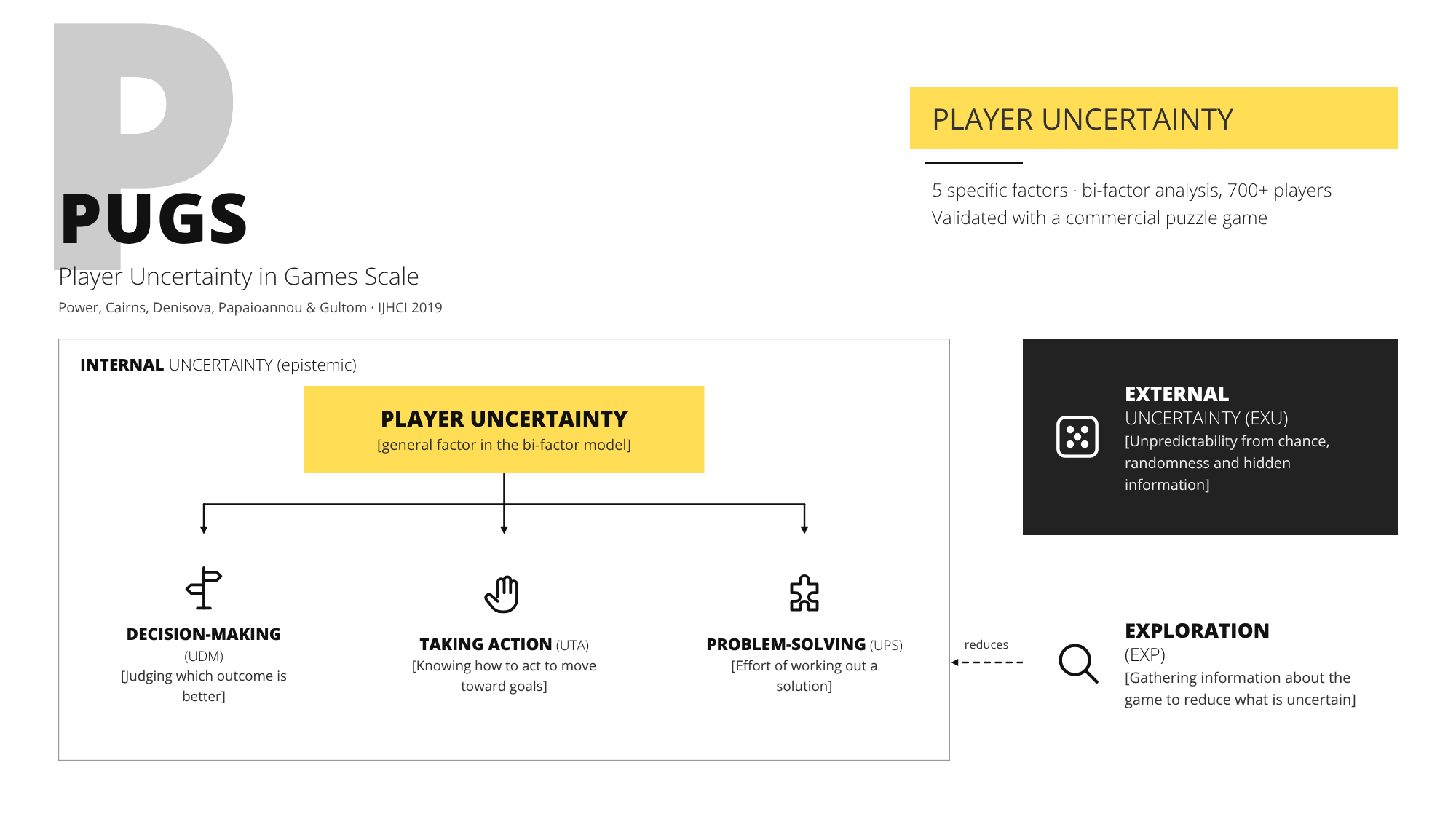
PUGS, the Player Uncertainty in Games Scale: a general player uncertainty factor with internal uncertainty about decision-making, taking action and problem-solving, plus external uncertainty and exploration, which reduces uncertainty.

Journal2019 · International Journal of Human–Computer Interaction

Lost at the Edge of Uncertainty: Measuring Player Uncertainty in Digital Games

Power, C., Cairns, P., Denisova, A., Papaioannou, T., & Gultom, R.

Uncertainty makes games engaging, but it can feel good or bad, and there was no way to measure it. Using survey data from over 700 players, we developed a questionnaire of how players experience uncertainty and validated it with a commercial puzzle game.

Themes:

Short papers

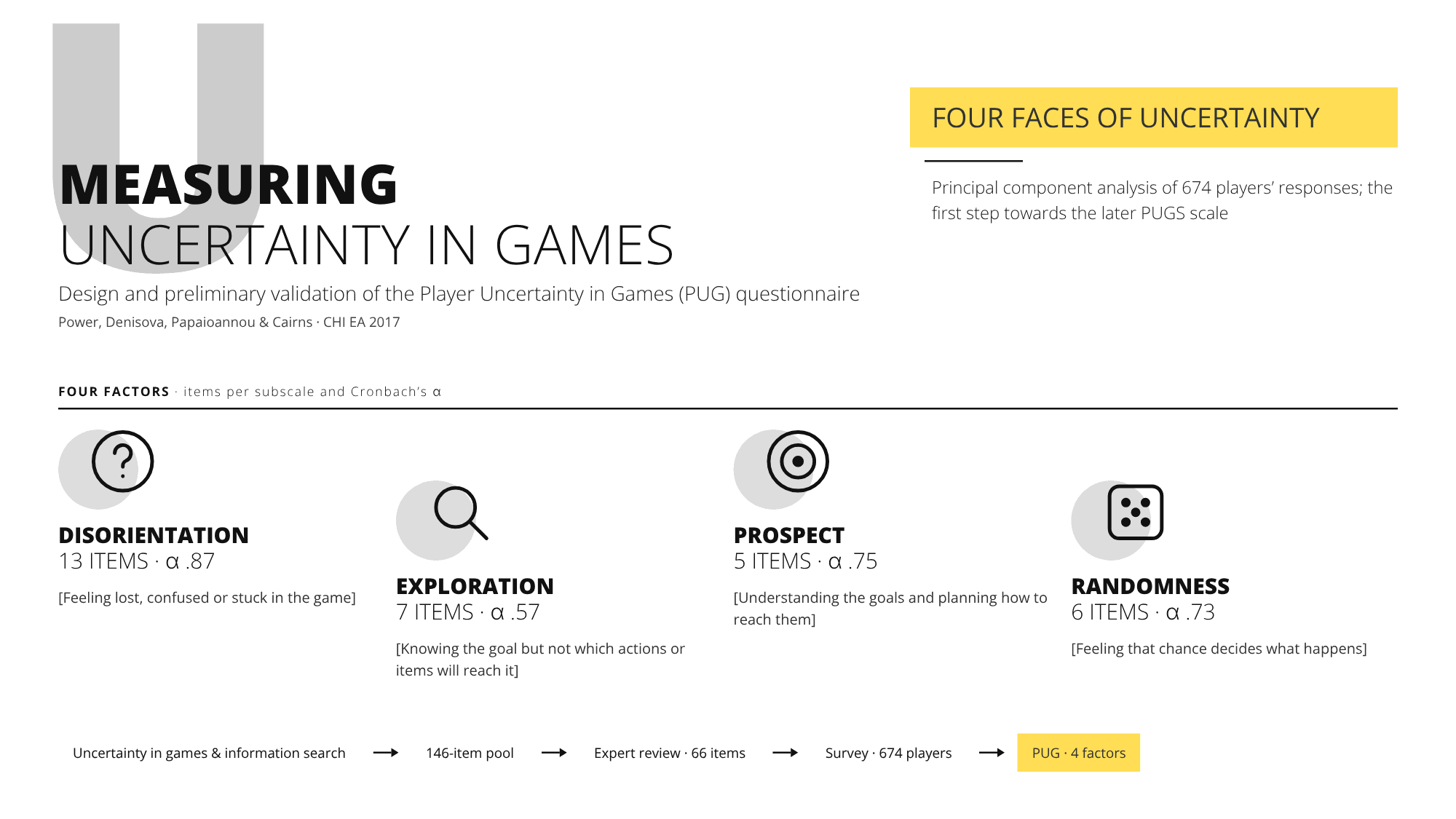
Teaser figure: the four factors of the PUG questionnaire (disorientation, exploration, prospect and randomness) with item counts and reliability, and the development steps from a 146-item pool to a survey of 674 players.

ConferenceShort paper 2017 · Extended Abstracts of the 2017 CHI Conference on Human Factors in Computing Systems (CHI EA'17)

Measuring Uncertainty in Games: Design and Preliminary Validation

Power, C., Denisova, A., Papaioannou, T., & Cairns, P.

An early version of the uncertainty questionnaire that became PUGS. The 66-item scale, refined through player interviews and expert review and tested in an online survey, showed four factors: disorientation, exploration, prospect and randomness.

Themes:
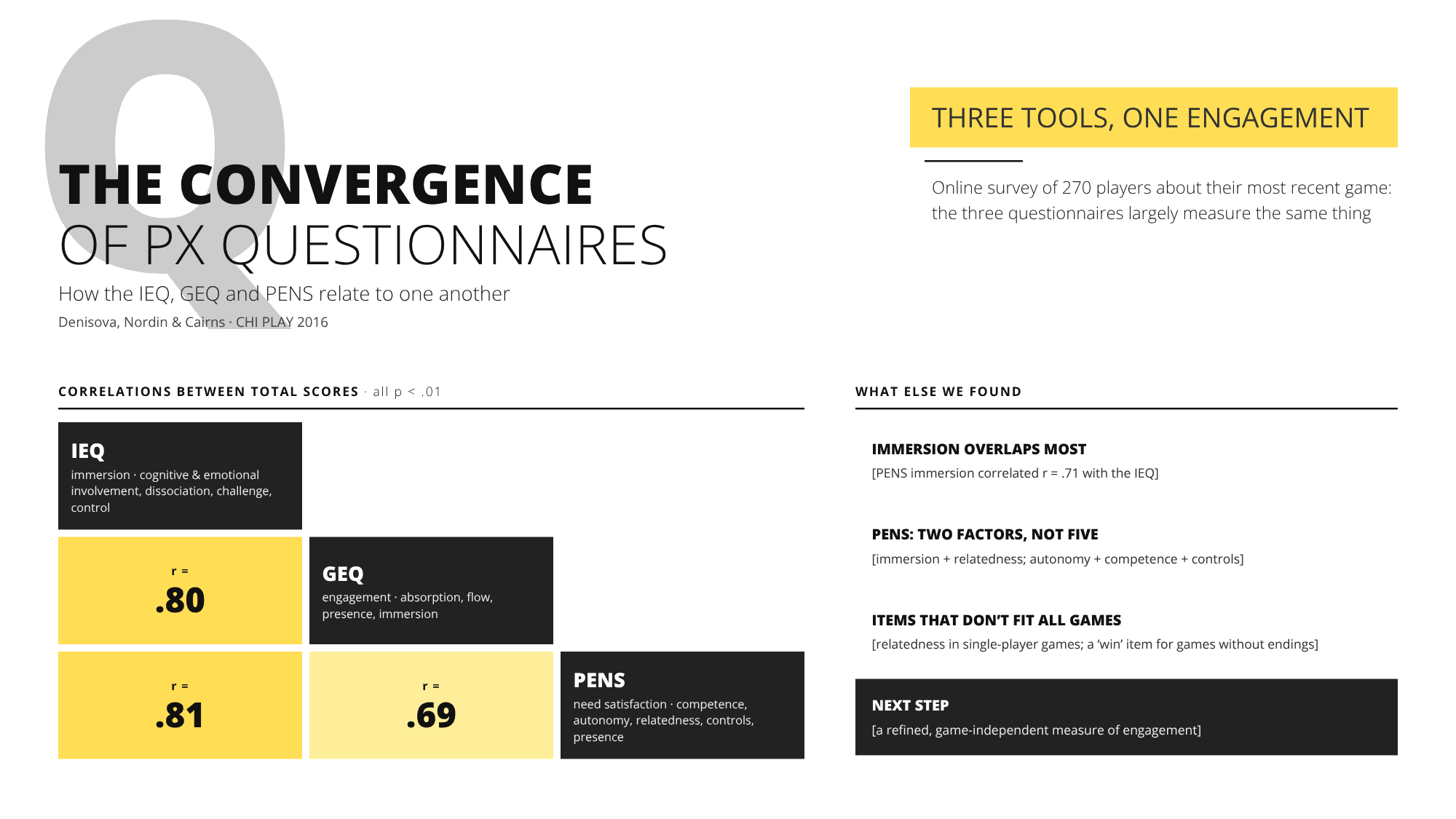
Teaser figure: correlations between total scores on the IEQ, GEQ and PENS (r = .80, .81 and .69) from 270 players, with further findings on overlapping immersion items and PENS loading on two factors.

ConferenceShort paper 2016 · Proceedings of the Annual Symposium on Computer-Human Interaction in Play (CHI PLAY'16)

The Convergence of Player Experience Questionnaires

Denisova, A., Nordin, A. I., & Cairns, P.

Compares three widely used player experience questionnaires (IEQ, GEQ and PENS) using 270 players' reports of their most recent game. The three overlap considerably, leaving room to refine them into one broader measure of game engagement.

Themes:
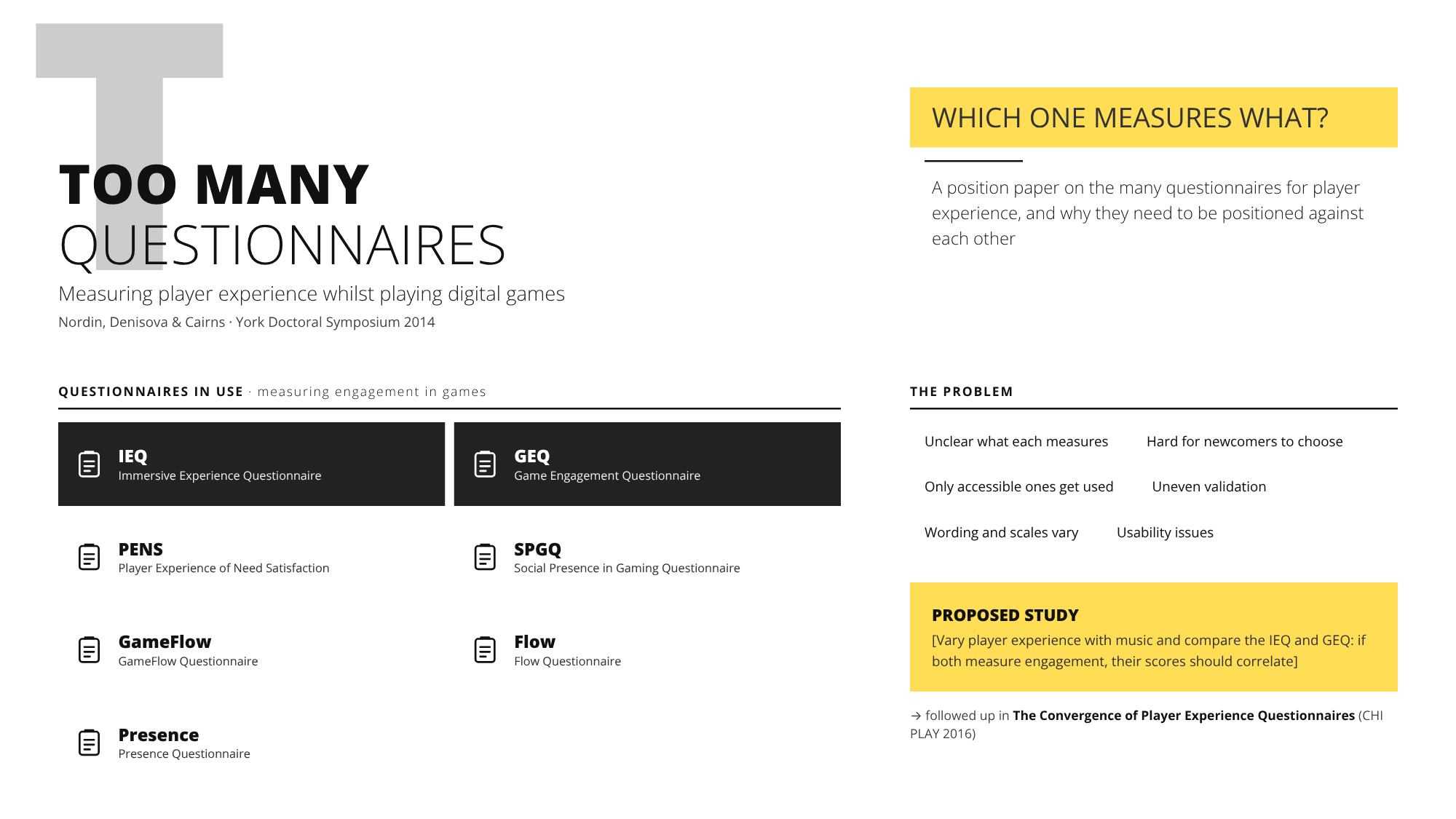
Teaser figure: seven questionnaires used to measure engagement in games (IEQ, GEQ, PENS, SPGQ, GameFlow, Flow, Presence), the problems this causes, and a proposed study comparing the IEQ and GEQ.

ConferenceShort paper 2014 · The 7th York Doctoral Symposium on Computer Science and Electronics

Too Many Questionnaires: Measuring Player Experience Whilst Playing Digital Games

Nordin, A. I., Denisova, A., & Cairns, P.

Lists the questionnaires available for measuring engagement in digital games and argues that they need to be positioned against each other, so researchers know which aspect of experience each one measures.

Themes:

Also relevant

Papers whose main theme is elsewhere but which also contribute here.