Proactive or Reactive? Comparison of Dynamic Difficulty Adjustment Effects on Player Experience and Physical Effort in a Running Exergame
ConferenceIEEE Conference on Games (CoG'26), 2026
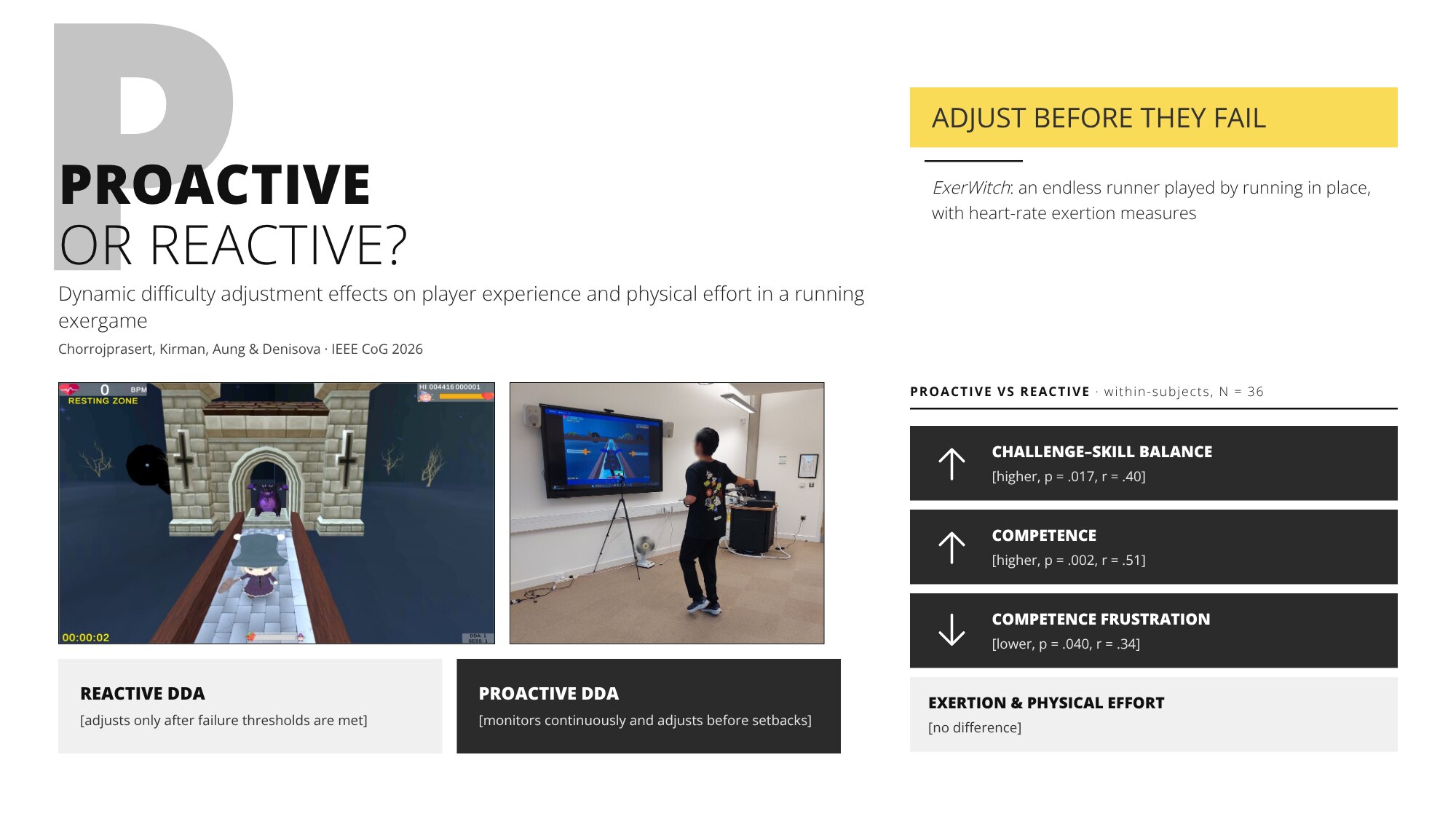
In short
Compares proactive and reactive dynamic difficulty adjustment in a running exergame, looking at the effects on player experience and on players' physical effort.
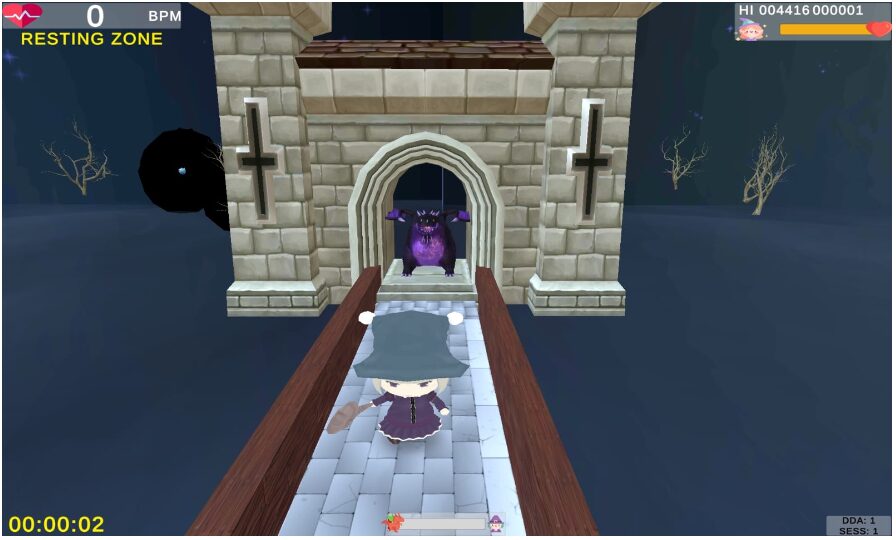
Meet “ExerWitch”
A custom indoor running exergame: players run in place to keep the witch ahead of the dragon.
Reactive and proactive adjustment
In “ExerWitch”, players run in place to escape a chasing dragon. Both versions adjust the dragon’s speed, but differ in when they step in.
Schematic illustration of the two rules described in the paper, not study data. In both versions the dragon’s speed is reset when it moves back.
| Aspect | Reactive | Proactive |
|---|---|---|
| Trigger | Setback (2 collisions) | Proximity (distance ≤ 2) |
| Timing | Post-failure | Pre-failure |
| Impact | Punishment (forced avatar stop) | No punishment |
| Goal | Failure-driven | Anticipatory |
Key findings
- Compared with reactive difficulty adjustment, proactive adjustment improved challenge–skill balance (p = .017, r = .40) and perceived competence (p = .002, r = .51).
- Proactive adjustment reduced competence frustration (p = .040, r = .34).
- There were no significant differences in perceived exertion or physical effort, suggesting proactive adjustment may sustain engagement by reducing frustration without changing how hard people work.
Don’t just ask how to adapt: ask when
From my CoG 2026 talk
Timing is a design variable
“Proactive (predictive) and reactive (retrospective) DDA are not interchangeable. The trigger point shapes how players experience challenge and competence.”
Failure is not required to sustain effort
“Preventing setbacks did not reduce heart rate or perceived exertion. Players still worked just as hard.”
Match the trigger to what failure demands
“If failure mainly asks for more physical output, intervene early. If failure opens strategic alternatives, reacting after failure may remain appropriate.”
Design the DDA trigger around the type of challenge
From my CoG 2026 talk
Proactive DDA is not always better: its value depends on what failure asks the player to do.
When physical effort is the main way to overcome failure
Proactive DDA is more beneficial
“Prevents repeated setbacks, preserves movement continuity, supports competence, reduces punishment-recovery cycles. Best fit: locomotion-heavy exergames like “ExerWitch”.”
When players have other ways to respond
Reactive DDA can still work well
“Failure provides diagnostic feedback, enables strategy change and learning, recovery need not rely on physical output, maintains meaningful risk and tension. Examples: rhythm games, adventure games with puzzles, team sports games.”
Read and cite
APA citation
Chorrojprasert, S., Kirman, B., Aung, M., & Denisova, A. (2026). Proactive or Reactive? Comparison of Dynamic Difficulty Adjustment Effects on Player Experience and Physical Effort in a Running Exergame. In IEEE Conference on Games (CoG'26).
Line of work
- Builds on · 2025Exploring the Effects of Dynamic Difficulty Adjustment Functions on Player Experience and Physical Effort in a Running Exergame
- This paper · 2026Proactive or Reactive? Comparison of Dynamic Difficulty Adjustment Effects on Player Experience and Physical Effort in a Running Exergame
- The Challenge of Evaluating Player Experience in Tabletop Role-Playing Games PDF of The Challenge of Evaluating Player Experience in Tabletop Role-Playing GamesPublisher's version of The Challenge of Evaluating Player Experience in Tabletop Role-Playing Games
- Keep Calm and Aim for the Head: Biofeedback-Controlled Dynamic Difficulty Adjustment in a Horror Game PDF of Keep Calm and Aim for the Head: Biofeedback-Controlled Dynamic Difficulty Adjustment in a Horror GamePublisher's version of Keep Calm and Aim for the Head: Biofeedback-Controlled Dynamic Difficulty Adjustment in a Horror Game
- Challenge in Digital Games: Towards Developing a Measurement Tool PDF of Challenge in Digital Games: Towards Developing a Measurement ToolPublisher's version of Challenge in Digital Games: Towards Developing a Measurement Tool