Challenge in Digital Games: Towards Developing a Measurement Tool
ConferenceExtended Abstracts of the 2017 CHI Conference on Human Factors in Computing Systems (CHI EA'17), 2017
In short
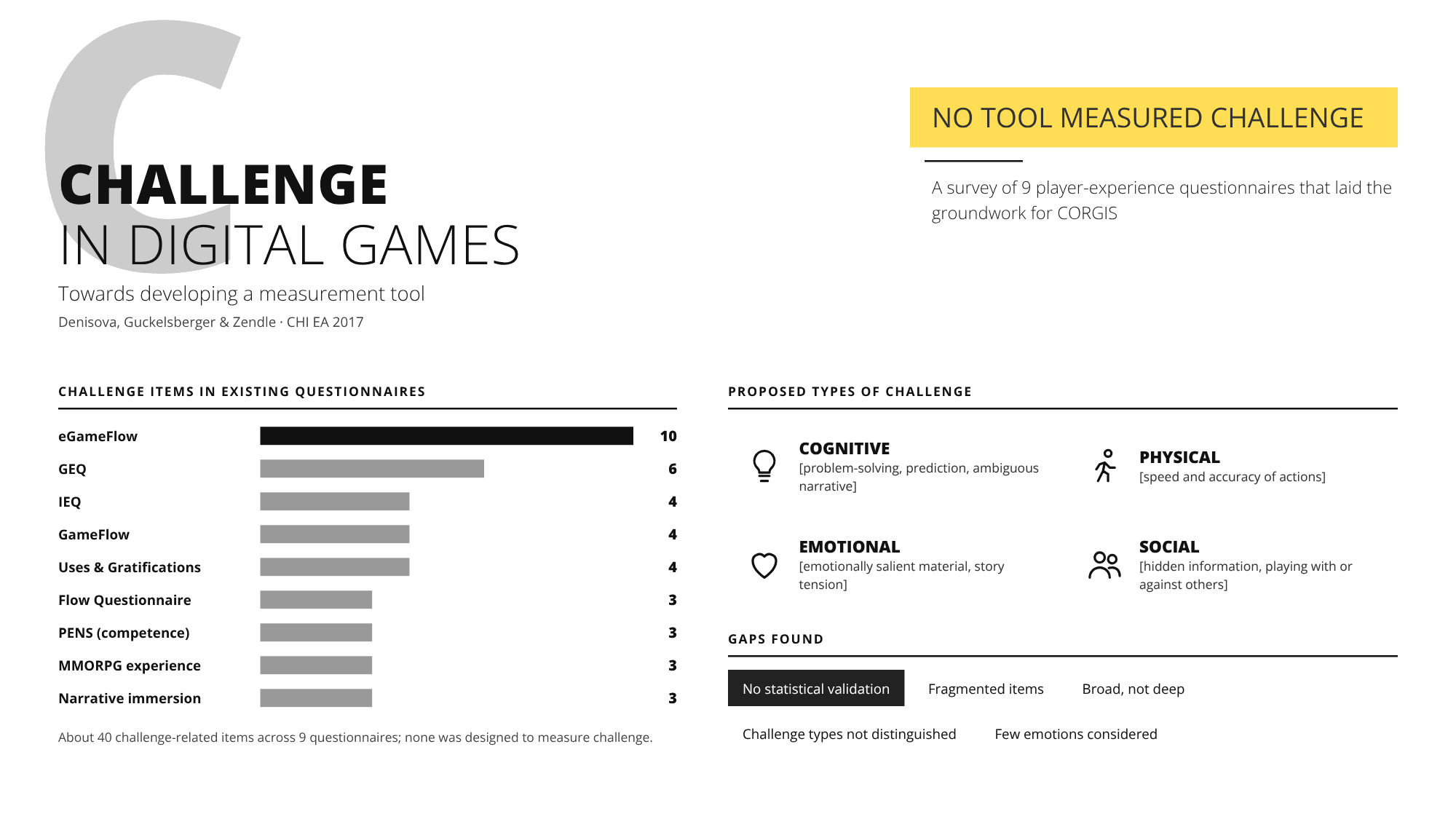
Challenge is arguably the experience players most seek in games, yet there was no reliable way to measure how challenged they feel. We surveyed definitions and types of challenge, and the items existing player experience questionnaires use to capture it, drawing on game design, HCI and game AI.
Types of challenge
The challenge types the review draws on, in the paper’s words.
Cognitive
“Challenge that addresses the player’s cognitive and problem-solving capacities.”
Physical
“Physical challenges address a player’s abilities with regards to the speed and accuracy with which they perform actions in games.”
Emotional
“Challenge which confronts the player with emotionally salient material or the use of strong characters, and a captivating story.”
What existing questionnaires miss
Despite addressing the very general properties of challenge, the questionnaires lack depth.
Discussion of Table 1
Most importantly, different types of challenge are not distinguished, in particular not emotional and social challenge.
Discussion of Table 1
A player cannot overcome emotional challenge with skill or dexterity, but by resolving tension in the narrative, by identifying with characters, and by resolving ambiguities.
On emotional challenge
Key findings
- About 40 challenge-related items appear across nine existing questionnaires, but none of them was designed to measure challenge.
- The literature points to several distinct types of challenge, including cognitive, physical (performative), emotional and social challenge.
- Existing items are fragmented, broad rather than deep, and mostly not statistically validated: the groundwork that led to CORGIS.
Read and cite
APA citation
Denisova, A., Guckelsberger, C., & Zendle, D. (2017, May). Challenge in Digital Games: Towards Developing a Measurement Tool. In Extended Abstracts of the 2017 CHI Conference on Human Factors in Computing Systems (CHI EA'17) (pp. 2511-2519).
Line of work
- This paper · 2017Challenge in Digital Games: Towards Developing a Measurement Tool
- Followed by · 2020Measuring Perceived Challenge in Digital Games: Development & Validation of the Challenge Originating from Recent Gameplay Interaction Scale (CORGIS)
- ChallengeDetect: Investigating the Potential of Detecting In-Game Challenge Experience from Physiological Measures PDF of ChallengeDetect: Investigating the Potential of Detecting In-Game Challenge Experience from Physiological MeasuresPublisher's version of ChallengeDetect: Investigating the Potential of Detecting In-Game Challenge Experience from Physiological Measures
- Comparing Measures of Perceived Challenge and Demand in Video Games: Exploring the Conceptual Dimensions of CORGIS and VGDS PDF of Comparing Measures of Perceived Challenge and Demand in Video Games: Exploring the Conceptual Dimensions of CORGIS and VGDSPublisher's version of Comparing Measures of Perceived Challenge and Demand in Video Games: Exploring the Conceptual Dimensions of CORGIS and VGDS
- The Challenge of Evaluating Player Experience in Tabletop Role-Playing Games PDF of The Challenge of Evaluating Player Experience in Tabletop Role-Playing GamesPublisher's version of The Challenge of Evaluating Player Experience in Tabletop Role-Playing Games