The Convergence of Player Experience Questionnaires
ConferenceProceedings of the Annual Symposium on Computer-Human Interaction in Play (CHI PLAY'16), 2016
In short
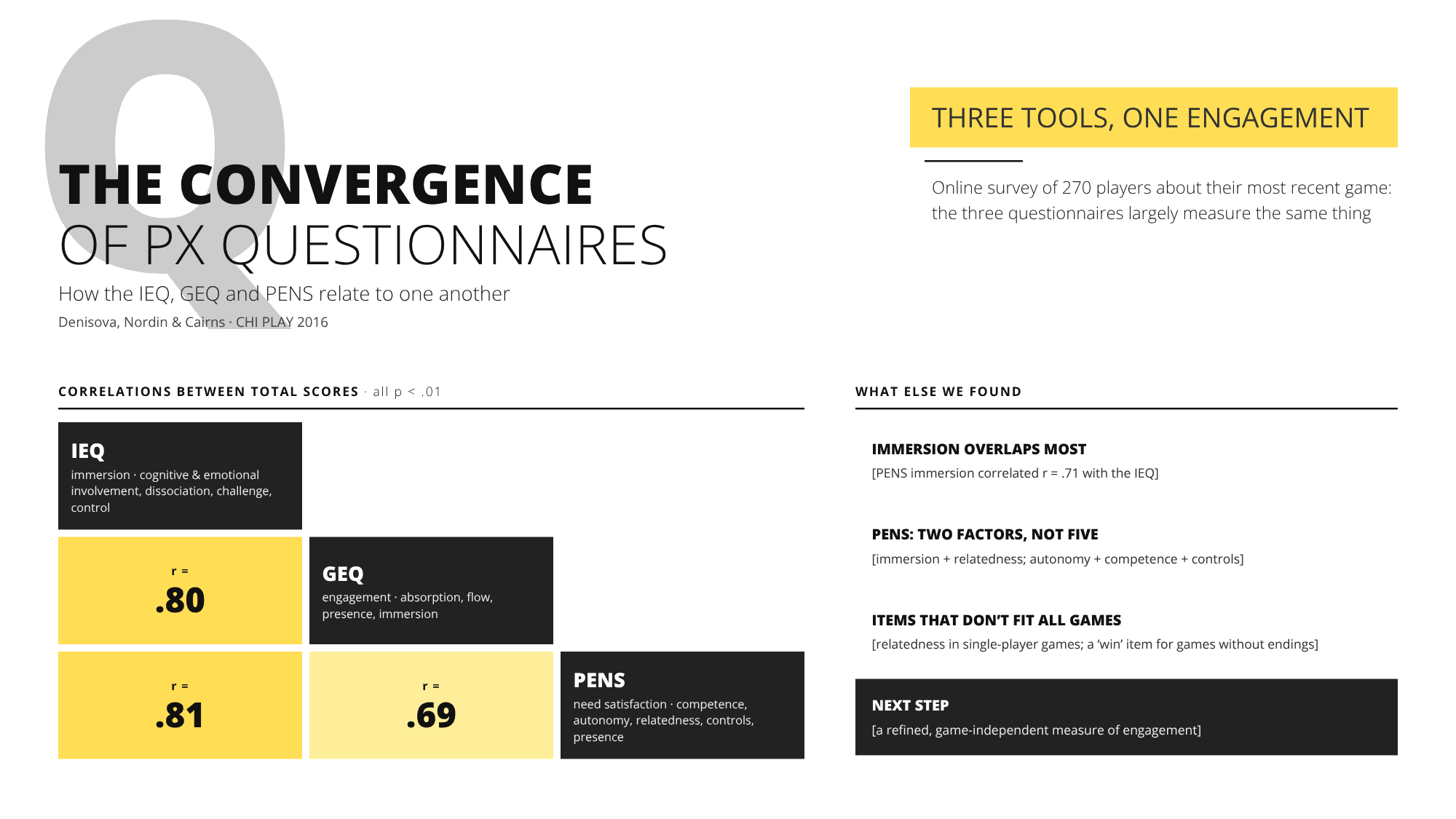
Many questionnaires measure player experience, which makes it hard to choose between them or compare studies. We compared three widely used ones, the Immersive Experience Questionnaire (IEQ), the Game Engagement Questionnaire (GEQ) and the Player Experience of Need Satisfaction (PENS), using an online survey of 270 players about their most recent game.
How the study worked
- Participants
- 270 valid responses (287 respondents), from 32 countries
- Task
- Reflect on their most recent experience of playing a digital game
- Questionnaires
- IEQ, GEQ and PENS combined into one online survey, all items as present-tense statements on a 7-point scale
- Recruitment
- Online forums such as the Steam Users’ Forum, Twitter and relevant Facebook groups
Items that did not fit every game
The three questionnaires were merged into one, with every item rephrased as a statement: for example, the IEQ question “To what extent did you find the game easy?” became “I find the game easy”.
| Questionnaire | Item | Why it was a problem |
|---|---|---|
| PENS | Relationships with other players | As many single-player games do not provide opportunities for this experience, this question was viewed as confusing. |
| IEQ | Wanting to “win” the game | Not all games have a clear ending. |
| GEQ | “I feel scared” | Does not necessarily apply to many games. |
| GEQ | “I feel different” and “Things seem to happen automatically” | Vaguely phrased questions … provided too many opportunities for interpretation. |
The appeal of it isn’t like Skyrim or The Witcher in the sense I want to be immersed in another world but more of the sense you get when you play a sport.
A League of Legends player
Key findings
- Total scores on the three questionnaires were highly correlated (IEQ–GEQ r = .80), suggesting that immersion and engagement address the same underlying experience.
- The PENS immersion items overlapped most with the other two questionnaires, and the PENS subscales grouped into two factors rather than five.
- Some items do not fit every game, such as relatedness in single-player games, leaving room for a refined, game-independent measure of engagement.
Read and cite
APA citation
Denisova, A., Nordin, A. I., & Cairns, P. (2016). The Convergence of Player Experience Questionnaires. In Proceedings of the Annual Symposium on Computer-Human Interaction in Play (CHI PLAY'16) (pp. 33-37). https://doi.org/10.1145/2967934.2968095
- What We Talk About When We Talk About Agency: A Systematic Review of Agency in Video Games PDF of What We Talk About When We Talk About Agency: A Systematic Review of Agency in Video GamesPublisher's version of What We Talk About When We Talk About Agency: A Systematic Review of Agency in Video Games
- The Basic Needs in Games Scale (BANGS): A new tool for investigating positive and negative video game experiences PDF of The Basic Needs in Games Scale (BANGS): A new tool for investigating positive and negative video game experiencesPublisher's version of The Basic Needs in Games Scale (BANGS): A new tool for investigating positive and negative video game experiences
- ChallengeDetect: Investigating the Potential of Detecting In-Game Challenge Experience from Physiological Measures PDF of ChallengeDetect: Investigating the Potential of Detecting In-Game Challenge Experience from Physiological MeasuresPublisher's version of ChallengeDetect: Investigating the Potential of Detecting In-Game Challenge Experience from Physiological Measures