Measuring Uncertainty in Games: Design and Preliminary Validation
ConferenceExtended Abstracts of the 2017 CHI Conference on Human Factors in Computing Systems (CHI EA'17), 2017
In short
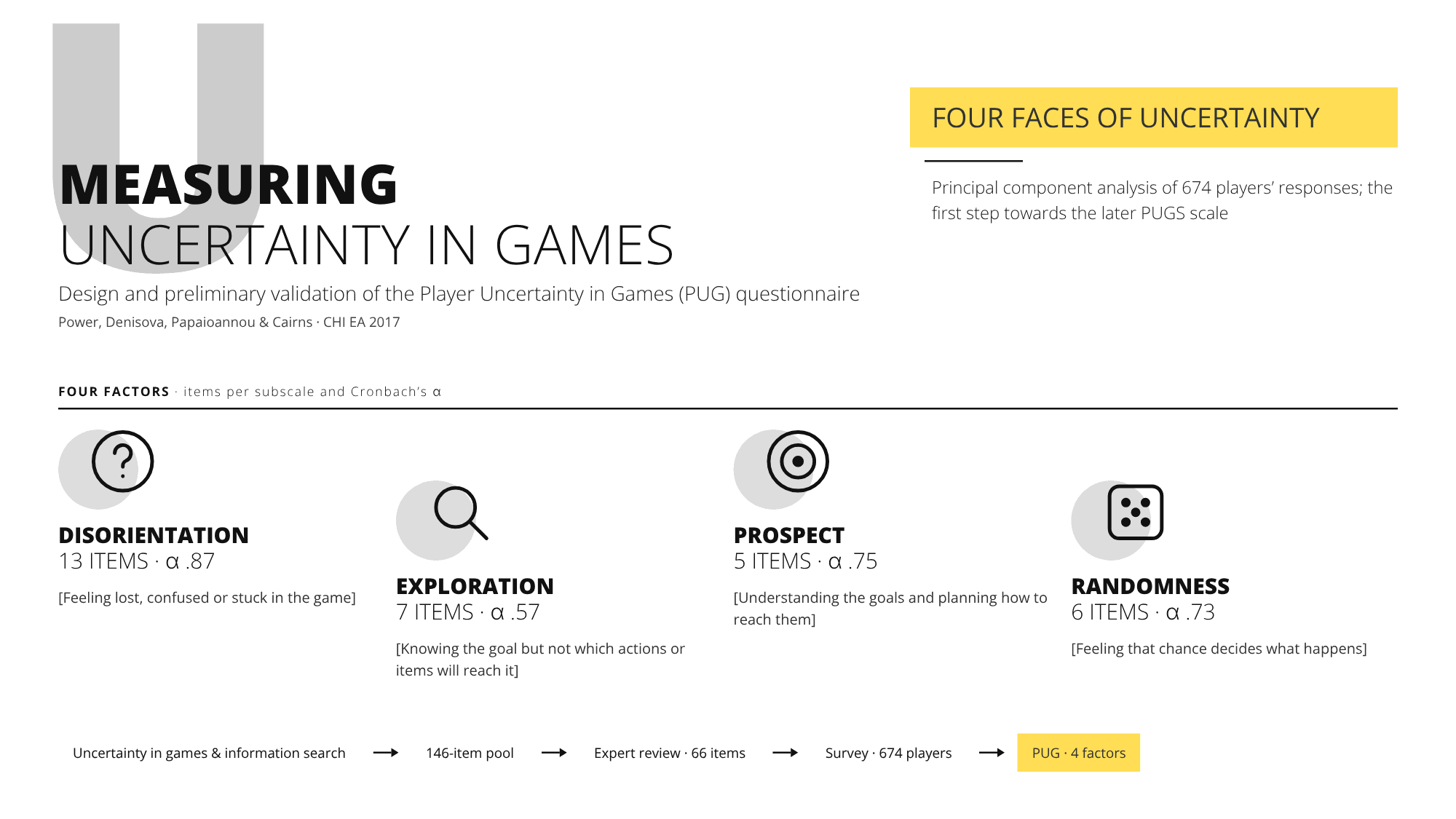
Uncertainty is widely seen as a precondition for good player experience, but it could not be measured. We designed the Player Uncertainty in Games (PUG) questionnaire from games research and work on information search, refined it to 66 items through player interviews and expert review, and tested it with an online survey of players.
Key findings
- Principal component analysis found four distinct but related factors: disorientation, exploration, prospect and randomness.
- Prospect and disorientation were only slightly negatively correlated, so they are separate experiences rather than opposites.
- This was the first step towards PUGS, the validated Player Uncertainty in Games Scale.
Read and cite
APA citation
Power, C., Denisova, A., Papaioannou, T., & Cairns, P. (2017). Measuring Uncertainty in Games: Design and Preliminary Validation. In Extended Abstracts of the 2017 CHI Conference on Human Factors in Computing Systems (CHI EA'17) (pp. 2839-2845).
- What We Talk About When We Talk About Agency: A Systematic Review of Agency in Video Games PDF of What We Talk About When We Talk About Agency: A Systematic Review of Agency in Video GamesPublisher's version of What We Talk About When We Talk About Agency: A Systematic Review of Agency in Video Games
- The Basic Needs in Games Scale (BANGS): A new tool for investigating positive and negative video game experiences PDF of The Basic Needs in Games Scale (BANGS): A new tool for investigating positive and negative video game experiencesPublisher's version of The Basic Needs in Games Scale (BANGS): A new tool for investigating positive and negative video game experiences
- ChallengeDetect: Investigating the Potential of Detecting In-Game Challenge Experience from Physiological Measures PDF of ChallengeDetect: Investigating the Potential of Detecting In-Game Challenge Experience from Physiological MeasuresPublisher's version of ChallengeDetect: Investigating the Potential of Detecting In-Game Challenge Experience from Physiological Measures