Generative AI in Game Development: A Qualitative Research Synthesis
ConferenceCORE conference ranking: CORE A*Proceedings of the 2026 CHI Conference on Human Factors in Computing Systems (CHI'26), 2026
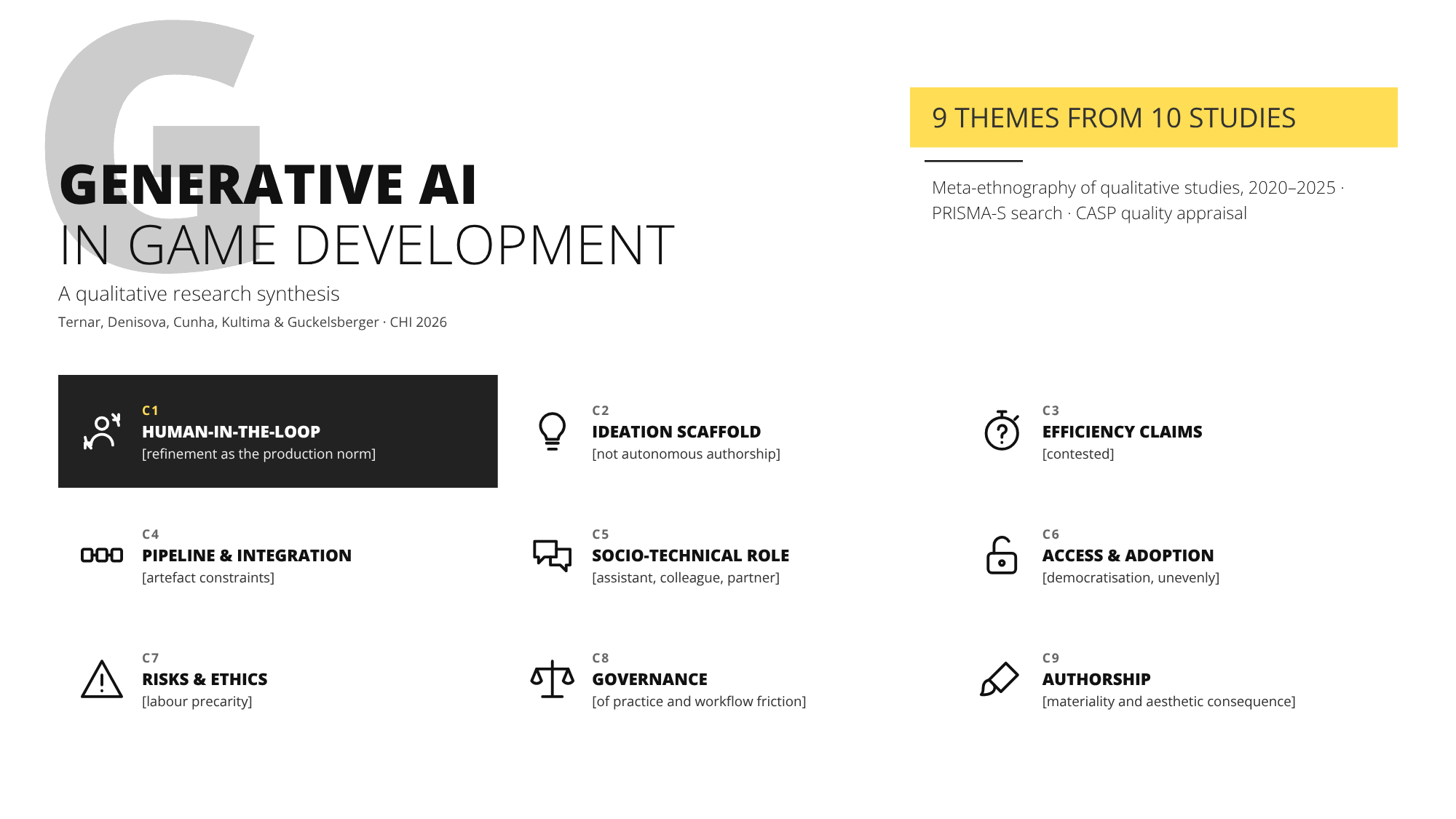
In short
Generative AI is changing how games are made, but the early qualitative studies of its use are scattered and rarely build on each other. We brought together the qualitative research published between 2020 and 2025 using meta-ethnography.
Key findings
- Ten eligible studies were synthesised, found through a systematic search following PRISMA-S guidelines.
- The synthesis identified nine overarching themes about generative AI in game development.
- We give recommendations for practitioners, researchers and policymakers, and relate the findings to wider changes in game production.
The nine themes
- Human-in-the-loop refinement as the production norm
- Early-stage ideation scaffold, not autonomous authorship
- Efficiency claims contested
- Pipeline, integration, and artefact constraints
- Socio-technical positioning: assistant, colleague, partner
- Access, democratisation, and adoption
- Risks, ethics, and labour precarity
- Governance of practice and workflow friction
- Authorship, materiality, and aesthetic consequence
Recommendations for practice
We recommend to treat integration as a first-class design problem.
Pipeline, integration, and artefact constraints
For both research and practice, the implication is to design for assistantship as the durable baseline.
Socio-technical positioning
Democratisation should be treated as a conditional process rather than a guaranteed outcome.
Access, democratisation, and adoption
Risk management should be treated as a primary design and governance concern.
Risks, ethics, and labour precarity
Governance should be treated as a design object in its own right.
Governance of practice and workflow friction
Authorship policies must be medium-aware.
Authorship, materiality, and aesthetic consequence
Read and cite
APA citation
Ternar, D. A., Denisova, A., Cunha, J. M., Kultima, A., & Guckelsberger, C. (2026, April). Generative AI in Game Development: A Qualitative Research Synthesis. In Proceedings of the 2026 CHI Conference on Human Factors in Computing Systems (CHI'26) (pp. 1-24).
- Envisioning and Co-Creating Generative AI for Future Creative Workers in Gaming: A CHI PLAY 2026 Workshop Publisher's version of Envisioning and Co-Creating Generative AI for Future Creative Workers in Gaming: A CHI PLAY 2026 Workshop
- From Pixels to Play: Opportunities and Challenges of a Diverse and Democratized Games Industry Publisher's version of From Pixels to Play: Opportunities and Challenges of a Diverse and Democratized Games Industry
- Towards Democratisation of Games User Research: Exploring Playtesting Challenges of Indie Video Game Developers PDF of Towards Democratisation of Games User Research: Exploring Playtesting Challenges of Indie Video Game DevelopersPublisher's version of Towards Democratisation of Games User Research: Exploring Playtesting Challenges of Indie Video Game Developers