Narrative-Driven VR Exergames for Active Older Adults: Examining the Impact of Narrative Styles and Themes on Motivation and User Experience
JournalCORE journal ranking: CORE AInternational Journal of Human-Computer Studies, 2026
In short
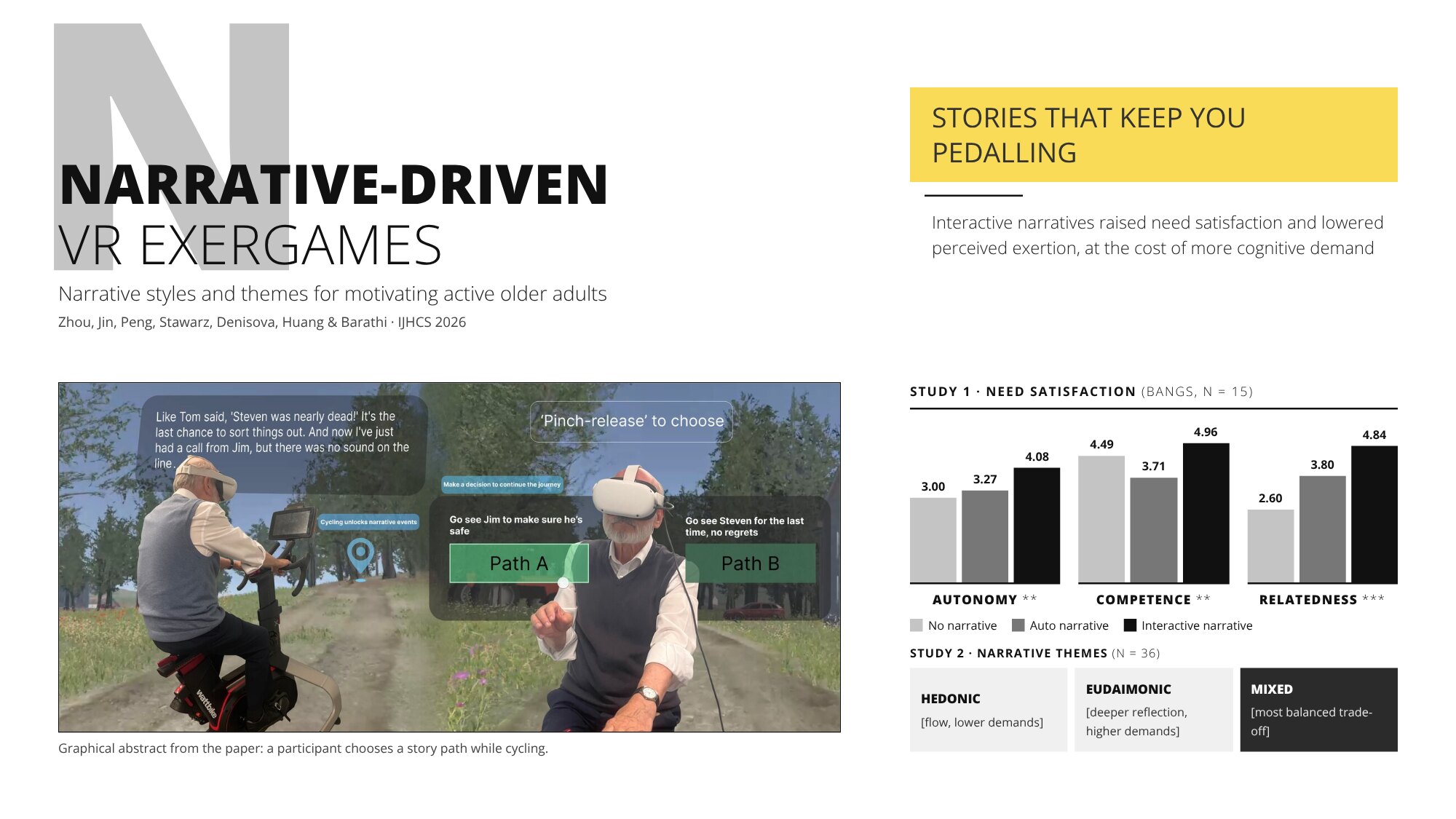
Can a story keep active older adults motivated in a VR cycling exergame? Across two studies we compared narrative styles that asked for different amounts of interaction, and three kinds of story: hedonic, eudaimonic and mixed-affective.
The game in the study
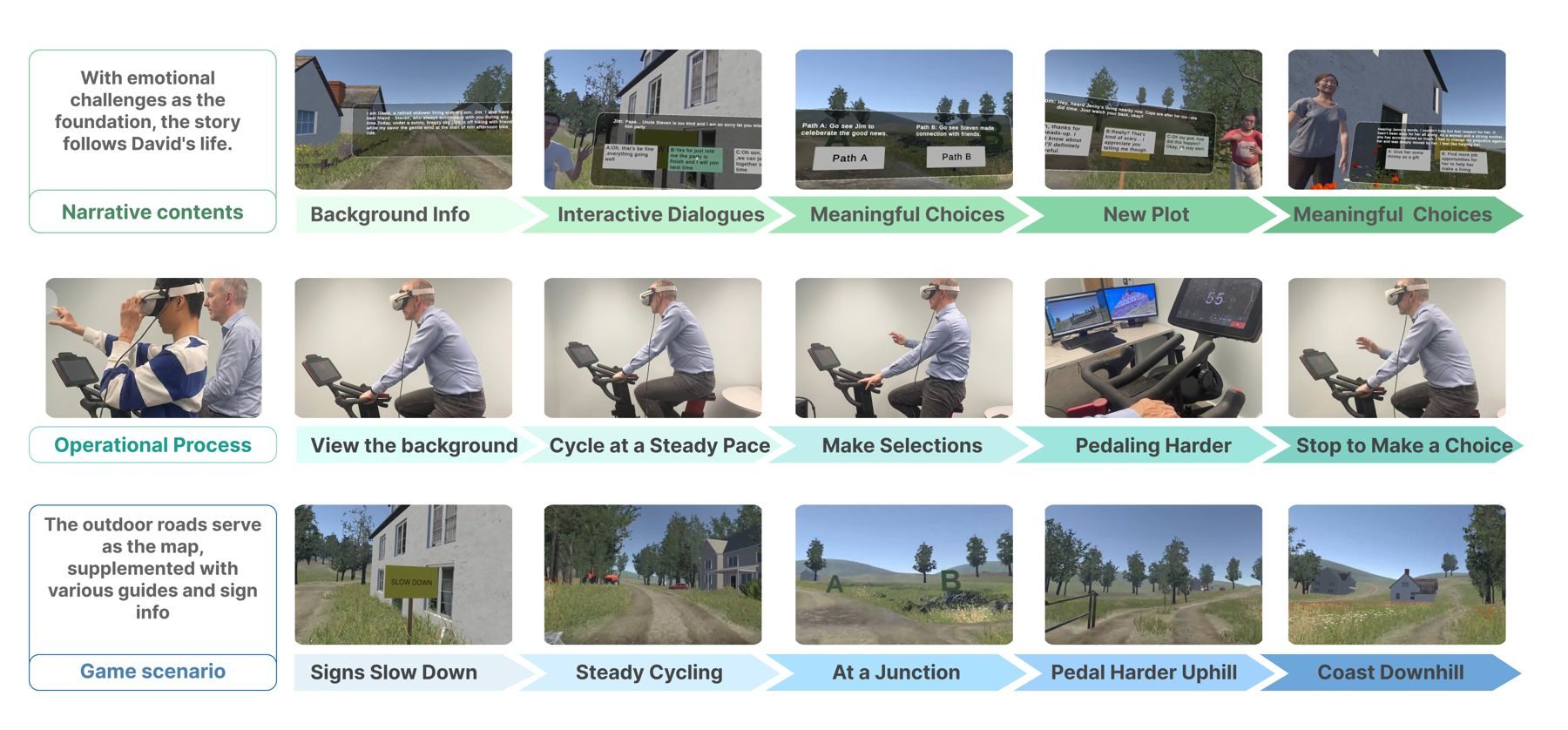
A VR cycling exergame developed in Unity and played on a stationary bike, told from the perspective of the protagonist, David.

Key findings
- With 15 participants, interactive narratives increased feelings of autonomy and relatedness and lowered perceived exertion, though they were more cognitively demanding.
- With 36 participants, hedonic stories supported flow and motivation at a low cognitive cost, while eudaimonic stories prompted deeper reflection but were more demanding and less replayable.
- Mixed-affective stories offered the best balance between motivation and feeling competent.
Read and cite
© 2026. This manuscript version is made available under the CC BY-NC-ND 4.0 licence.
APA citation
Zhou, M., Jin, M., Peng, X., Stawarz, K., Denisova, A., Huang, J., & Barathi, S. C. (2026). Narrative-Driven VR Exergames for Active Older Adults: Examining the Impact of Narrative Styles and Themes on Motivation and User Experience. International Journal of Human-Computer Studies, 103954. https://doi.org/10.1016/j.ijhcs.2026.103954
- Seeing Your Own Mind Playing Out on the Screen: A Constructivist Grounded Theory of Video Games as Dynamic Coping Systems PDF of Seeing Your Own Mind Playing Out on the Screen: A Constructivist Grounded Theory of Video Games as Dynamic Coping SystemsPublisher's version of Seeing Your Own Mind Playing Out on the Screen: A Constructivist Grounded Theory of Video Games as Dynamic Coping Systems
- The Future of Games in Society (Manifesto from Dagstuhl Perspectives Workshop 25102) Dagstuhl 25102 pagePDF of The Future of Games in Society (Manifesto from Dagstuhl Perspectives Workshop 25102)Publisher's version of The Future of Games in Society (Manifesto from Dagstuhl Perspectives Workshop 25102)
- Playing Through Tough Times: Exploring the Relationship between Game Aspects and Coping Strategies during Difficult Life Challenges PDF of Playing Through Tough Times: Exploring the Relationship between Game Aspects and Coping Strategies during Difficult Life ChallengesPublisher's version of Playing Through Tough Times: Exploring the Relationship between Game Aspects and Coping Strategies during Difficult Life Challenges