Games for good

How games help people through difficult times, and serious games built for health and education.

How games and specific game elements help people cope during difficult life challenges, and what makes some games especially supportive.

This theme also includes games we have built ourselves, including an educational game for young children about maggot therapy for chronic wounds and a game prototype supporting recovery from PTSD, as well as games designed for older adults.

Papers

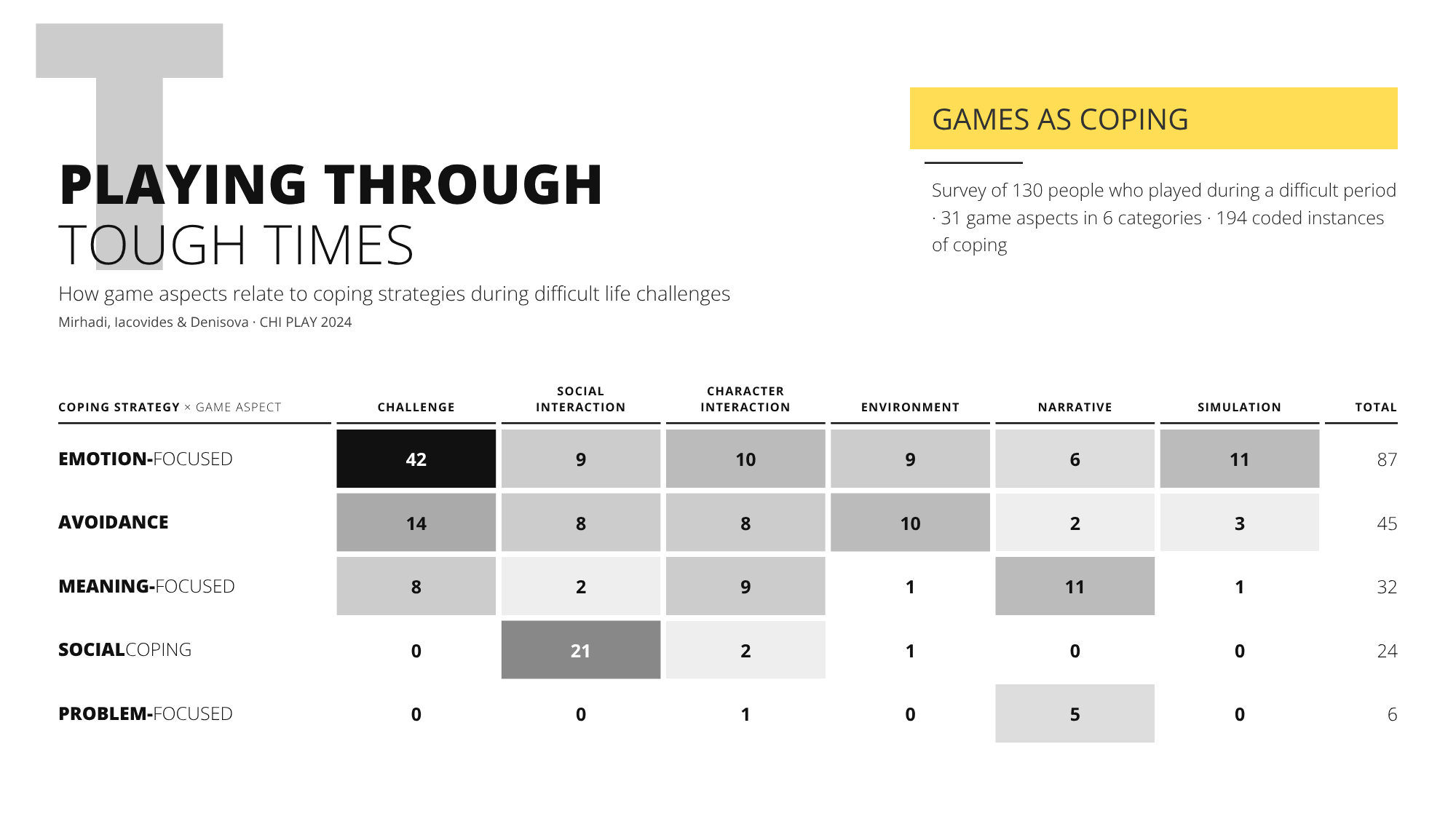
Heat map of 194 coded instances linking coping strategies (emotion-focused, avoidance, meaning-focused, social and problem-focused) to game aspects; emotion-focused coping linked to challenge was the most common pairing.
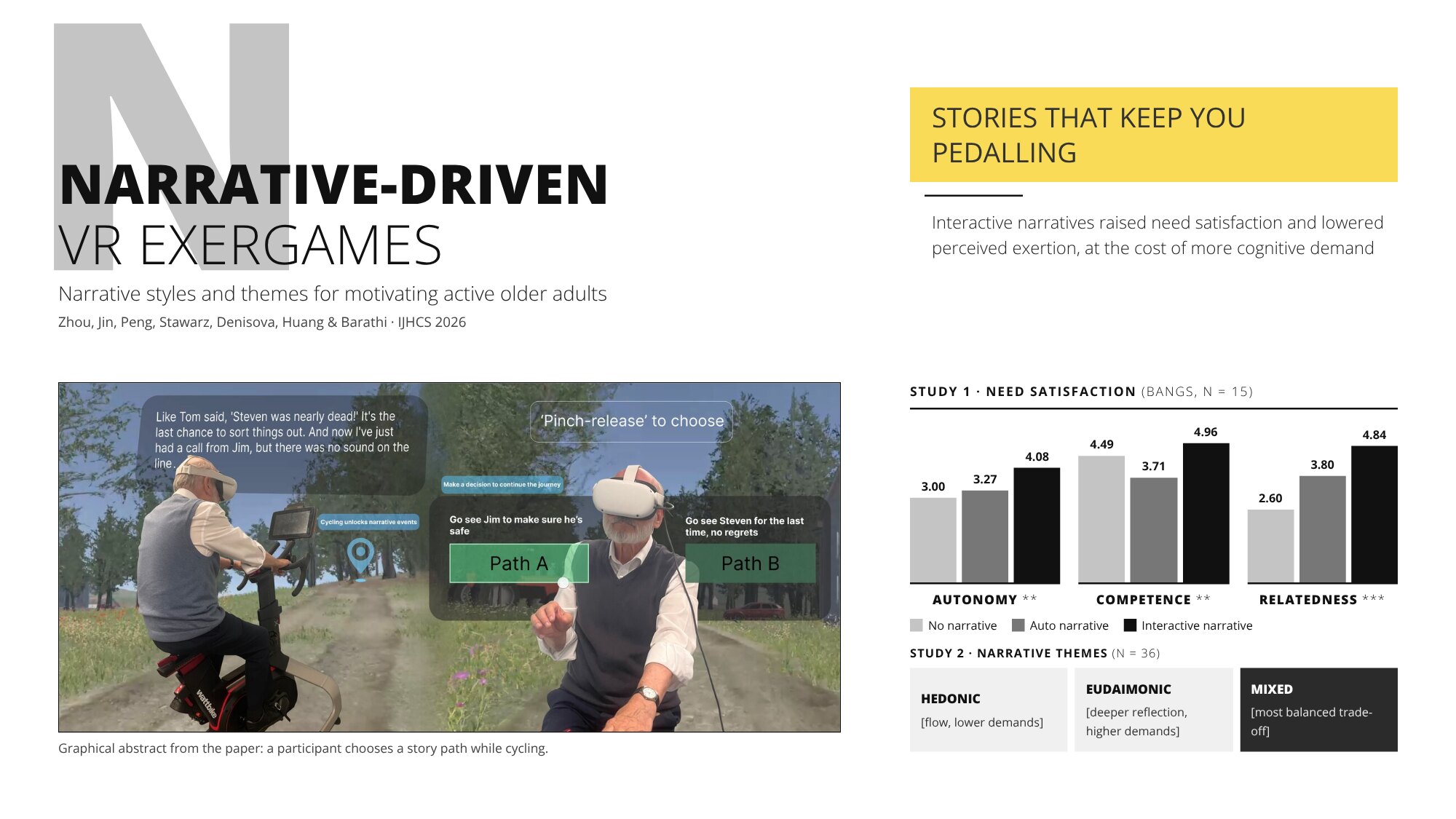
Teaser figure: Narrative-driven VR exergames. An older adult cycling in VR chooses between story paths A and B. Bar charts from Study 1 (N = 15) show autonomy, competence and relatedness were highest with interactive narrative, then auto narrative, then no narrative. Study 2 (N = 36) compared hedonic, eudaimonic and mixed narrative themes, with mixed giving the most balanced trade-off.
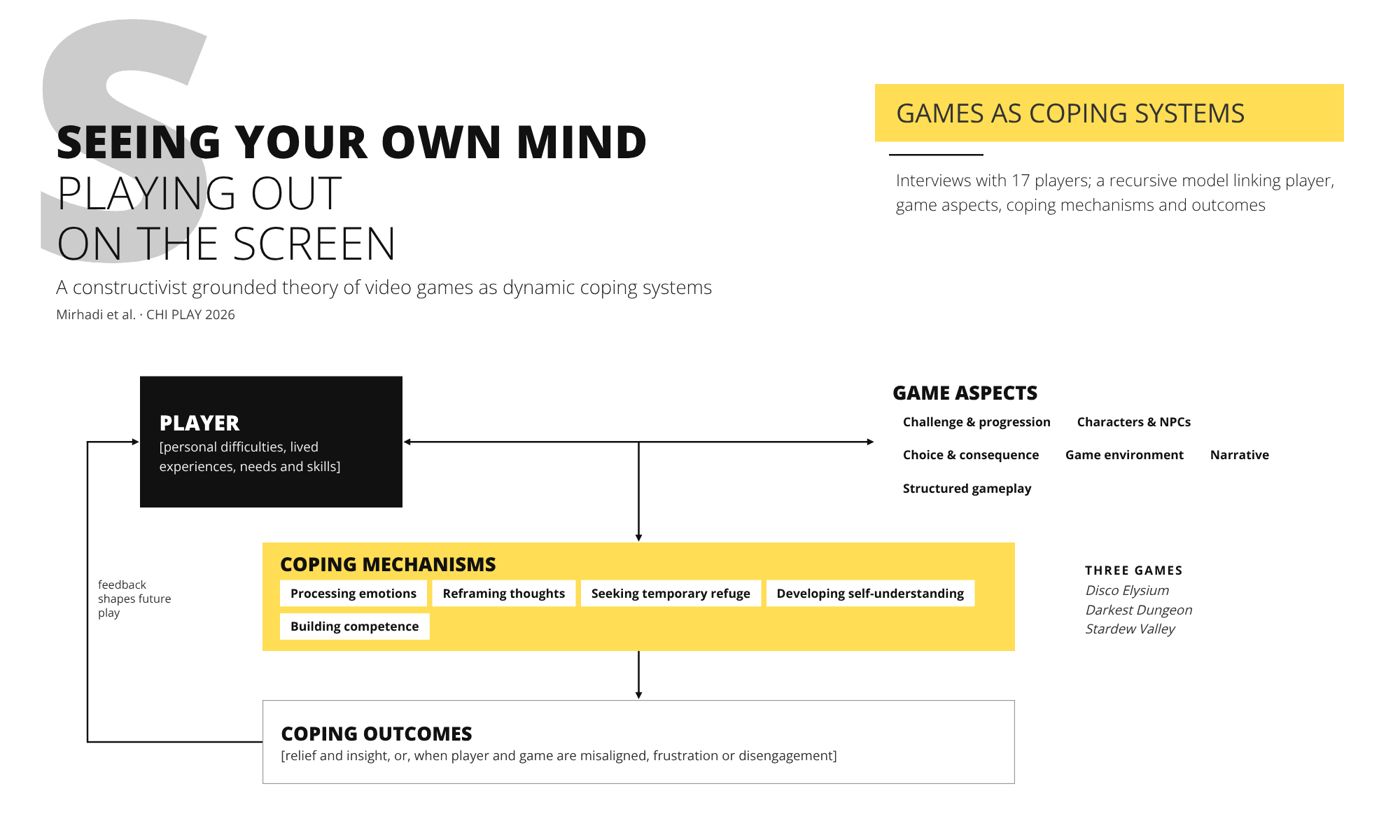
Teaser figure: Seeing your own mind playing out on the screen. A model from interviews with 17 players links the player (personal difficulties, lived experiences, needs and skills) with game aspects such as challenge, characters, choice, environment and narrative. These lead to coping mechanisms (processing emotions, reframing thoughts, seeking temporary refuge, developing self-understanding, building competence) and to coping outcomes, which feed back into future play. The games discussed were Disco Elysium, Darkest Dungeon and Stardew Valley.

JournalSCImago Journal Rank: PACM HCI, first quartile: SJR Q12026 · Proceedings of the ACM on Human-Computer Interaction (CHI PLAY 2026)

Seeing Your Own Mind Playing Out on the Screen: A Constructivist Grounded Theory of Video Games as Dynamic Coping Systems

Mirhadi, S., Iacovides, J., & Denisova, A.

Video games can help people cope during periods of personal difficulty, but we know little about exactly how they do so. In this constructivist grounded theory study, we interviewed 17 players of Disco Elysium, Darkest Dungeon and Stardew Valley about their lived experiences, and developed the Games as Dynamic Coping Systems model.

Other publications

Also relevant

Papers whose main theme is elsewhere but which also contribute here.