ChallengeDetect: Investigating the Potential of Detecting In-Game Challenge Experience from Physiological Measures
ConferenceCORE conference ranking: CORE A*Proceedings of the 2023 CHI Conference on Human Factors in Computing Systems (CHI'23), 2023
In short
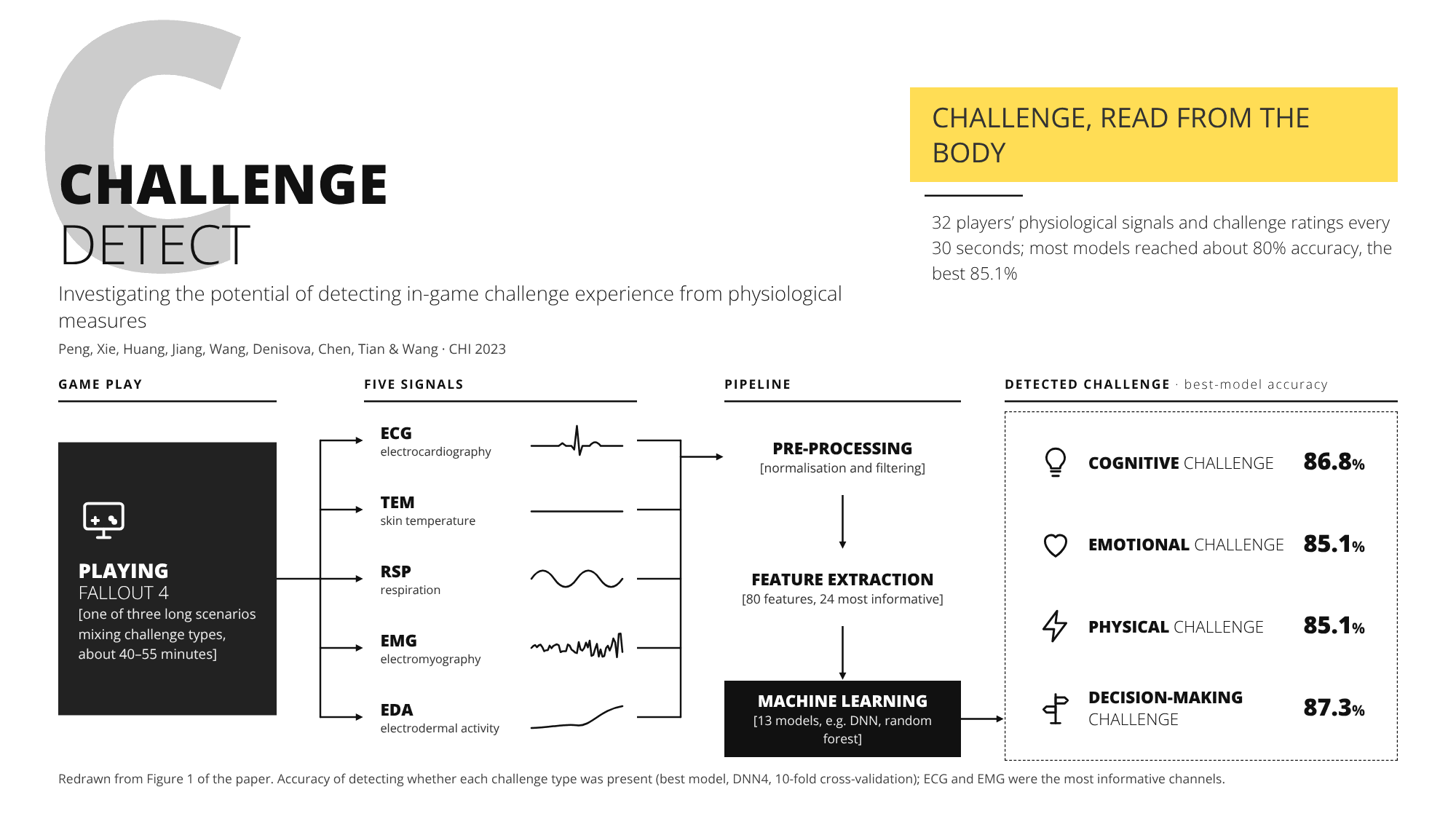
Questionnaires only capture challenge after play has ended. ChallengeDetect explores whether perceived challenge can instead be detected from players' physiological signals, moment to moment.
Key findings
- Physiological data were collected from 32 players across three typical game scenarios.
- Most of the machine learning methods tested detected challenge experiences with around 80% accuracy.
- The paper discusses physiological indicators of challenge and AI-supported challenge evaluation.
Read and cite
APA citation
Peng, X., Xie, X., Huang, J., Jiang, C., Wang, H., Denisova, A., Chen, H., Tian, F., & Wang, H. (2023, April). ChallengeDetect: Investigating the Potential of Detecting In-Game Challenge Experience from Physiological Measures. In Proceedings of the 2023 CHI Conference on Human Factors in Computing Systems (CHI'23).
- Comparing Measures of Perceived Challenge and Demand in Video Games: Exploring the Conceptual Dimensions of CORGIS and VGDS PDF of Comparing Measures of Perceived Challenge and Demand in Video Games: Exploring the Conceptual Dimensions of CORGIS and VGDSPublisher's version of Comparing Measures of Perceived Challenge and Demand in Video Games: Exploring the Conceptual Dimensions of CORGIS and VGDS
- Measuring Perceived Challenge in Digital Games: Development & Validation of the Challenge Originating from Recent Gameplay Interaction Scale (CORGIS) PDF of Measuring Perceived Challenge in Digital Games: Development & Validation of the Challenge Originating from Recent Gameplay Interaction Scale (CORGIS)Publisher's version of Measuring Perceived Challenge in Digital Games: Development & Validation of the Challenge Originating from Recent Gameplay Interaction Scale (CORGIS)
- Challenge in Digital Games: Towards Developing a Measurement Tool PDF of Challenge in Digital Games: Towards Developing a Measurement ToolPublisher's version of Challenge in Digital Games: Towards Developing a Measurement Tool