Exploring the (Placebo) Effect of an AI-Powered Dialogue System on Player Experience
ConferenceIEEE Conference on Games (CoG'25), 2025
In short
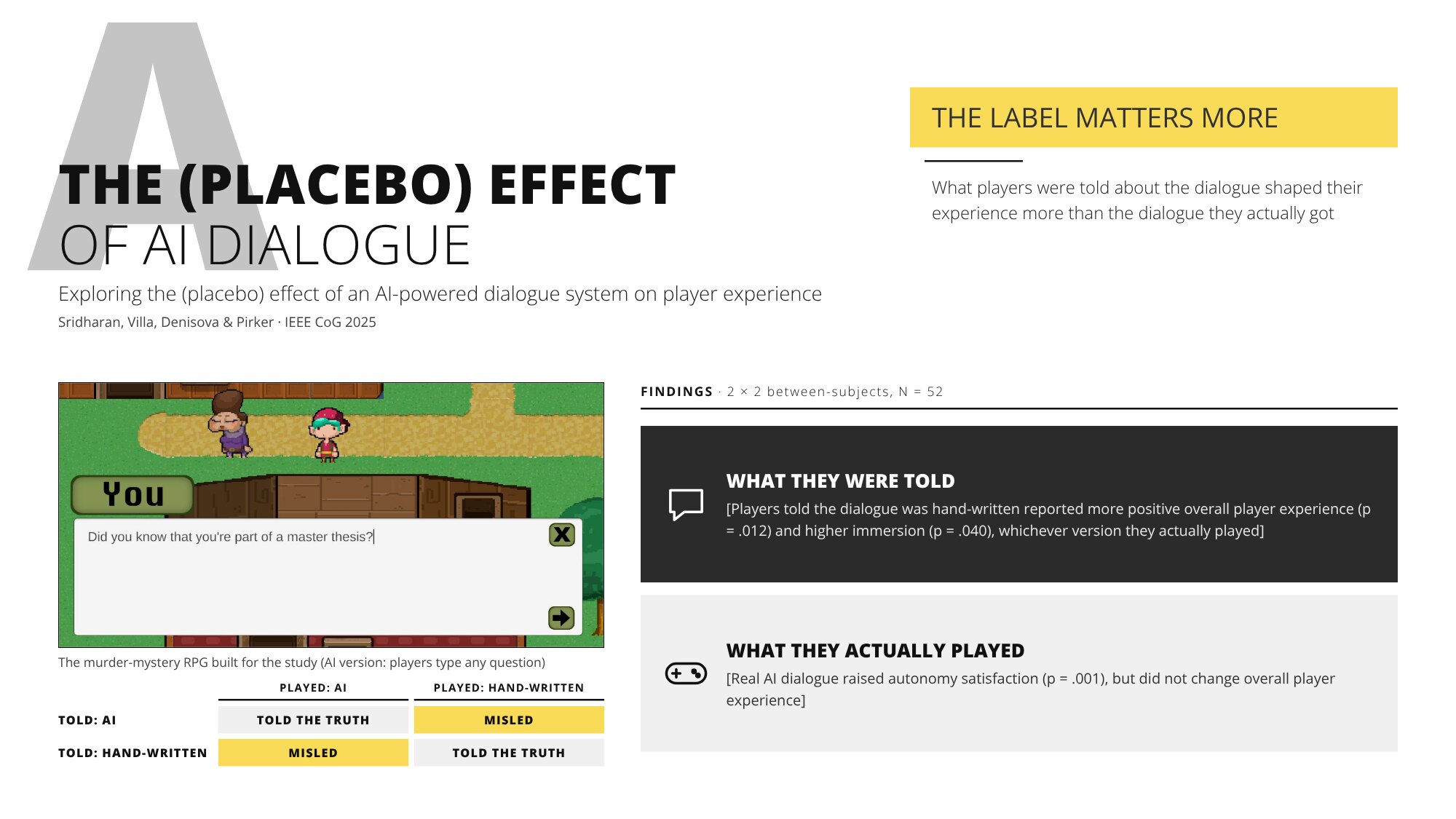
Does AI-generated dialogue change how players experience a game, or is it what they believe about it? In a murder-mystery game, we varied both the dialogue players actually got (AI-generated or human-written) and how the game was described to them (labelled as AI or as human-written), and measured overall player experience, immersion and perceived autonomy.
How the study worked
What players were told
Participants were told the study aimed to investigate the effects of GPT-generated dialogue in a game and received a brief explanation of the two game versions. They were not informed that they might be playing a different version than the one described to them.
- Game
- A 2D murder mystery RPG: as a detective, the player finds the murderer only through dialogue with the victim’s three neighbours
- Players
- 52
- Design
- 2 × 2 between-subjects: the version played (GPT-4o or hand-written dialogue) × the version described (AI or hand-written). For half of the players the two did not match.
- Dialogue
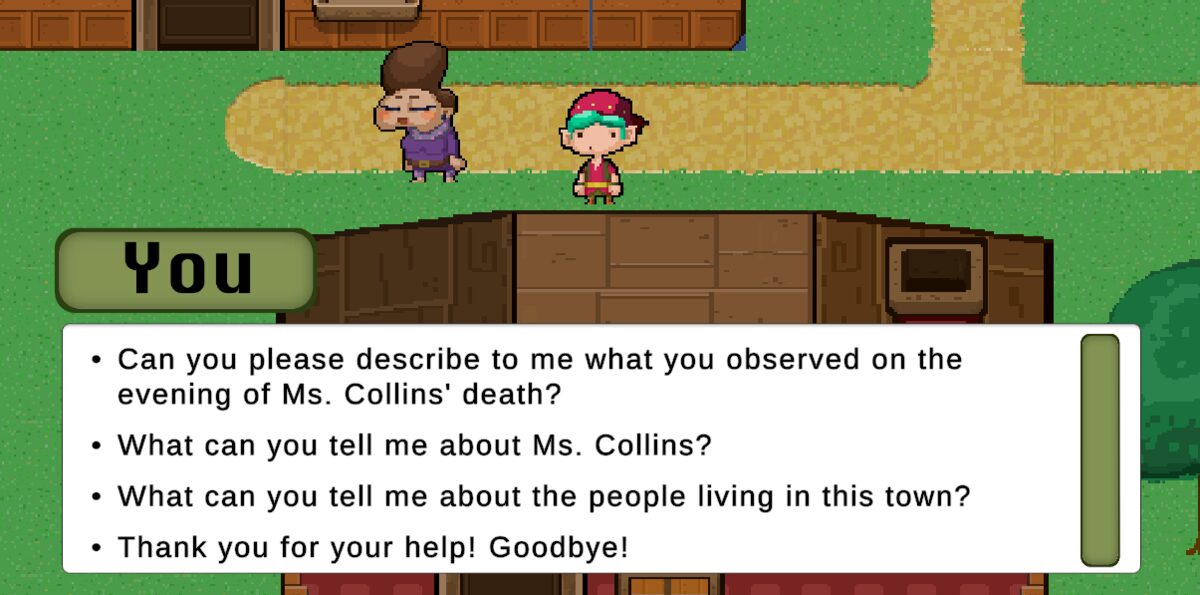
- GPT version: free text input. Hand-written version: choosing from several responses.
- Play time
- Up to 20 minutes, followed by a short interview
- Measures
- Expectations (revised iExpect), overall player experience (miniPXI), immersion (PXI), autonomy satisfaction and frustration (BANGS), emotional challenge (CORGIS)
The two versions of the game

Key findings
- Player expectations, shaped by the game description, affected overall player experience more than the dialogue players actually received.
- Players who believed the narrative was human-written reported more positive player experience, higher immersion and higher perceived autonomy, whichever version they played.
- Interacting with the AI-generated dialogue increased perceived autonomy, suggesting AI dialogue can enhance a sense of freedom without necessarily improving the overall experience.
The takeaway
From my CoG 2025 talk on this paper
Technology alone does not guarantee better play. What matters is how it is framed, and how well it supports the story at the heart of the game.
Summary
Read and cite
APA citation
Sridharan, S., Villa, S., Denisova, A., & Pirker, J. (2025). Exploring the (Placebo) Effect of an AI-Powered Dialogue System on Player Experience. In IEEE Conference on Games (CoG'25) (pp. 1-8).
Line of work
- Builds on · 2015The Placebo Effect in Digital Games: Phantom Perception of Adaptive Artificial Intelligence
- This paper · 2025Exploring the (Placebo) Effect of an AI-Powered Dialogue System on Player Experience
- AI for Romantic Comedies Dagstuhl 22251 pagePublisher's version of AI for Romantic Comedies
- Player Experience and Deceptive Expectations of Difficulty Adaptation in Digital Games PDF of Player Experience and Deceptive Expectations of Difficulty Adaptation in Digital GamesPublisher's version of Player Experience and Deceptive Expectations of Difficulty Adaptation in Digital Games
- Power-Ups in Digital Games: The Rewarding Effect of Phantom Game Elements on Player Experience PDF of Power-Ups in Digital Games: The Rewarding Effect of Phantom Game Elements on Player ExperiencePublisher's version of Power-Ups in Digital Games: The Rewarding Effect of Phantom Game Elements on Player Experience