The placebo effect

How what players are told, or what a feature looks like, changes what they experience.

People approach technology with expectations, and researchers often describe their systems in ways that shape those expectations. This work shows how players' experience changes with the description of a system or the look of a game element, even when the feature does very little. This is the placebo effect of technology.

Our first study of this, The Placebo Effect in Digital Games (CHI PLAY 2015), was covered by New Scientist in Placebo effect works in video games too.

It started with my PhD on adaptive AI in games and now extends to AI-powered systems such as AI-driven dialogue. A recurring conclusion is that studies in games and in HCI more broadly should include placebo controls.

How the game is balanced is important, but equally important is how players believe the game is challenging them.

From my CoG 2025 keynote, “Not all struggles leave data”

Papers

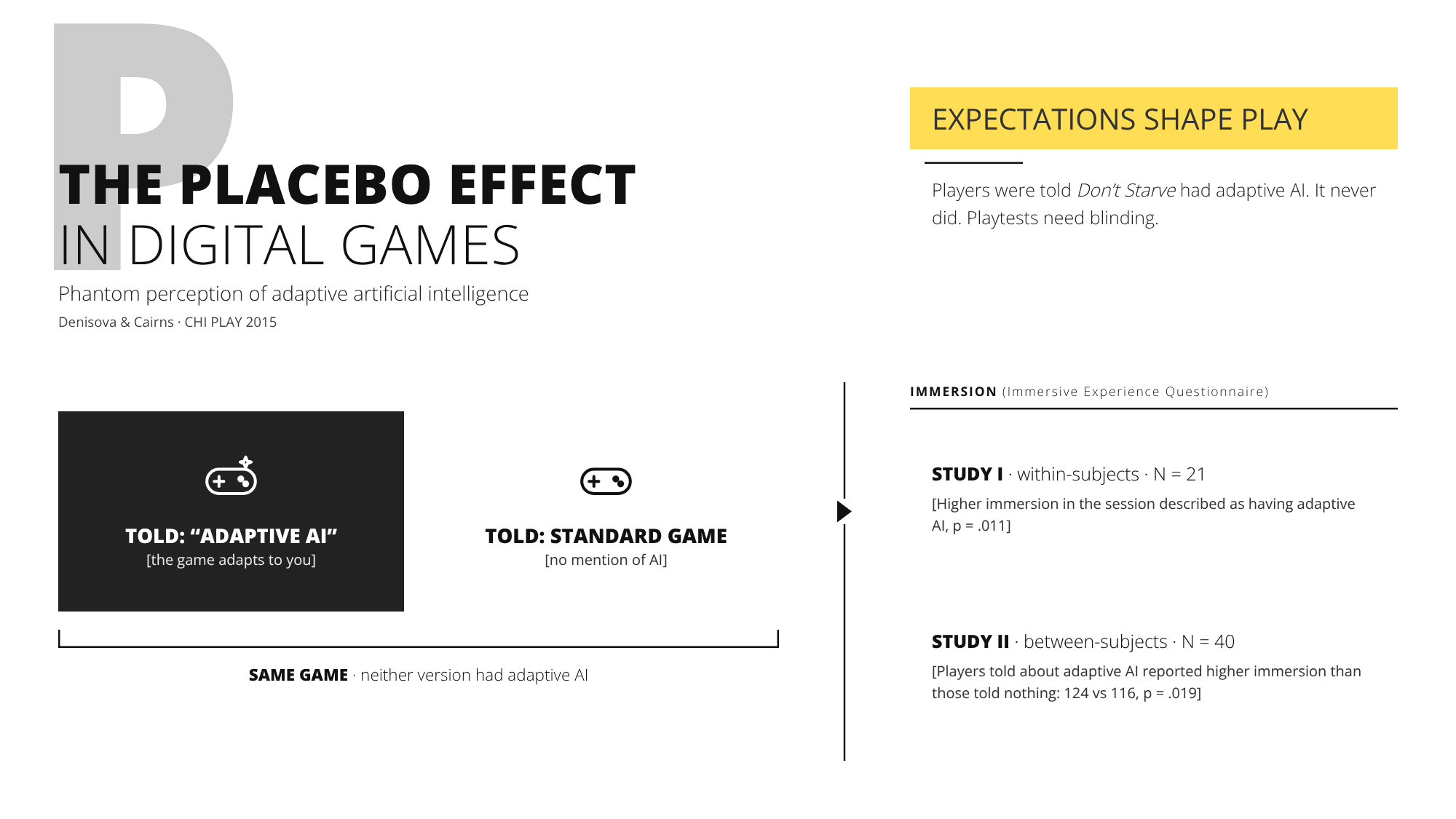
Study design: players played the same game, told either that it had adaptive AI or that it was a standard game; in two studies, players told about adaptive AI reported higher immersion, although neither version had it.

Conference2015 · Proceedings of the Annual Symposium on Computer-Human Interaction in Play (CHI PLAY'15)

The Placebo Effect in Digital Games: Phantom Perception of Adaptive Artificial Intelligence
Denisova, A., & Cairns, P.

Can simply telling players that a game has adaptive AI change their experience? In two studies, players were told the game contained adaptive artificial intelligence, although it did not.

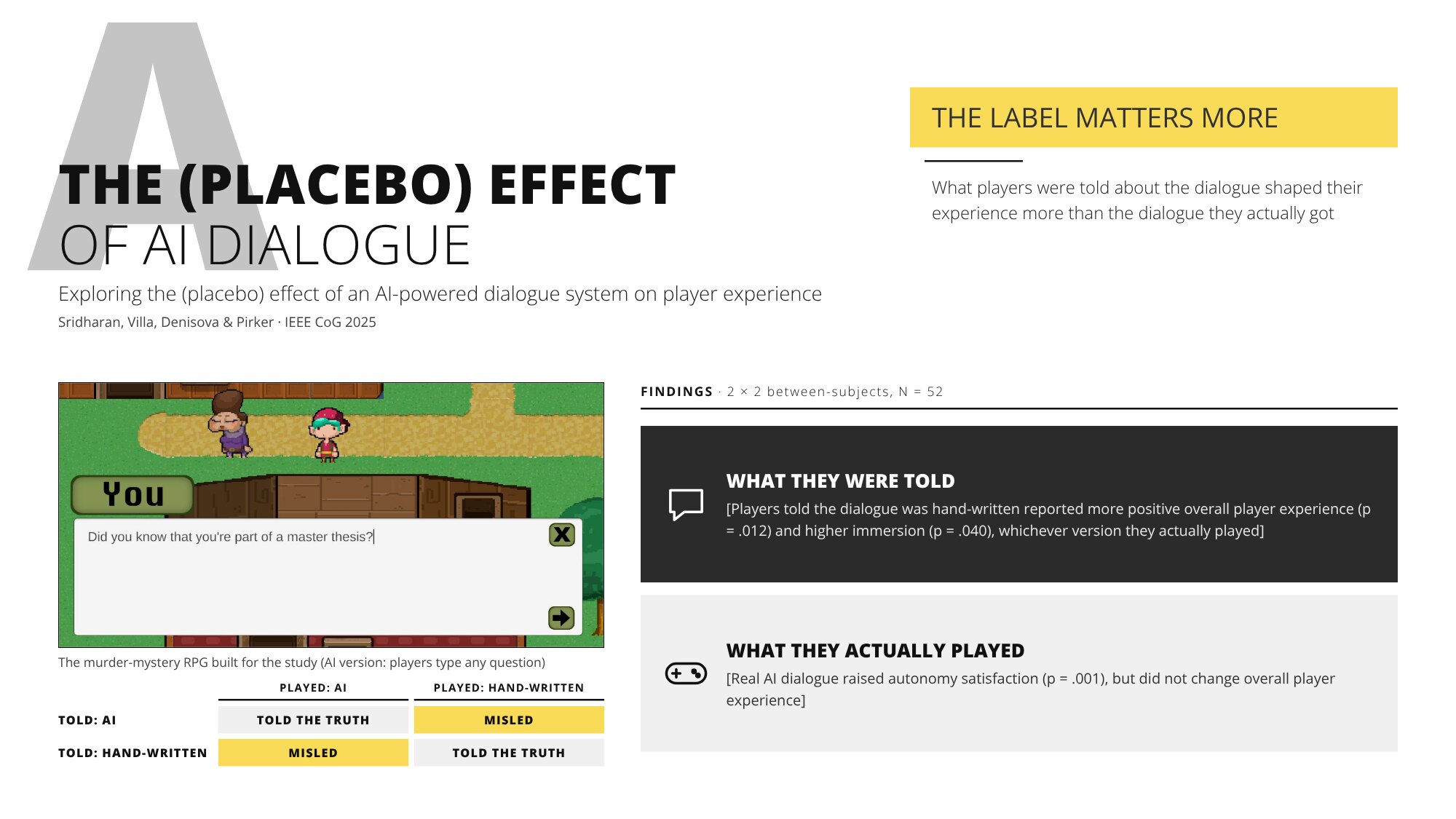
Teaser figure: The (placebo) effect of AI dialogue. A screenshot of the murder-mystery RPG built for the study, where players type free-text questions to villagers. In a 2 by 2 study (N = 52), players were told the dialogue was AI-generated or hand-written, and played either version. Players told it was hand-written reported more positive player experience (p = .012) and higher immersion (p = .040), whichever version they played; the real AI dialogue raised autonomy (p = .001) but did not change overall player experience.

Conference2025 · IEEE Conference on Games (CoG'25)

Exploring the (Placebo) Effect of an AI-Powered Dialogue System on Player Experience

Sridharan, S., Villa, S., Denisova, A., & Pirker, J.

Does AI-generated dialogue change how players experience a game, or is it what they believe about it? In a murder-mystery game, we varied both the dialogue players actually got (AI-generated or human-written) and how the game was described to them (labelled as AI or as human-written), and measured overall player experience, immersion and perceived autonomy.

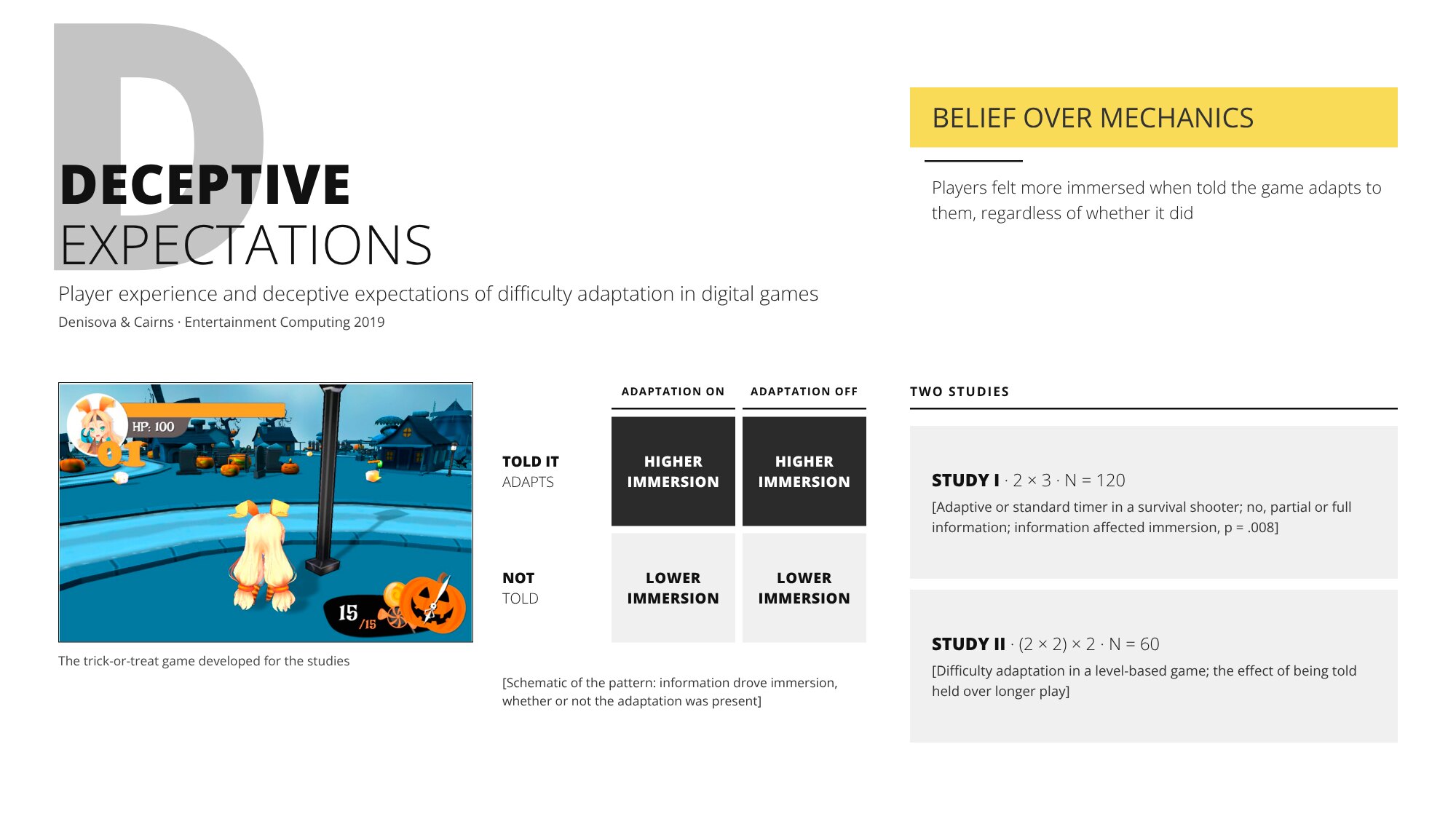
Teaser figure: Deceptive expectations. A screenshot of the trick-or-treat game. A schematic shows that players told the game adapts reported higher immersion whether or not adaptation was on. Study I (N = 120) used an adaptive or standard timer with no, partial or full information; Study II (N = 60) showed the effect held over longer play.

Journal2019 · Entertainment Computing

Player Experience and Deceptive Expectations of Difficulty Adaptation in Digital Games

Denisova, A., & Cairns, P.

Does telling players that a game adapts to them change their experience, whether or not it really does? In two studies with two games using different performance-based adaptations, we varied both what players were told and whether adaptation was present.

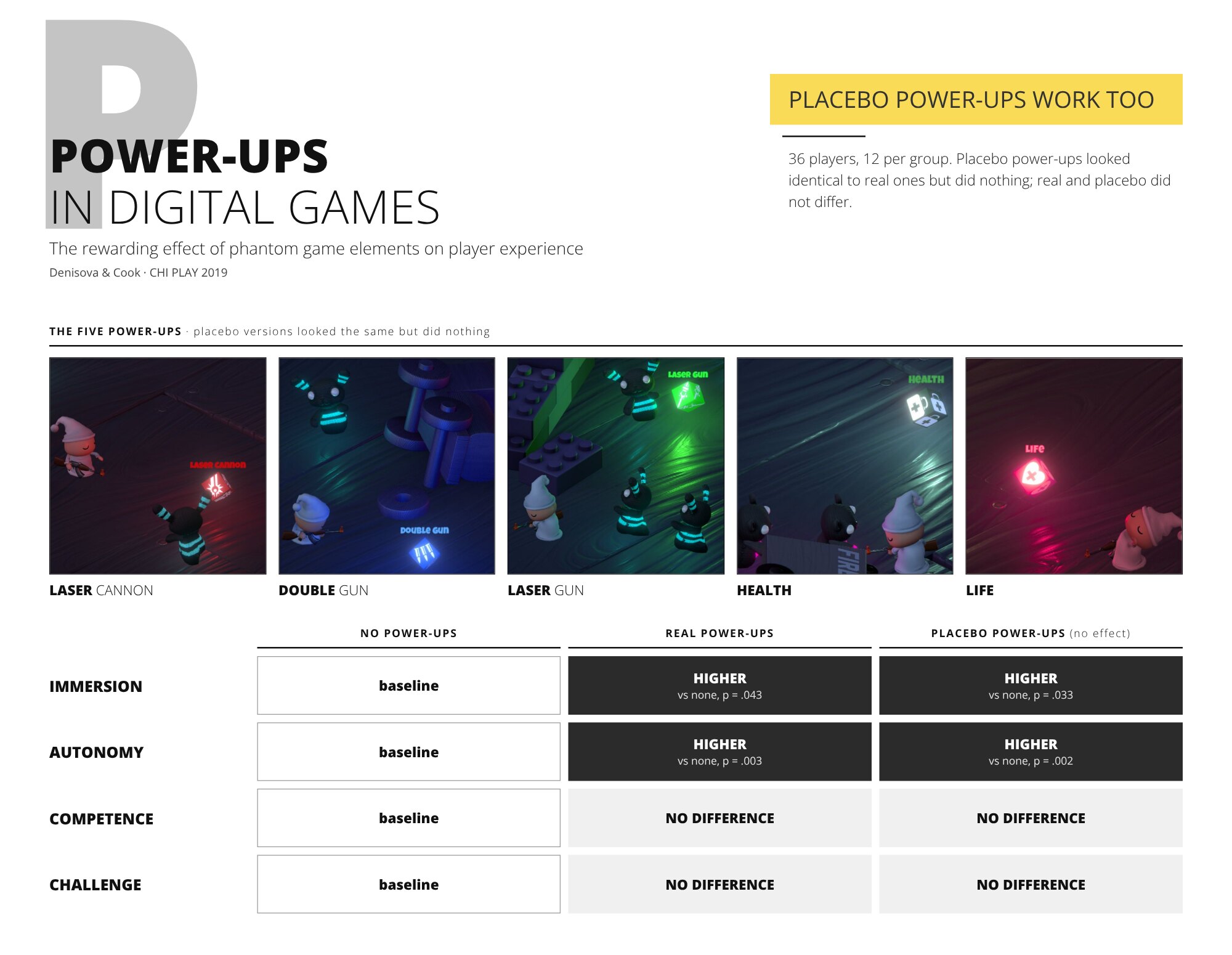
Teaser figure: Power-ups in digital games. Screenshots of five power-ups: laser cannon, double gun, laser gun, health and life. With 36 players, both real and placebo power-ups (which looked the same but did nothing) gave higher immersion and autonomy than no power-ups, with no difference in competence or challenge.

Conference2019 · Proceedings of the Annual Symposium on Computer-Human Interaction in Play (CHI PLAY'19)

Power-Ups in Digital Games: The Rewarding Effect of Phantom Game Elements on Player Experience

Denisova, A., & Cook, E.

Power-ups are everywhere in games, but their effect on player experience is poorly understood. We compared playing with power-ups, without them, and with 'placebo' power-ups that did nothing at all.

Other publications