Redefining Play: A Novel Framework for Differentiating Agency and Autonomy in Video Games
ConferenceProceedings of the Digital Games Research Association Conference (DiGRA'25), 2025
In short
Player agency is often confused with autonomy. Drawing on the literature, we propose a framework that separates the two, built around a single completed player action, and clarifies how self-efficacy and competence relate to them.
In games
Examples the paper uses
-
In the paper
It Takes Two
Lacking autonomy: in the toy elephant scene, “players may not want to be cruel to the stuffed animal, but the game does not offer any other options”.
-
In the paper
It Takes Two
Agency in the platforming sections, “through immediate and precise feedback”: even a missed jump, with its exaggerated flailing animation and quick respawn, shows “their action still matters in the game”.
-
In the paper
Papers, Please
Approving or denying an entry gets a colored stamp and a small figure walking through or being turned away: “minimal yet clear feedback” that “reinforces their Agency in the game, even without a complex storyline”.
Key terms
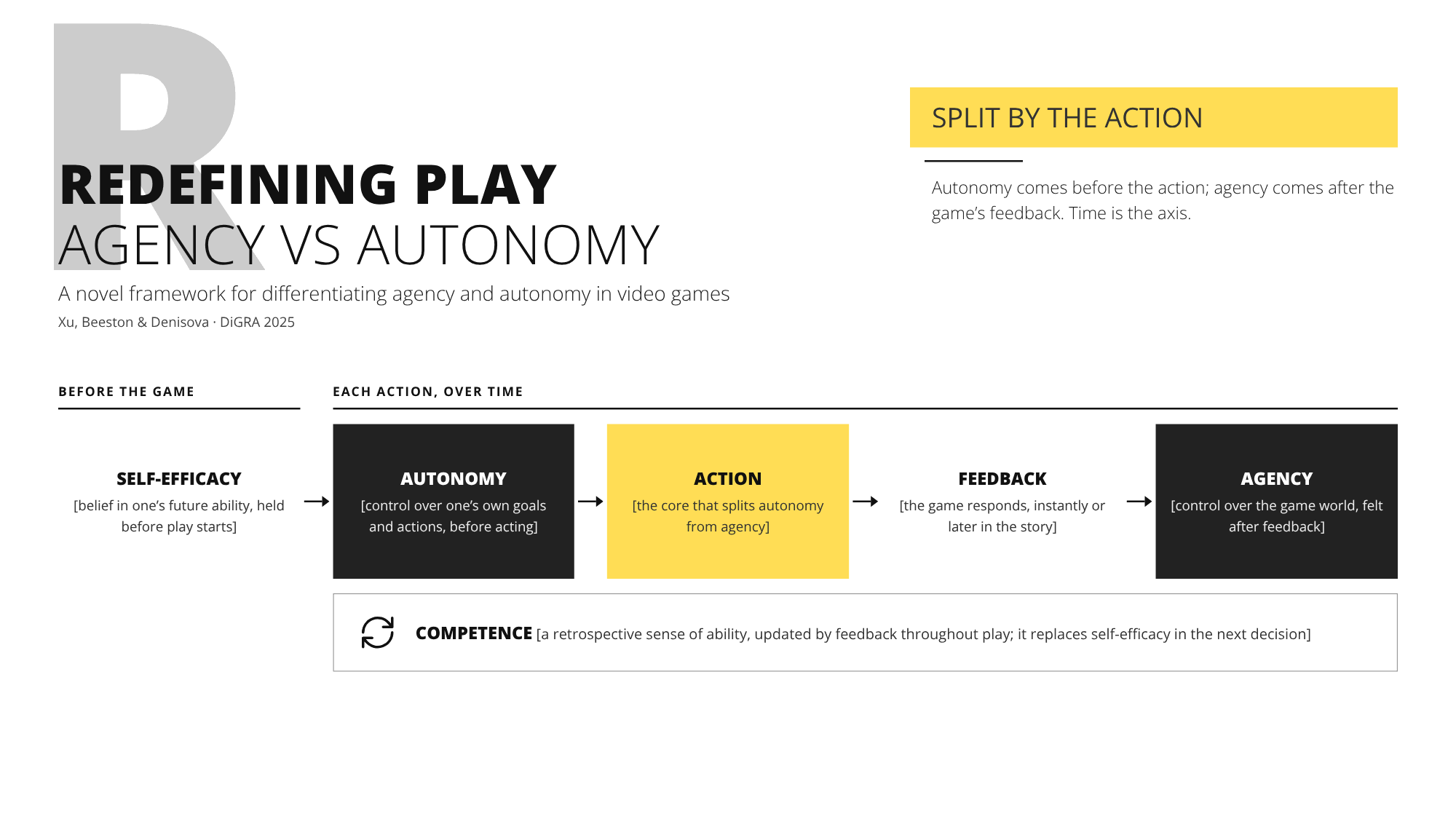
The framework places four related concepts around a single completed player action.
Before the game starts
Self-efficacy
Before the action
Autonomy
Player action
After feedback
Agency
Competence throughout play
- Autonomy
- “The experience of controlling the action itself before the player performs.” It “represents a player’s sense of volitional decision-making at the moment of choice.”
- Agency
- “The experience of controlling the action object after the player receives feedback from the system.” It “unfolds over time as players experience the consequences of their decisions.”
- Self-efficacy
- “Representing the player’s predictions of future ability,” it “is located at the very beginning of the timeline, before the game is started.”
- Competence
- “Iterates over the duration of the game based on the information the players receive about their abilities,” “mapping out the player’s capabilities and guiding the player’s choice of action options.”
Key findings
- A clear conceptual distinction between agency and autonomy in video games.
- A model showing how self-efficacy and competence relate to agency and autonomy.
- A foundation for future research on, and design of, complex player experiences.
Read and cite
APA citation
Xu, X., Beeston, J., & Denisova, A. (2025, June). Redefining Play: A Novel Framework for Differentiating Agency and Autonomy in Video Games. In Proceedings of the Digital Games Research Association Conference (DiGRA'25). DOI: 10.26503/dl.v2025i2.2477.
- What We Talk About When We Talk About Agency: A Systematic Review of Agency in Video Games PDF of What We Talk About When We Talk About Agency: A Systematic Review of Agency in Video GamesPublisher's version of What We Talk About When We Talk About Agency: A Systematic Review of Agency in Video Games
- Non-Euclidean Video Games: Exploring Player Perceptions and Experiences inside Impossible Spaces PDF of Non-Euclidean Video Games: Exploring Player Perceptions and Experiences inside Impossible SpacesPublisher's version of Non-Euclidean Video Games: Exploring Player Perceptions and Experiences inside Impossible Spaces
- The Basic Needs in Games Scale (BANGS): A new tool for investigating positive and negative video game experiences PDF of The Basic Needs in Games Scale (BANGS): A new tool for investigating positive and negative video game experiencesPublisher's version of The Basic Needs in Games Scale (BANGS): A new tool for investigating positive and negative video game experiences