The Placebo Effect in Digital Games: Phantom Perception of Adaptive Artificial Intelligence
ConferenceProceedings of the Annual Symposium on Computer-Human Interaction in Play (CHI PLAY'15), 2015
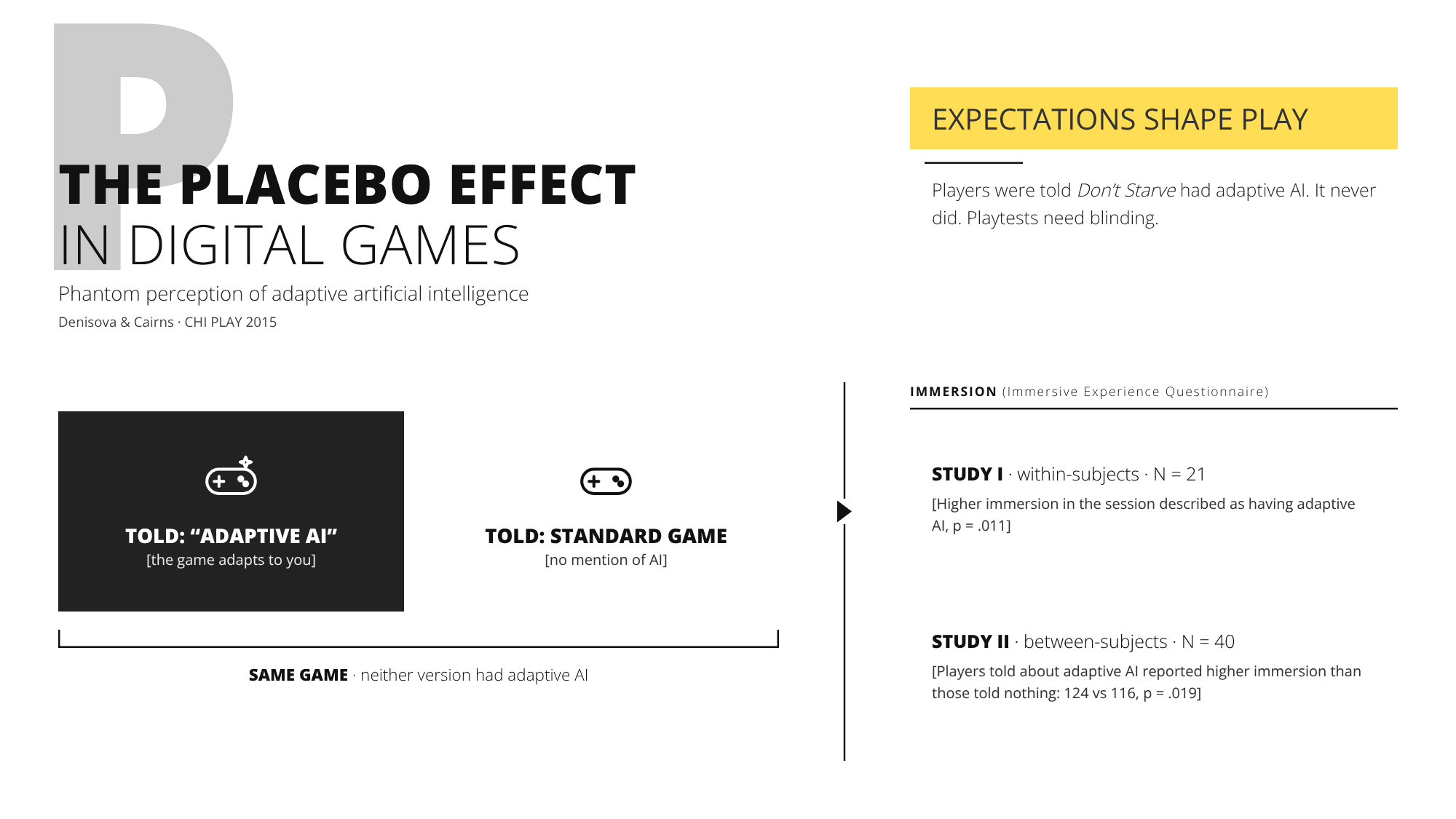
In short
Can simply telling players that a game has adaptive AI change their experience? In two studies, players were told the game contained adaptive artificial intelligence, although it did not.
How the studies worked
What players were told
“Unlike in a standard game, the world was generated based on the participant’s performance in the game” and, “depending on how well they performed in the game, it would ‘adapt’ the game world to match the player’s skills.”
Study 1
- Game
- Don't Starve
- Players
- 21
- Design
- Within-subject: each player played two sessions
- Play time
- A 5-minute tutorial, then two 20-minute sessions
- Measures
- Immersive Experience Questionnaire (IEQ) and an additional questionnaire
Study 2
- Game
- Don't Starve
- Players
- 40 (20 in the experimental group)
- Design
- Between-subject: the experimental group received the explanation of adaptive AI; the control group was told nothing about the feature
- Play time
- About 5 minutes, then 20 more minutes from the beginning
- Measures
- IEQ and an additional questionnaire
The game never contained adaptive AI. The explanation was deliberately vague.
Key findings
- Players who were told about the adaptive AI reported higher immersion.
- Even basic instructions can change how players perceive a game.
What this means
The mere expectation of a difference can be sufficient to change the experience.
Discussion
Players may have an improved experience over earlier versions of the game simply because they expect it.
Discussion
Players are using their own beliefs and knowledge to generate the experience.
Discussion
In the media
- New Scientist Placebo effect works in video games too
Read and cite
APA citation
Denisova, A., & Cairns, P. (2015). The Placebo Effect in Digital Games: Phantom Perception of Adaptive Artificial Intelligence. In Proceedings of the Annual Symposium on Computer-Human Interaction in Play (CHI PLAY'15) (pp. 23-33).
Line of work
- This paper · 2015The Placebo Effect in Digital Games: Phantom Perception of Adaptive Artificial Intelligence
- Followed by · 2019Player Experience and Deceptive Expectations of Difficulty Adaptation in Digital Games
- Followed by · 2019Power-Ups in Digital Games: The Rewarding Effect of Phantom Game Elements on Player Experience
- Followed by · 2025Exploring the (Placebo) Effect of an AI-Powered Dialogue System on Player Experience
- Keep Calm and Aim for the Head: Biofeedback-Controlled Dynamic Difficulty Adjustment in a Horror Game PDF of Keep Calm and Aim for the Head: Biofeedback-Controlled Dynamic Difficulty Adjustment in a Horror GamePublisher's version of Keep Calm and Aim for the Head: Biofeedback-Controlled Dynamic Difficulty Adjustment in a Horror Game
- Adaptive Technologies in Digital Games: The Influence of Perception of Adaptivity on Immersion
- Proactive or Reactive? Comparison of Dynamic Difficulty Adjustment Effects on Player Experience and Physical Effort in a Running Exergame PDF of Proactive or Reactive? Comparison of Dynamic Difficulty Adjustment Effects on Player Experience and Physical Effort in a Running Exergame