Challenge and adaptation

What makes a game challenging, how to measure it, and how games can adapt to keep that challenge right for each player.

Challenge is central to what makes games enjoyable, but it is hard to define. My work separates challenge from difficulty and measures it with CORGIS, a questionnaire covering performative, cognitive, emotional and decision-making challenge. Decision-making challenge was a new type that emerged while we developed the questionnaire.

We also design and test ways of adapting challenge so it stays balanced in different contexts, from horror games to running exergames. Some adapt to the player's performance; others respond to physiological signals such as heart rate. Newer work looks at personalising games to players' personality types.

A game does not need to be difficult to be challenging.

From my CoG 2025 keynote, “Not all struggles leave data”

Definition

Perceived challenge

A player's subjective experience of the obstacles or challenges presented by a game, encompassing both positive (stimulating, motivating) and negative (frustrating, discouraging) valences. It captures how demanding the game feels to the player in relation to their skills, which are shaped by prior gameplay.

Unlike objective difficulty, which denotes the measurable probability of failure, perceived challenge is relational and dynamic, depending on how the player interprets and responds to barriers and tasks during recent gameplay.

Where this work is going

  • Co-create tools with indie developers to fit real-world practices
  • Evaluate procedurally generated content and narratives
  • Assess emotional and moral experiences
  • Support guided decision-making from player data
  • Explore how AI and large language models might assist, but keep human insight central
  • Build stronger collaboration between academia and industry

Papers

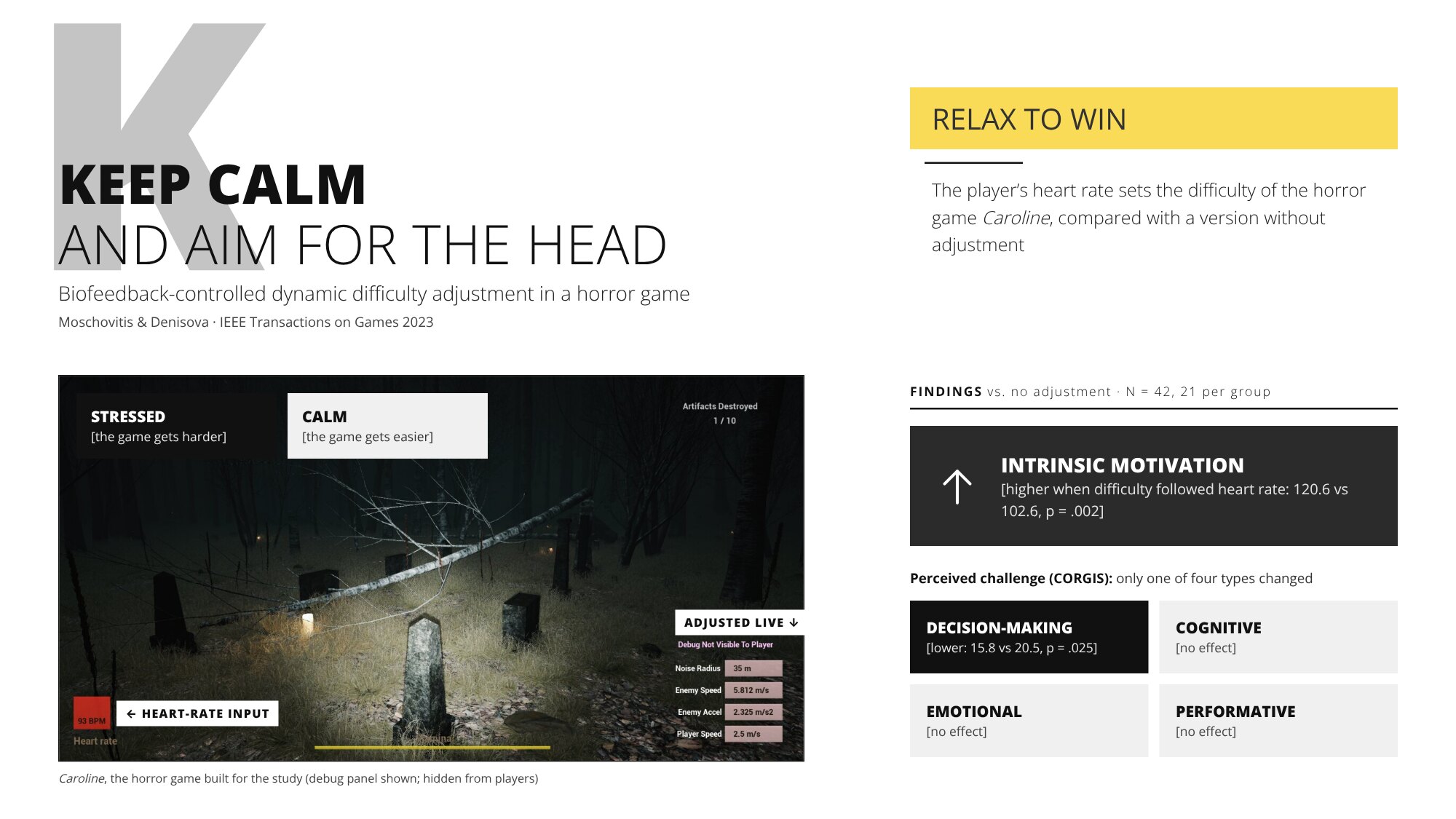
Teaser figure: Keep Calm and Aim for the Head. A screenshot of the horror game “Caroline”, a dark forest graveyard, with heart-rate input and live-adjusted difficulty. When stressed the game gets harder, when calm it gets easier. With 42 players, intrinsic motivation was higher with heart-rate adjustment (120.6 vs 102.6, p = .002); of four challenge types only decision-making changed.

Journal2022 · IEEE Transactions on Games

Keep Calm and Aim for the Head: Biofeedback-Controlled Dynamic Difficulty Adjustment in a Horror Game
Moschovitis, P., & Denisova, A.

We built “Caroline”, a horror game that reads the player's heart rate and adjusts its difficulty in real time: stressed players get a harder game and relaxed players an easier one. We compared it with a version of the game without the adjustment.

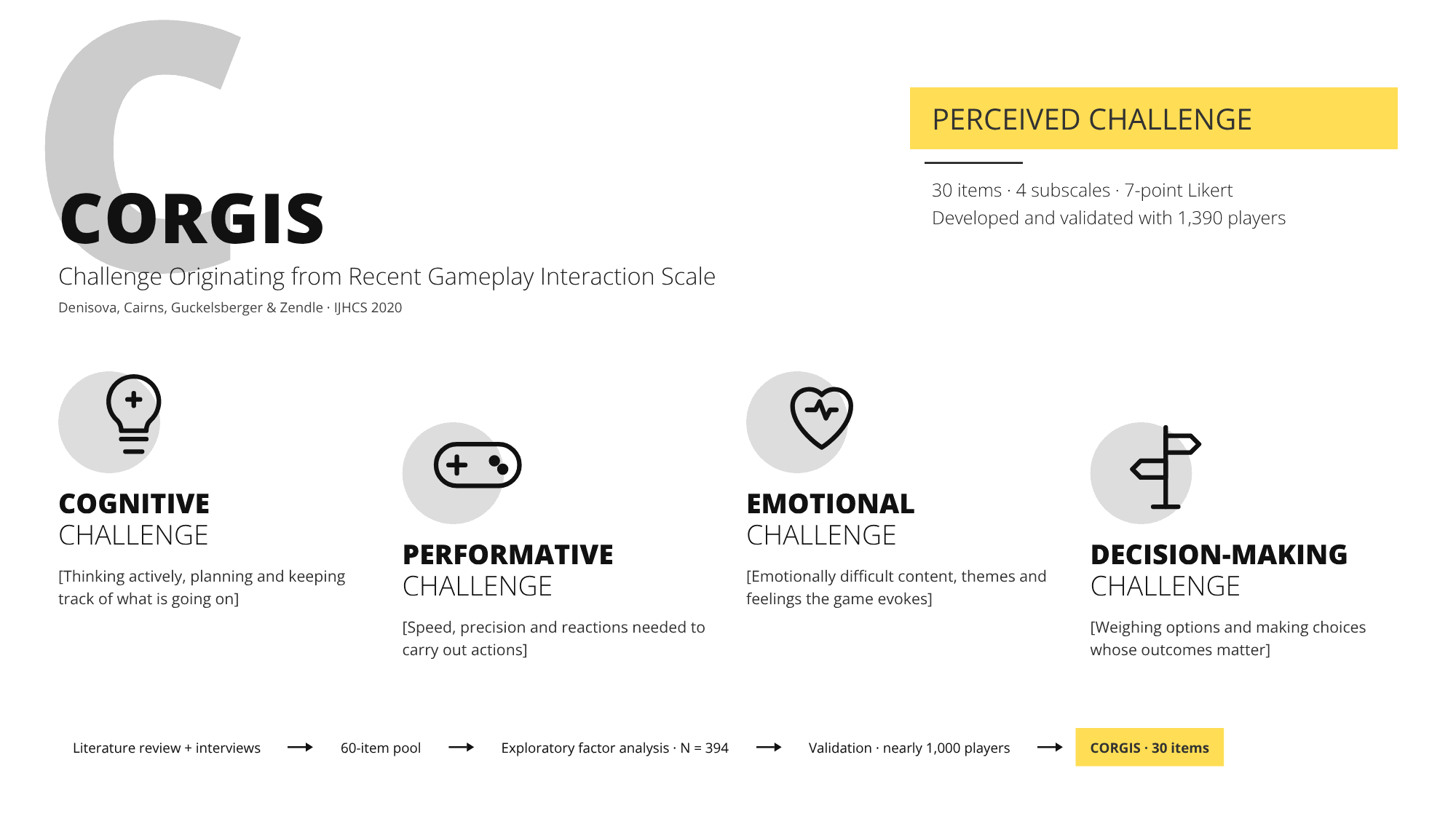
CORGIS, the Challenge Originating from Recent Gameplay Interaction Scale: 30 items measuring four kinds of perceived challenge (cognitive, performative, emotional and decision-making), developed from a literature review and interviews, a 60-item pool, factor analysis with 394 players and validation with nearly 1,000 players.

JournalCORE journal ranking: CORE A2020 · International Journal of Human-Computer Studies

Measuring Perceived Challenge in Digital Games: Development & Validation of the Challenge Originating from Recent Gameplay Interaction Scale (CORGIS)

Denisova, A., Cairns, P., Guckelsberger, C., & Zendle, D.

Players can find a game challenging in more ways than needing quick reflexes. This paper presents CORGIS, the Challenge Originating from Recent Gameplay Interaction Scale: a questionnaire that measures how challenging players found the game they just played. Its items came from a review of games user research, game design and game AI literature, and from interviews with researchers and players.

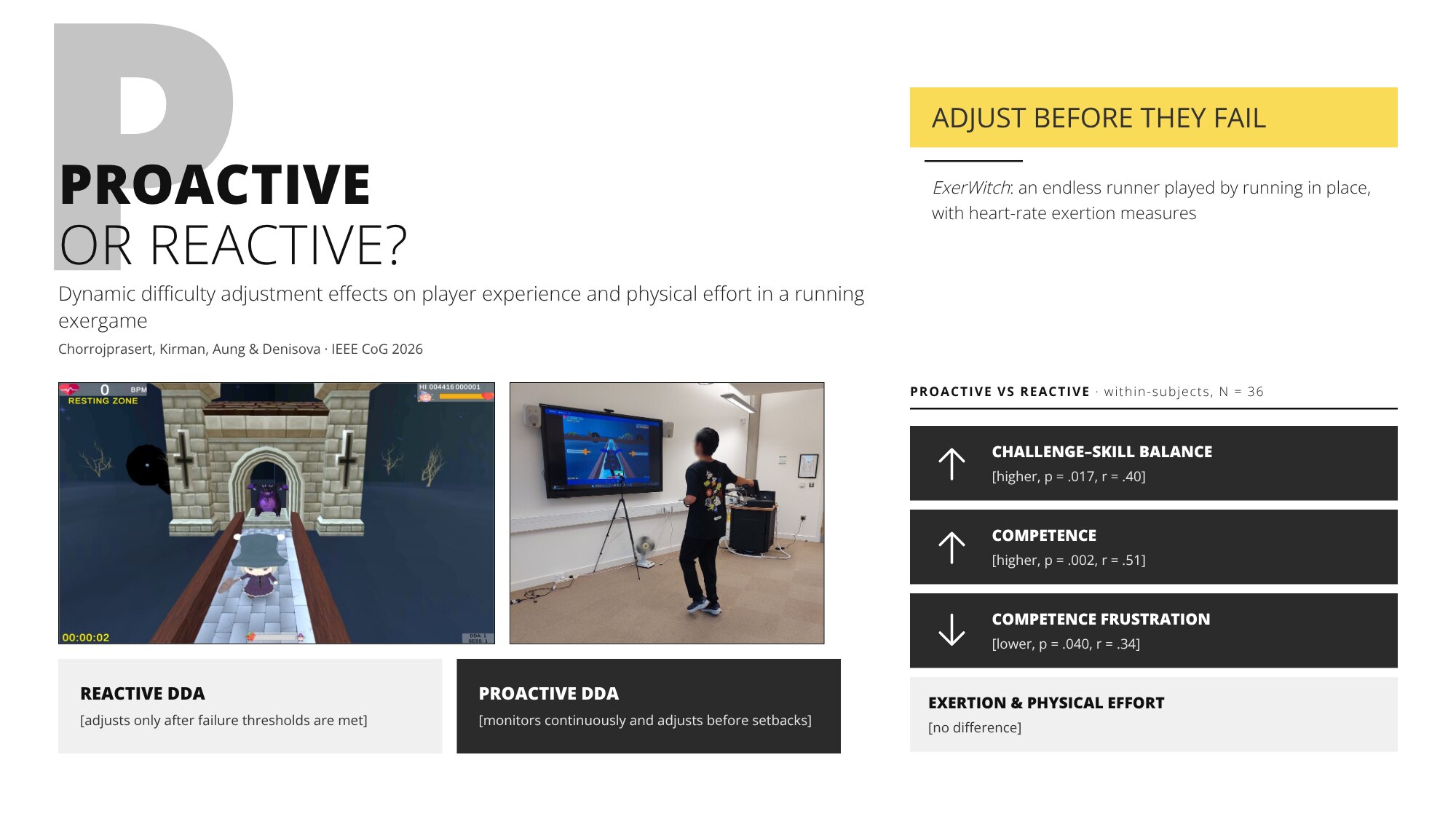
Teaser figure: Proactive or reactive dynamic difficulty adjustment. Screenshots of “ExerWitch”, an endless runner played by running in place. In a within-subjects study (N = 36), proactive DDA gave higher challenge–skill balance and competence and lower competence frustration than reactive DDA, with no difference in exertion or physical effort.
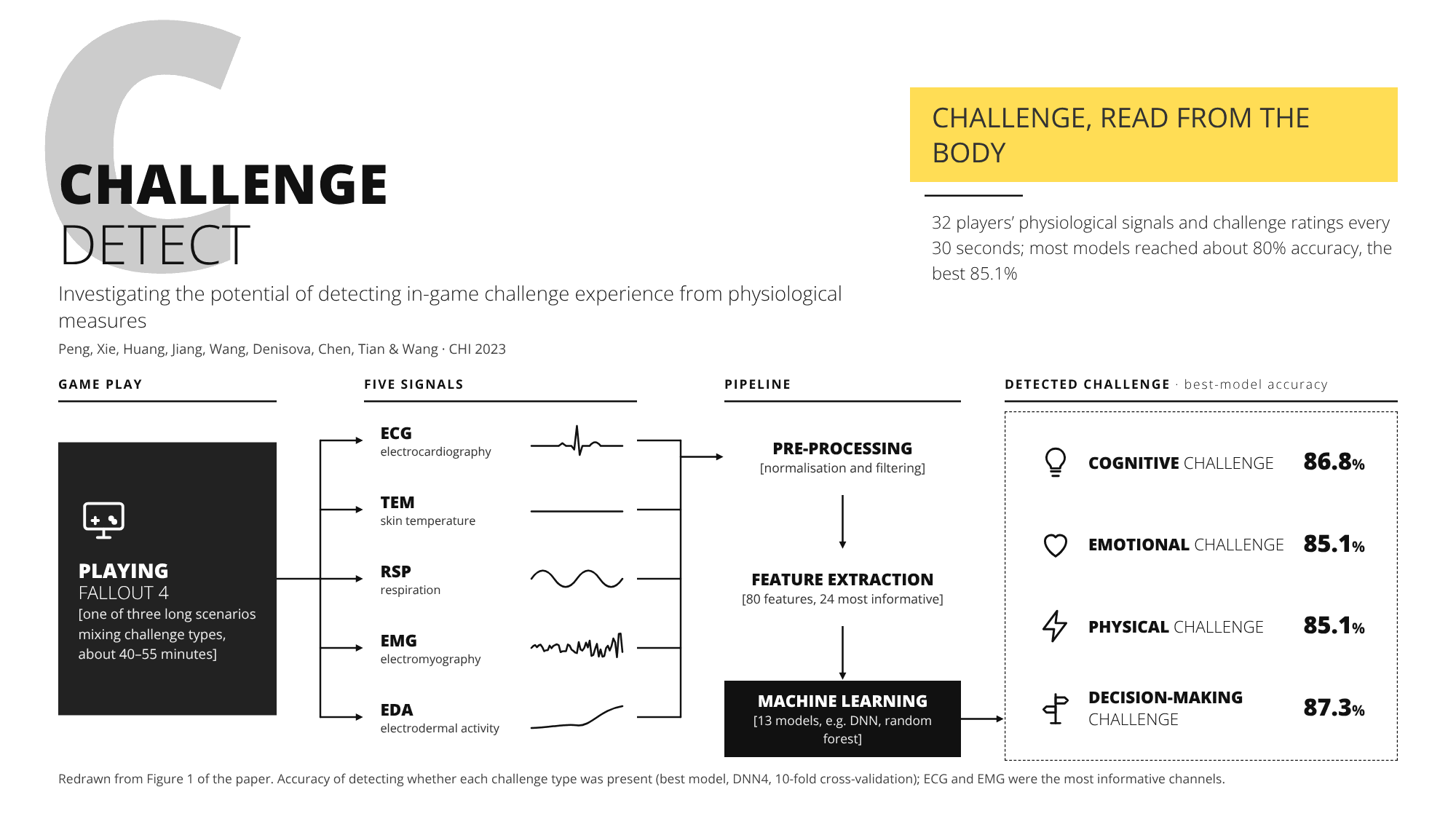
Teaser figure: ChallengeDetect. 32 players played Fallout 4 while five physiological signals were recorded (ECG, skin temperature, respiration, EMG and electrodermal activity). After pre-processing, feature extraction (80 features, 24 most informative) and machine learning (13 models), the best model detected cognitive challenge with 86.8% accuracy, emotional and physical challenge with 85.1%, and decision-making challenge with 87.3%.

ConferenceCORE conference ranking: CORE A*2023 · Proceedings of the 2023 CHI Conference on Human Factors in Computing Systems (CHI'23)

ChallengeDetect: Investigating the Potential of Detecting In-Game Challenge Experience from Physiological Measures

Peng, X., Xie, X., Huang, J., Jiang, C., Wang, H., Denisova, A., Chen, H., Tian, F., & Wang, H.

Questionnaires only capture challenge after play has ended. ChallengeDetect explores whether perceived challenge can instead be detected from players' physiological signals, moment to moment.

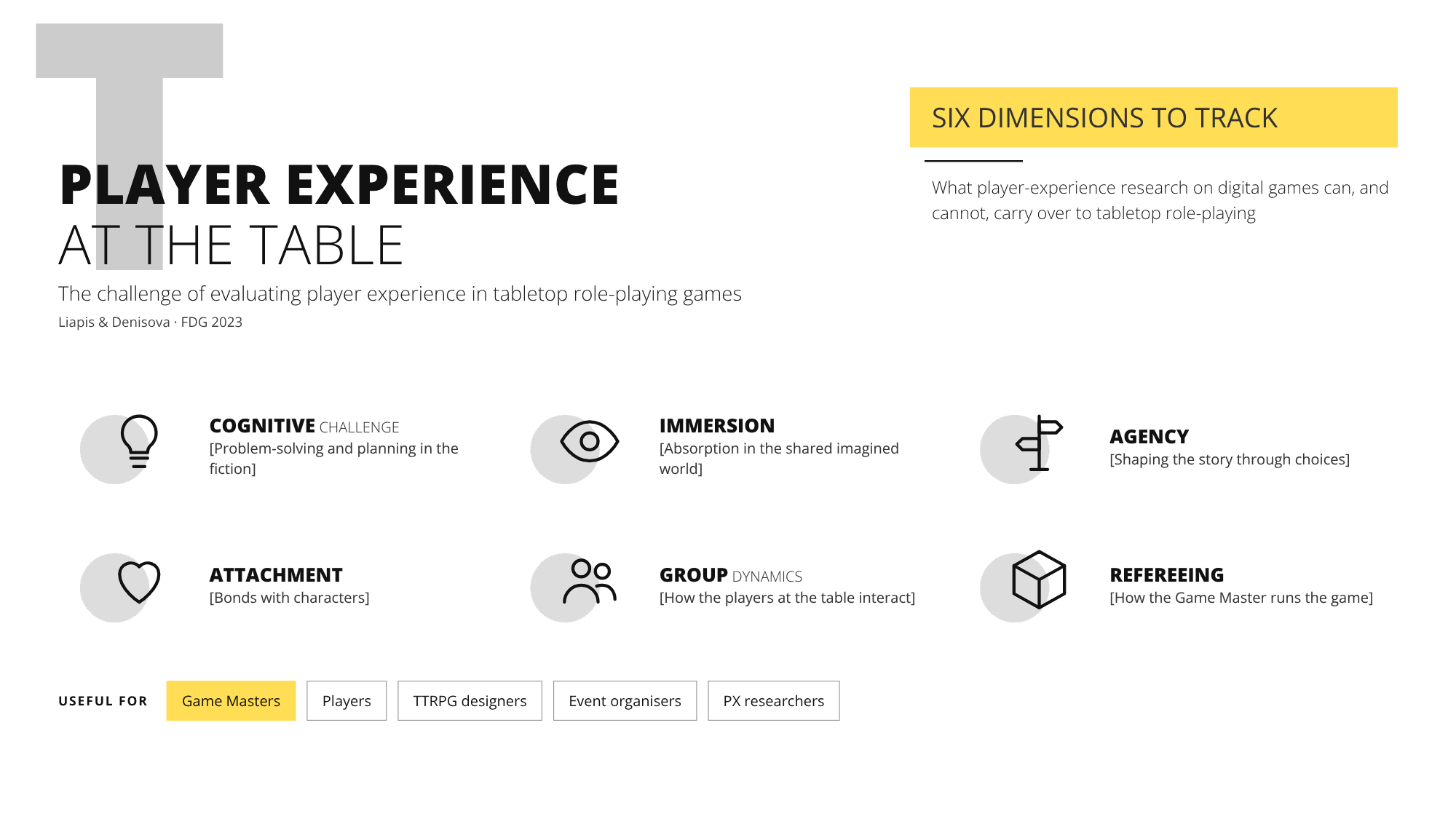
Six player experience dimensions for tabletop role-playing games: cognitive challenge, immersion, agency, attachment, group dynamics and refereeing.

Conference2023 · Proceedings of the 18th International Conference on the Foundations of Digital Games (FDG'23)

The Challenge of Evaluating Player Experience in Tabletop Role-Playing Games

Liapis, A., & Denisova, A.

Evaluating player experience could help game masters, players and designers of tabletop role-playing games, but no formal method exists. We compared player experience measures from digital games with what happens around the table.

Short papers

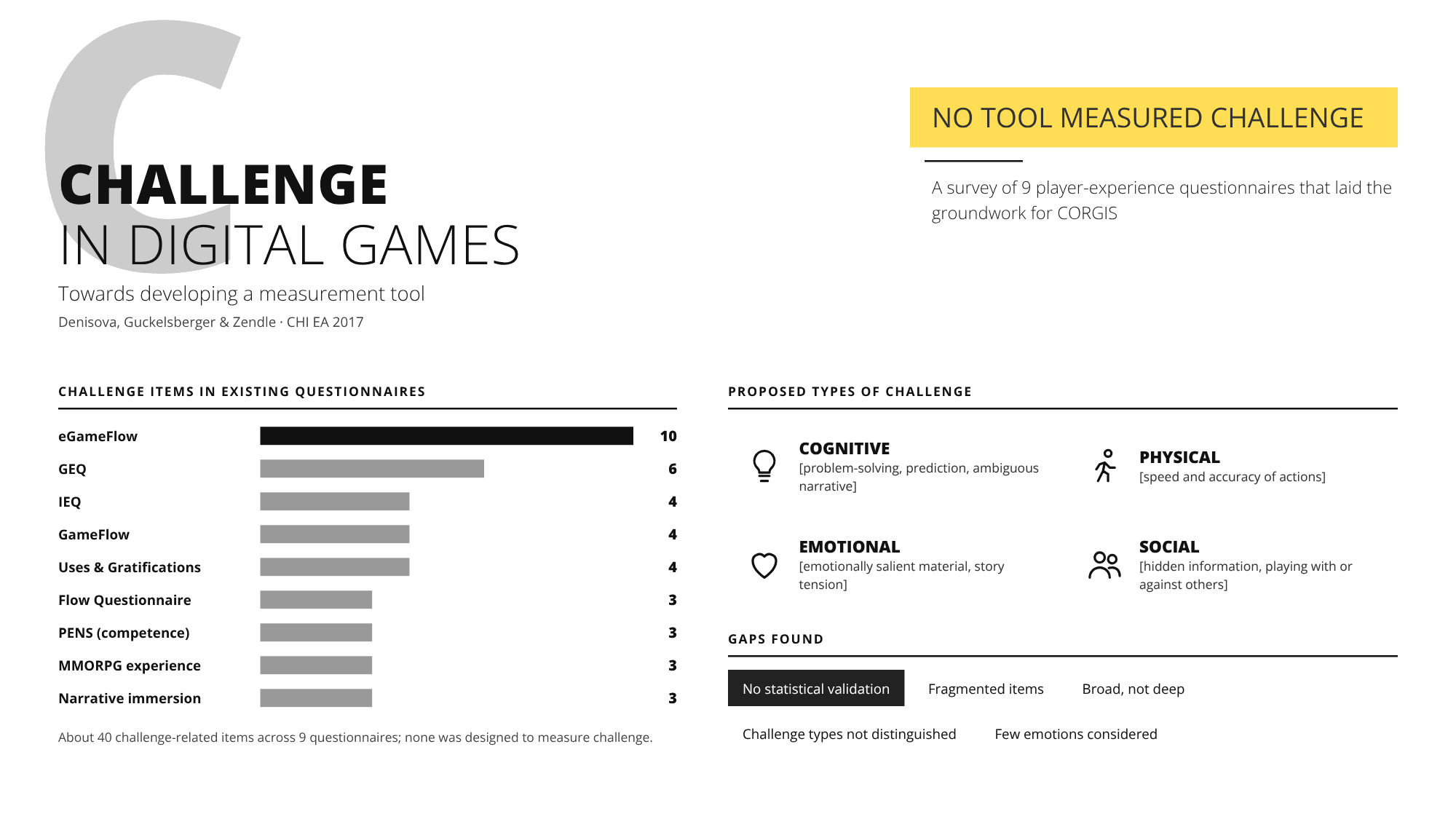
Teaser figure: challenge-related items in nine existing questionnaires, from 10 in eGameFlow to 3 in several others; proposed cognitive, physical, emotional and social challenge types; and gaps found, such as no statistical validation.

ConferenceShort paper 2017 · Extended Abstracts of the 2017 CHI Conference on Human Factors in Computing Systems (CHI EA'17)

Challenge in Digital Games: Towards Developing a Measurement Tool

Denisova, A., Guckelsberger, C., & Zendle, D.

Reviews how challenge in games is defined, what types of challenge exist and how they relate to player experience, drawing on game design, HCI and game AI. This review laid the groundwork for the CORGIS questionnaire.

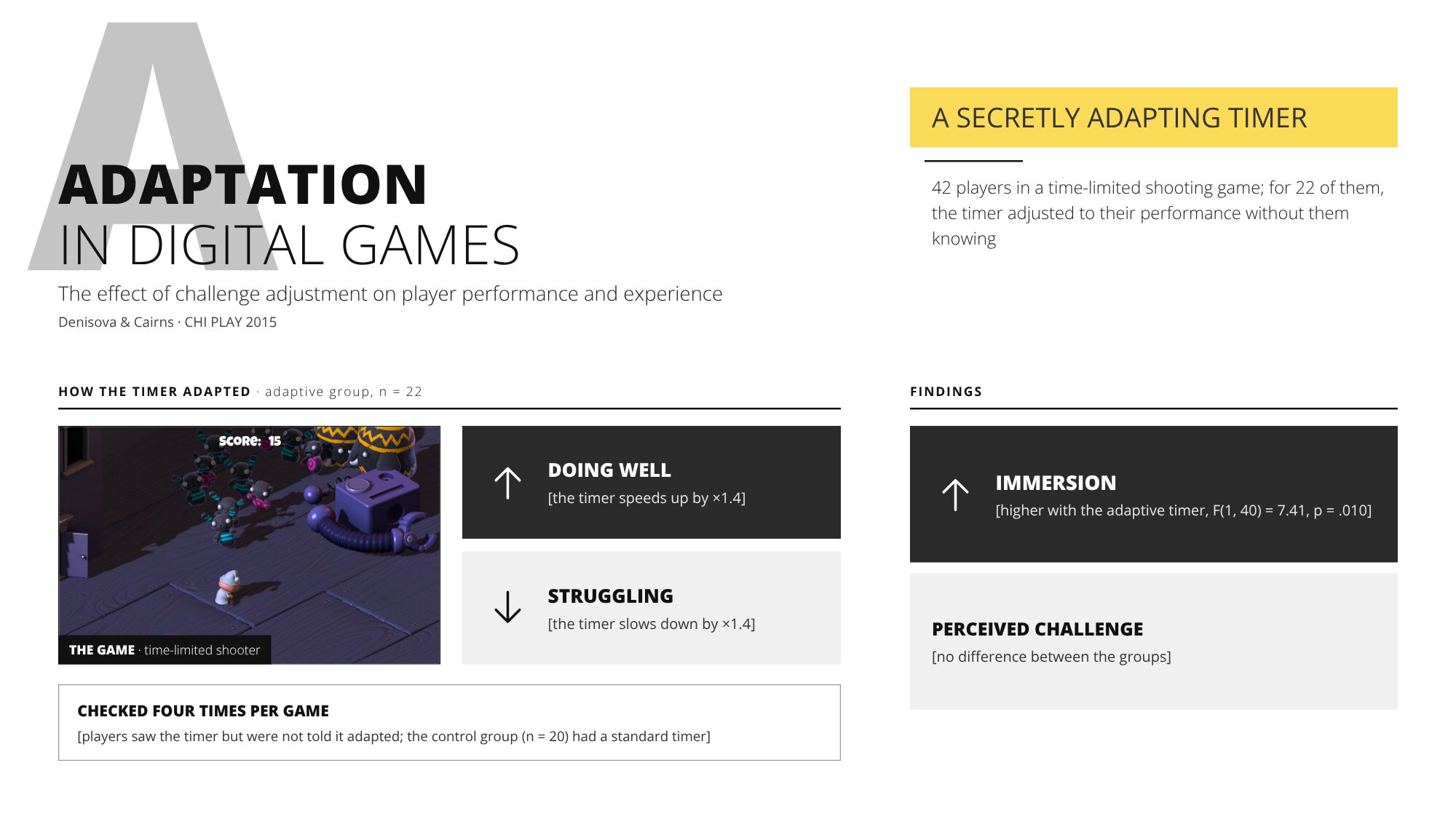
Teaser figure: Adaptation in digital games. A screenshot of the time-limited shooting game. For 22 of 42 players the timer secretly adapted: it sped up by 1.4 times when they were doing well and slowed down when they struggled, checked four times per game. Immersion was higher with the adaptive timer, F(1, 40) = 7.41, p = .010, while perceived challenge did not differ.

ConferenceShort paper 2015 · Proceedings of the Annual Symposium on Computer-Human Interaction in Play (CHI PLAY'15)

Adaptation in Digital Games: The Effect of Challenge Adjustment on Player Performance and Experience

Denisova, A., & Cairns, P.

Good gaming experiences depend on balancing challenge against the player's skill. We tested a simple form of dynamic difficulty adjustment: changing a game's timer based on each player's performance, without telling players it was happening.

Themes:

Other publications

  • Exploring the Effects of Dynamic Difficulty Adjustment Functions on Player Experience and Physical Effort in a Running Exergame Preprint Chorrojprasert, S., Kirman, B., Aung, M. T., & Denisova, A. · 2025 · Preprint, SSRN 5312627

Also relevant

Papers whose main theme is elsewhere but which also contribute here.